
Cart
0

Building a watch collection is a deeply personal journey. It all starts with a simple roadmap: figure out what you genuinely like, set some clear goals, and decide on a budget you can actually live with. Getting this foundation right is what transforms a casual hobby into a lifelong passion, ensuring every watch you add feels like a meaningful part of your story.
Defining Your Collector Identity
Before you even start scrolling through listings, the first real step is to look inward. A truly great collection is a mirror, reflecting its owner's lifestyle, personal taste, and even the milestones they've hit along the way. It's about curating pieces you can't wait to put on your wrist, not just chasing whatever is trending this week.
So, where do you begin? Start with some honest self-reflection. Are you drawn to the understated elegance of a classic dress watch that slips neatly under a shirt cuff? Or does the tough, tool-like design of a dive watch with its chunky bezel and glowing markers get your heart racing? Maybe it's the intricate dials of a chronograph or the clever utility of a GMT that captures your imagination.
Don't worry if you don't have it all figured out on day one. Your taste will change and grow over time—that’s part of the fun. The goal right now is just to find a starting point that feels authentic to who you are today.
Your Personal Style and Goals
Think about your day-to-day life. A collection for a boardroom executive will naturally look quite different from one built for a weekend rock climber.
- Your Daily Driver: Do you need a go-anywhere, do-anything piece? A stainless steel sports watch is often the perfect anchor for a new collection because of its sheer versatility.
- Dressing Up: For formal events, weddings, or big meetings, a slim, refined dress watch on a leather strap is a timeless classic.
- Specialized Needs: If you're constantly in different time zones, a GMT is a lifesaver. If you're a data nerd who loves timing things, a chronograph is both functional and endlessly fascinating to look at.
Once you’ve got a handle on your style, give yourself a tangible goal. Instead of a fuzzy idea like "I want to own nice watches," get specific. For many new enthusiasts, the perfect first goal is the classic "three-watch collection": one for everyday, one for dress, and one sports or complication model. This simple framework covers nearly every situation you can think of.
Below is a simple blueprint for what that first three-watch collection could look like, focusing on the incredible value you can find in the pre-owned market.
Your First Three Watch Collection Blueprint
| Watch Category | Purpose | Example Model (Pre-Owned Focus) | Why It Works |
|---|---|---|---|
| The Everyday Watch | Your reliable go-to for work, weekends, and everything in between. | Tudor Black Bay 58 | A fantastic alternative to a Submariner, it offers vintage charm, robust build quality, and a versatile size that works for almost anyone. |
| The Dress Watch | For formal occasions, important meetings, or when you need a touch of class. | Cartier Tank Must (Quartz) | An icon of design. It's elegant, understated, and instantly recognizable. The pre-owned market makes this classic surprisingly accessible. |
| The Complication/Sport | A fun, functional piece that adds a specific capability to your collection. | Omega Speedmaster Reduced | Offers the legendary "Moonwatch" DNA in a more wearable size and at a lower price point. The automatic movement is also a plus for daily wear. |
This is just a starting point, of course. The key is to find the models within each category that truly speak to you and your own personal style.
The Power of the Pre-Owned Market
Getting comfortable with the secondary market is a complete game-changer, especially when you're starting out. Shopping pre-owned opens up a massive world of watches, including discontinued classics and rare gems, often at prices that are far more approachable than retail.
It’s no surprise that the global luxury watch market, projected to hit USD 75.28 billion by 2032, is seeing so much of its growth fueled by savvy collectors. Recent data shows that 40% of millennial and Gen Z buyers are now opting for pre-owned, drawn in by the combination of value and certified authenticity. You can dive deeper into the secondary watch market's recent trends to see just how much this space is booming.
A well-curated collection isn't about having the most expensive watches; it's about having the right watches for you. Each piece should tell a story and serve a purpose in your life.
Your collector identity is simply a mix of your taste and your real-world needs. If you’re curious, exploring what your favorite watch models say about your personality can be a fun way to connect the dots. Remember, building a collection is a marathon, not a sprint. By laying this thoughtful groundwork now, you ensure that every watch you buy from here on out is a deliberate and rewarding step in your journey.
Choosing Your Cornerstone Brands and Models
Alright, you’ve figured out what kind of collector you want to be. Now for the fun part: diving into the world of watches. It’s a massive landscape, from the titans of the industry to incredible independent makers and heritage brands you might not have heard of yet.
Learning how to build a watch collection isn’t just about memorizing logos. It's about getting to know the stories behind the dials. Why is Rolex so revered? It boils down to a history of bulletproof reliability and game-changing innovations like the waterproof Oyster case. And Omega? It’s forever tied to the legacy of space exploration as the first watch on the moon.
Getting to know each brand’s history is one of the most rewarding parts of this hobby. It’s what turns a simple purchase into something you genuinely connect with.
Look Beyond the Obvious Names
The Swiss giants are a fantastic starting point, but a truly well-rounded collection often includes pieces from a wider world of watchmaking. Expanding your horizons opens you up to entirely different designs, engineering philosophies, and often, better value.
- German Precision: Brands like A. Lange & Söhne and Glashütte Original bring a totally different vibe. Think meticulous, almost obsessive finishing and a design language that’s uniquely their own.
- Japanese Craftsmanship: If you haven’t looked into Grand Seiko, you’re missing out. Collectors go nuts for their stunning dials and the mind-bendingly smooth sweep of their Spring Drive movements. They easily go toe-to-toe with the Swiss.
- The Independent Spirit: This is where things get really interesting. Makers like F.P. Journe or H. Moser & Cie. are the artists of the watch world, creating mechanically brilliant pieces that push boundaries. These are often grail-level watches for seasoned collectors.
Exploring these alternatives ensures your collection tells a more interesting story than just a single brand's greatest hits.
Ultimately, you're looking for brands that click with you. Do you admire the over-engineered toughness of a German tool watch, or are you drawn to the artistry of an independent? The answer will point you toward your first key pieces.
Identifying Your Cornerstone Models
Within every great brand, there are the icons—the "cornerstone" models that really define them. Think of the Rolex Submariner as the blueprint for every dive watch that followed it, or the Cartier Tank as the definition of a timeless dress watch. These pieces often become the backbone of a great collection because they’re respected, versatile, and just plain significant.
When you’re thinking about a cornerstone piece, ask yourself how it actually fits into your life. The best collections are built around a few watches that can handle almost anything you throw at them.
Most collectors agree that a solid collection is built on a few core archetypes:
- The Dive Watch: Your go-anywhere, do-anything piece. Defined by a rotating bezel, high water resistance, and killer legibility. It’s the ultimate weekend watch. (Examples: Rolex Submariner, Omega Seamaster 300M).
- The Dress Watch: Slim, elegant, and understated, usually on a leather strap. Perfect for formal events, but a good one can easily be dressed down with jeans. (Examples: Patek Philippe Calatrava, Jaeger-LeCoultre Reverso).
- The Chronograph: Basically a stopwatch on your wrist, with extra dials and pushers. It’s functional, sporty, and has a cool, technical look. (Examples: Omega Speedmaster Professional, Breitling Navitimer).
- The GMT/Travel Watch: A must-have for frequent flyers or anyone working across time zones. An extra hand tracks a second time zone at a glance. (Examples: Rolex GMT-Master II, Tudor Black Bay GMT).
Start with one or two of these. That gives you a solid foundation. From there, you can explore more unique complications or niche designs that catch your eye. It also doesn't hurt to know which luxury watches that hold value when you're making these foundational picks. In the end, every piece should add something new to the mix, creating a lineup that is both practical and 100% yours.
Sourcing Your Watches Like a Pro
Now for the fun part: the hunt. Finding and buying your next timepiece is where the real thrill of collecting kicks in. This is your game plan for navigating the market like a seasoned pro, making smart, confident purchases every single time. It all comes down to knowing where to look, who to trust, and what to ask.
The global luxury watch market is absolutely booming, set to jump from USD 45.0 billion in 2025 to USD 61.2 billion by 2032. A massive chunk of that action is happening online, which makes knowing how to source watches safely more critical than ever.
The Big Decision: New vs. Certified Pre-Owned
Your first major crossroads is whether to buy brand-new from an authorized dealer (AD) or dive into the exciting world of certified pre-owned (CPO). There's nothing quite like peeling the plastic off a factory-fresh watch, but for a collector, the CPO market offers some seriously compelling advantages.
- Access to Discontinued Models: The pre-owned market is the only place you'll find some of the most iconic and beloved references that are no longer in production. Think of it as a gateway to watchmaking history.
- A Smarter Value Proposition: Just like a new car, a brand-new watch often takes an immediate depreciation hit. Buying CPO lets you sidestep that initial drop, meaning you get more watch for your money.
- Immediate Availability: Tired of hearing about multi-year waitlists for popular steel sports models? The CPO market has those watches available right now. You can get the piece you want without the indefinite wait.
For most collectors, especially those just starting out, the secondary market is where the real action and opportunity lie. Our guide on buying used luxury watches digs much deeper into navigating this space.
How to Vet Sellers and Listings
Let’s be clear: not all sellers are created equal. The secret to a great purchase is learning to spot a reputable, independent dealer versus an anonymous seller on a giant marketplace. A dealer you can trust will always be transparent and stand behind every watch they sell.
When you find a listing that catches your eye, it's time to put on your detective hat. Here’s what you need to scrutinize:
- High-Resolution Photos: Demand clear, detailed photos of the actual watch for sale—not stock images. You want to see everything: the case, dial, bracelet, clasp, and even the movement, all from multiple angles.
- Honest Condition Reports: Vague descriptions like "good condition" are a major red flag. A great seller will give you specific notes on any scratches, dings, or signs of polishing. They’ll point out the flaws so you don't have to find them yourself.
- Confirmation of "Box and Papers": The listing must clearly state if the original box, warranty card, and manuals are included. This "full set" is crucial for a watch's provenance and future value.
Don't ever hesitate to ask questions. A reputable seller will gladly discuss service history, the originality of parts, and timekeeping accuracy. Their readiness to give you straight answers is one of the best signs of their credibility.
For busy collectors, juggling the research, communication, and logistics can become a job in itself. This is where learning how to hire a personal assistant can be a game-changer, freeing you up to enjoy the hobby instead of getting bogged down in the admin.
Your Pre-Purchase Inspection Checklist
Before you pull the trigger on a watch, run through this final mental checklist. Think of it as your last line of defense against a purchase you'll regret.
- Verify the Seller’s Reputation: Dig for independent reviews and testimonials. Do they have a professional website or a physical storefront? An established business has a reputation to protect.
- Confirm Authenticity Guarantees: Does the seller provide a clear, written guarantee of authenticity? A dealer like Perpetual Time, who owns their inventory, takes on this responsibility directly.
- Understand the Return Policy: Know the exact terms before you buy. A fair return policy shows the seller is confident in the quality of their watches.
- Check for Serial Number Clarity: Make sure the serial numbers on the watch and the paperwork match up. If the photos aren't perfectly clear, ask the seller to confirm them for you.
Following these steps turns the hunt from a nerve-wracking gamble into a secure and rewarding process. It's how you ensure every new addition to your collection is a source of pride, not problems.
Protecting Your Collection for the Long Haul
Owning a luxury watch is one thing, but being its responsible caretaker is something else entirely. These little machines are marvels of engineering, built to outlast us all, but only if they’re treated with the right respect. Protecting your growing collection goes far beyond just avoiding a few scratches; it's about preserving its mechanical soul, its beauty, and its future value.
Think of it as a fundamental habit of good ownership. Simple routines—how you wear it, how you clean it, where you store it—make an enormous difference. This isn't just about keeping your watches looking sharp. It’s about ensuring the hundreds of tiny, intricate parts humming away inside keep doing their job exactly as they were designed to.
The principles of care are universal for any valuable collection. For a different perspective on this, you can find some great insights on preserving your precious collection for the long haul, showing that the core ideas often translate across different passions.
Secure Storage and Regular Maintenance
Where does your watch live when it's not on your wrist? This question is more important than you might think. Just leaving a valuable timepiece on a dresser exposes it to dust, moisture, and the ever-present danger of being knocked onto the floor. For any serious collector, a high-quality watch box or a secure safe isn't a luxury—it's a necessity.
- Watch Boxes: A proper watch box with soft, individual cushions is your first line of defense. It prevents your watches from bumping and scratching each other while keeping them organized and dust-free.
- Watch Winders: If you have automatic watches that you don't wear daily, a winder is an incredibly useful tool. It gently rotates the watch to keep the mainspring wound, which ensures the movement's lubricants stay evenly distributed. Plus, your watch is always ready to go.
- Cleaning Routine: After wearing your watch, give it a quick wipe-down with a soft microfiber cloth. This simple act removes skin oils and grime that can, over time, degrade the finish on bracelets and even compromise the gaskets.
Beyond the day-to-day stuff, we have to talk about professional servicing. A mechanical watch is like a finely tuned engine; it needs a periodic overhaul. Over the years, the specialized oils that lubricate the movement can dry up, and tiny components can wear down from friction.
Adhering to the manufacturer's recommended service intervals isn't an optional expense. It's the single most effective way to prevent a small, fixable issue from turning into a catastrophic—and very costly—failure down the road.
To keep things simple, here’s a quick-reference table outlining the key maintenance milestones you should be aware of.
Essential Watch Maintenance Schedule
A regular care schedule is the best way to protect your investment and ensure your timepieces perform flawlessly for years to come.
| Maintenance Task | Automatic/Mechanical Watch | Quartz Watch | Key Considerations |
|---|---|---|---|
| Full Service | Every 5-7 years is a good rule of thumb, but always check the manufacturer's specific advice. | Generally only needed when issues arise or the battery dies. | A full service is a complete teardown: disassembly, ultrasonic cleaning, lubrication, and reassembly of the entire movement. |
| Battery Change | N/A | Every 2-3 years, or whenever it dies. | Always have a professional change the battery. This ensures the seals are correctly replaced to maintain water resistance. |
| Water Resistance Test | Every 1-2 years, especially if you frequently swim with it or own a dive watch. | Every 1-2 years, and always after a battery change. | Gaskets are made of rubber or silicone; they degrade over time, which can compromise the seal protecting the movement. |
Following these guidelines will help keep your watches in peak condition, safeguarding both their function and their value.
Documenting and Insuring Your Investment
As your collection grows, so does its value. This is where meticulous documentation and proper insurance become your financial safety net against theft, loss, or accidental damage.
The first step is to create a detailed inventory. For every single watch, you should have:
- High-quality photos from multiple angles, including the caseback and clasp.
- Scanned copies or photos of the original sales receipt, box, and warranty papers.
- The full serial and model numbers recorded in a secure place (like a password manager or encrypted cloud folder).
This documentation is absolutely essential for filing an insurance claim. Speaking of which, your standard homeowner's policy almost certainly won't cover the full value; most have low limits for valuables like jewelry and watches. You'll need to add a "rider" or "floater" to your policy or get a separate, specialized policy.
To get the right amount of coverage, you'll need a professional appraisal. This gives the insurance company a formal valuation. Make a point to get your collection reappraised every few years, as market values can change dramatically. This ensures you're covered for what your watch is worth now, not just what you paid for it. And if you have any doubts about a piece while you're documenting it, our guide on how to tell if your Rolex is real has some practical tips that can help.
Trading Up: How to Evolve Your Watch Collection
A truly great watch collection is never finished. It’s a living, breathing thing that grows and changes right along with you. As your knowledge deepens and your personal style refines, you'll inevitably find that some pieces just don't get the wrist time they once did. This isn't a mistake—it's the mark of a seasoned collector.
Think of your collection as a dynamic portfolio. Each watch serves a purpose, but those purposes can change over time. The real art of collecting is strategically trading or selling pieces that no longer fit your vision, freeing up cash and space for watches that get you genuinely excited.
This constant process of curating and refining is one of the most rewarding parts of the journey. It's a running conversation between you and your timepieces.
Knowing When It's Time for a Change
So, when is it time for a watch to leave the collection? It often comes down to a gut feeling, but there are a few practical signs that are hard to ignore.
- It Never Leaves the Box: If a watch is consistently being passed over when you're picking your watch for the day, that's your clearest signal. Your collection is meant to be worn and enjoyed.
- Your Tastes Have Matured: Maybe you started out loving big, bold dive watches, but now you find yourself drawn to the subtle elegance of a 36mm dress piece. It’s perfectly natural for your aesthetic to evolve.
- A New "Grail" Is Calling Your Name: Let's be honest, sometimes the only way to fund a major new acquisition is by selling a few existing watches.
Letting go can be tough, especially if a watch marked a special occasion. But always remember the goal: to build a collection where every single piece puts a smile on your face.
Smart collectors know that addition by subtraction is a powerful move. Selling one watch you've fallen out of love with to fund one you're passionate about is always a win for your collection.
Getting the Best Value for Your Watch
Once you’ve decided to sell or trade, the game shifts to maximizing its value. This takes a bit of market awareness and smart presentation. The pre-owned market is sharp, and informed buyers expect transparency.
First, get a handle on the current market value. Spend some time on forums and sales platforms to see what your exact model, in similar condition, has recently sold for. Watch prices can swing based on demand, so you need current data.
Next, presentation is everything. A watch that’s clean and photographed well will always get more attention and a better price. It just shows you cared for it.
Here’s a quick checklist to get your watch ready for sale:
- Get the Full Set Together: Dig out the original box, warranty card, manuals, and any extra bracelet links. Having a "full set" can seriously boost a watch's value, sometimes by as much as 15-20%.
- Take Great Photos: Use your phone in good, natural light and take clear, high-resolution pictures from every angle. Get shots of the dial, the sides of the case, the caseback, the bracelet, and the clasp. Be upfront and photograph any noticeable scratches—honesty pays off.
- Write an Honest Description: Clearly state the watch's condition, when it was last serviced, and exactly what’s included. Being transparent builds trust with buyers and prevents headaches later.
Why Working with a Trusted Partner Makes Sense
While you can always sell a watch privately, it’s not without its risks. You'll deal with scammers, endless lowball offers, and a lot of back-and-forth. For valuable timepieces, working with a trusted independent dealer like Perpetual Time is a much safer and more efficient way to go.
A reputable dealer provides a secure, professional transaction from start to finish. They have a built-in network of clients who are actively looking for quality watches, which means your piece gets in front of serious, qualified buyers. This usually leads to a faster sale at a fair market price, without you having to filter through dozens of time-wasters.
Even better, trading your watch toward a new one from the same dealer can be a brilliant move. It simplifies everything into one seamless deal. You can learn more about how this works in our guide on how to sell a Rolex watch, which breaks down the key steps. This is hands-down the best way to ensure your collection keeps evolving securely and rewardingly.
Your Five-Year Watch Collection Roadmap
Building a truly great watch collection is a marathon, not a sprint. The collections that really stand out are built with patience and intention, where every piece tells a story. Think of this five-year roadmap as a flexible blueprint, a guide to show how thoughtful, phased acquisitions can create a lineup that’s both impressive and deeply personal.
This timeline breaks down a patient approach to collecting, kicking things off with a single, do-it-all watch and then gradually branching out.
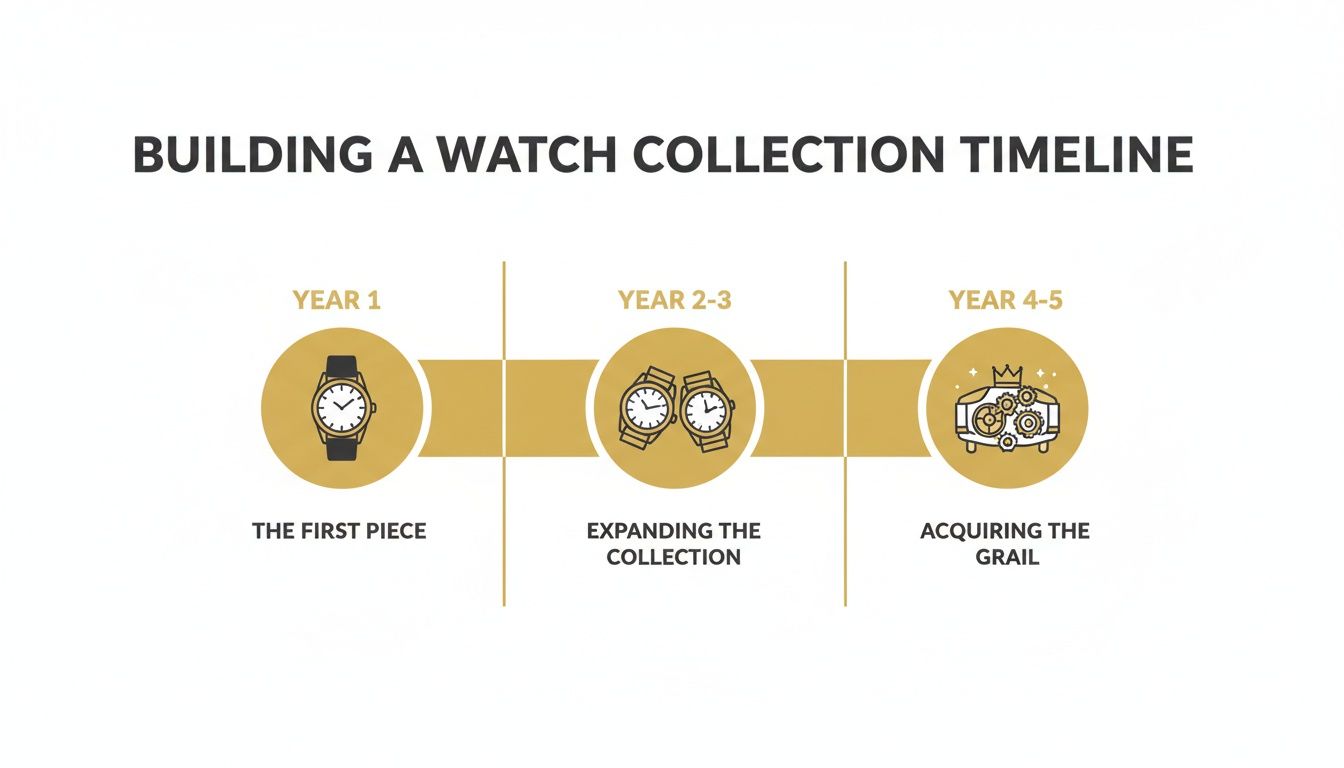
The real takeaway here? A fantastic collection doesn't just materialize overnight. It’s the result of deliberate, smart decisions made over several years.
Years 1 and 2: The Foundation
Your first year is all about finding one perfect watch. The goal isn’t to fill a watch box—it’s to find a single, high-quality, versatile timepiece you can wear almost anywhere. A stainless steel sports watch like an Omega Seamaster or a Tudor Black Bay makes an ideal cornerstone. It’s tough, it’s stylish, and it quickly becomes your trusty daily companion.
Once you hit year two, the focus shifts. It’s time to add a second piece that does something your first one doesn't. If you started with a diver, maybe now’s the time to hunt for an elegant dress watch on a leather strap. Or perhaps a functional chronograph is more your speed. This second purchase is what starts to build true versatility into your collection.
This strategic approach is more than just about what looks good; it’s about building a resilient portfolio of assets. A well-balanced strategy might allocate 40% to sports icons for their strong resale value, 30% to vintage pieces for historical appreciation, and 30% to unique independents. This kind of diversification mirrors global market dynamics and creates a more robust collection.
Years 3 to 5: Expansion and Grails
By year three, you've got a much clearer sense of your own taste. This is the perfect time to add a third watch that introduces a new complication or aesthetic to your lineup. Maybe a GMT for travel, or a piece from a smaller brand whose design language you’ve really come to admire. Your trio can now handle pretty much any occasion you throw at it.
Years four and five are for making a big move. With a solid three-watch foundation, you can patiently save for your first "grail" watch—that one special piece you've been dreaming of. This could be a major upgrade within a category you already love, or your first foray into a niche independent brand.
It also helps to keep an eye on the bigger picture. Understanding that the Asia-Pacific market commands up to 41.58% of luxury revenue, for example, can inform where you look for certain pieces or anticipate trends. You can dig into more global watch market trends to help guide these bigger, long-term decisions.
This patient roadmap is how a simple hobby evolves into a lifelong passion.
Answering Your Watch Collecting Questions
As you dive into the world of watches, you're going to have questions. Everyone does. Here are some of the most common ones I hear from people just starting out, with some straightforward answers to help guide you.
Do All Luxury Watches Appreciate In Value?
This is probably the biggest myth in watch collecting. While it's true that a few specific, ultra-hyped models from brands like Rolex, Patek Philippe, and Audemars Piguet can skyrocket in value, the reality is that most luxury watches will depreciate the moment you buy them—just like a new car.
Think of appreciation as a happy accident, not the reason for buying. Your goal should be value retention and, more importantly, personal enjoyment. Chasing investment returns is a surefire way to end up with watches you don't even like.
Buy what you love, and if it happens to go up in value, that’s just icing on the cake. The real return is the daily enjoyment you get from wearing a piece of mechanical art on your wrist.
Is Buying Pre-Owned Safe?
It's completely safe, if you know where to look. The pre-owned market is all about the seller. Your best bet is always a trusted, independent dealer who provides an authenticity guarantee and has a reputation to protect. Steer clear of anonymous sellers on big, open marketplaces where you have little to no protection if things go sideways.
A professional dealer lives and dies by their name. They'll have an exhaustive inspection process and will show you high-resolution photos of the actual watch you're buying. That level of transparency is what makes them the safest entry point into the pre-owned world.
How Many Watches Make a Collection?
There's no magic number. A "collection" could be two perfect watches or twenty. A very popular and practical goal for many is the classic "three-watch collection"—usually an everyday piece, a dress watch, and a sport model. It’s a setup that gives you incredible versatility for just about any occasion life throws at you.
At the end of the day, quality always beats quantity. Three watches you truly adore and wear constantly are infinitely better than a watch box full of pieces that don't get you excited.
What Should My First Watch Be?
Your first serious watch is the foundation of everything that comes next, so it needs to be a workhorse. It should be versatile, tough, and something you're genuinely proud to see on your wrist every morning. For most people, a stainless steel sports watch with decent water resistance is the perfect starting point. Think along the lines of an Omega Seamaster or a Tudor Black Bay—both are icons for a reason.
Look for a few key things in that first great watch:
- Versatility: You want something that looks right with a t-shirt on Saturday but doesn't look out of place with a blazer on Monday.
- Durability: It needs to be built to handle the bumps and scrapes of daily life.
- Timeless Design: Avoid anything too flashy or trendy. A classic design will never go out of style.
Take your time with this decision. This first watch sets the tone for your entire collection, so find one that really connects with you and your lifestyle.
At Perpetual Time, we believe every great collection starts with a foundation of trust and transparency. Explore our curated selection of certified pre-owned timepieces, each authenticated and owned by our expert team, to find the perfect cornerstone for your journey. Visit us at https://perpetualtime.com to get started.


