
Cart
0
Forget the idea that buying a used luxury watch means settling for less. For those in the know, it’s a strategic play that opens doors to incredible timepieces with major financial upsides. The pre-owned market gives you immediate access to the icons and often delivers better value retention than buying new.
Why Pre-Owned Is the Smartest Way to Buy a Luxury Watch
Let's kill the stigma around the word 'used'. In the world of high-end watchmaking, 'pre-owned' doesn't mean worn out—it means smart. It signals access, financial savvy, and a genuine appreciation for the craft. For countless collectors and even first-time buyers, it's really the only way that makes sense.
The biggest win? Skipping the absurd waitlists at authorized dealers. Have your heart set on a new Rolex Daytona or a Patek Philippe Nautilus? Good luck. You could be waiting 5 to 7 years, and that's if you're even offered a place in line. The pre-owned market simply erases that roadblock.
Get What You Want Now, Not Years From Now
The moment you decide you want that watch, you can find it, buy it, and have it on your wrist in a matter of days. That kind of instant access completely changes the game.
Beyond the speed, the financial logic is rock-solid. Just like driving a new car off the lot, many brand-new luxury watches take an immediate depreciation hit. When you buy a used luxury watch, you're stepping in after that initial drop has already happened. The first owner took the biggest financial hit for you. In fact, many popular models don't just hold their value; they start climbing.
This isn't some tiny corner of the market, either. It’s a global force.
The pre-owned luxury watch market was valued at a staggering USD 24.38 billion in 2023 and is on track to hit an incredible USD 45.01 billion by 2030. It’s not uncommon to see sought-after Rolex models appreciate by 10-20% annually after being purchased pre-owned.
This kind of growth is driven by smart buyers who see these watches for what they are: appreciating assets. For a closer look at the market's trajectory, the industry growth data from Grand View Research is eye-opening.
A World of Variety and a Nod to Sustainability
Opting for pre-owned is also a more sustainable move. You’re giving a new life to an object built to last for generations, which helps reduce the environmental impact of new manufacturing. It’s a perfect way to participate in a circular economy and own a piece of history.
The secondary market also gives you access to a selection you'll never find in a modern boutique. It's a treasure trove where you can discover:
- Discontinued Models: Get your hands on legendary pieces no longer in production, each with its own unique story.
- Vintage Gems: Explore decades of watchmaking history, from elegant dress watches to iconic tool watches of the past.
- Unique Variations: Find rare dial colors, bracelet options, and limited editions that are long gone from retail stores.
Ultimately, going the pre-owned route is a more rewarding, diverse, and financially sound way to get the watch you've always wanted. It elevates the purchase from a simple transaction to a calculated acquisition. To get ahead of the curve, you might find our deep dive into the pre-owned luxury watch market for 2025 particularly interesting.
How to Confidently Vet the Seller
When you're buying a pre-owned luxury watch, the single most important decision you'll make has nothing to do with the model or even the price. It's all about the seller. The pre-owned market is filled with incredible opportunities, but you have to know how to navigate it. Think of it as finding a trusted partner, not just a transaction.
You'll quickly run into three main types of sellers: private individuals, big online marketplaces, and specialized independent dealers. A private sale on a forum can look tempting with a lower price tag, but it’s the wild west—you’re on your own with zero buyer protection. Marketplaces might seem safer, but they often just connect you to those same private sellers, leading to a mixed bag of authentication and accountability.
A reputable independent dealer, on the other hand, operates on a completely different level. They aren't just a middleman; their entire reputation is on the line with every single watch they sell. This is where you should focus your energy.
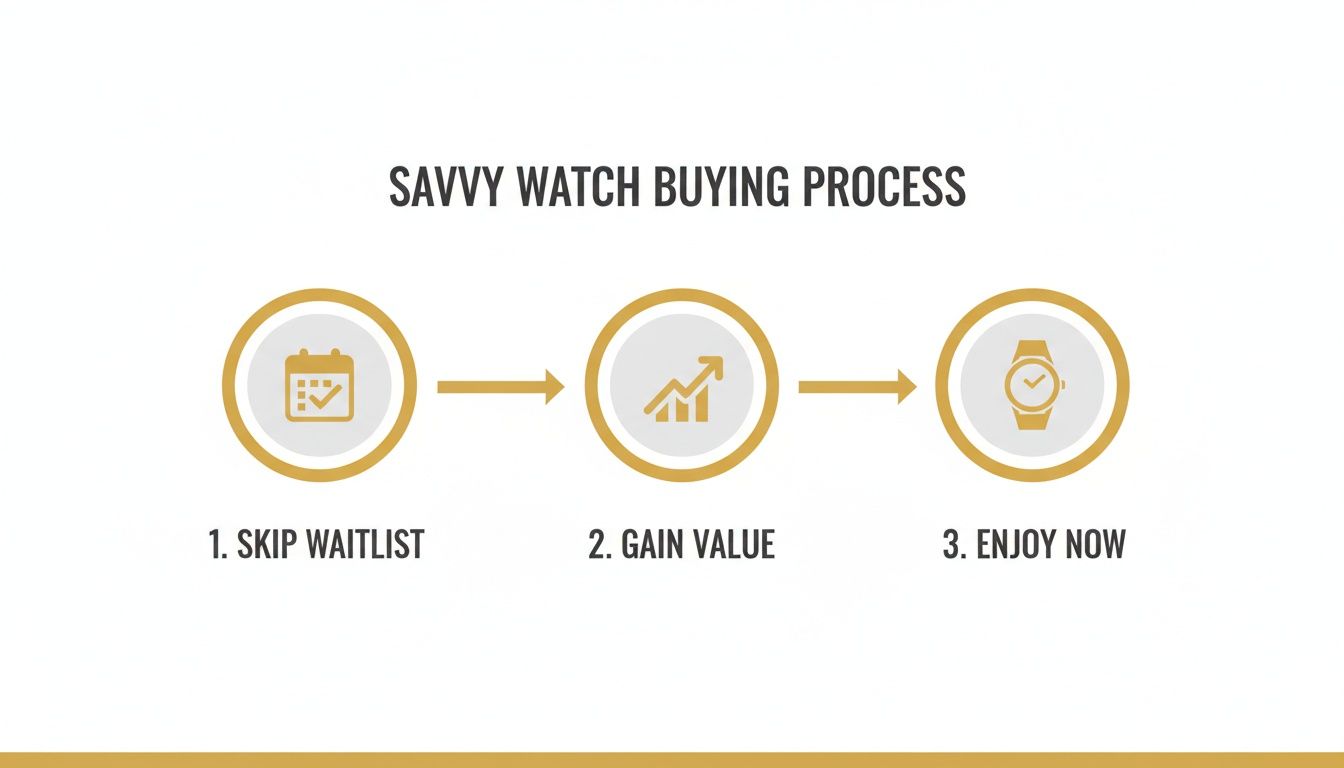
This simple flow really gets to the heart of it: you get to bypass the absurd retail waitlists, secure a fantastic asset, and start enjoying your watch right away. All of that is only possible when you start with a seller you can trust.
Identifying a Trustworthy Dealer
So, how do you separate a top-tier dealer from a risky gamble? You need to look for concrete signals of professionalism and accountability. A legitimate dealer has invested heavily in their business and won't be shy about showing it.
First, look for a physical presence. A dealer with a real showroom or office—even if it's by appointment only—is a business with roots. It’s a sign of stability and commitment that goes way beyond a simple website.
Next, find out if they own their inventory. This is a massive distinction. Many online listings are for "consignment" watches, which means the seller doesn't actually own the piece. They're just marketing it for someone else.
A dealer who owns their inventory has put their own money on the line for each watch. This means they've already done the hard work of vetting, authenticating, and inspecting it to protect their own investment—long before you ever laid eyes on the listing.
This direct ownership model dramatically cuts down your risk.
The Critical Questions You Must Ask
Once you’ve found a dealer that looks promising, it’s time to do some digging. How openly they answer your questions is one of the best ways to gauge their credibility. Don’t be timid—a great dealer wants to work with an informed buyer.
Here are the essential questions to get you started:
- Do you own this watch, or is it on consignment? This confirms they have skin in the game.
- Can you walk me through your authentication process? You're looking for a detailed, multi-point inspection done by their in-house experts, not just farmed out to a third party.
- Are the photos in the listing of the actual watch? Reputable dealers never use stock photos. They provide a full set of high-resolution images of the exact piece you’re buying.
- Has the watch been polished? An honest dealer will be upfront about any restoration work. Over-polishing can seriously devalue a watch, and you have a right to know.
- What kind of warranty and return policy do you offer? A dealer who stands behind their product will always offer protections that give you peace of mind.
The difference in quality is night and day when you start comparing listings. A marketplace post might have a couple of blurry phone pics and a vague "runs great" comment. A trusted dealer, by contrast, will provide a gallery of crisp, detailed photos showing the case, dial, bracelet, and clasp from every conceivable angle, backed by a transparent and honest condition report.
For a deeper dive into what to look for, especially with a sought-after brand like Rolex, our detailed guide on how to buy a used Rolex provides more specific insights.
Choosing your seller wisely is the key. It transforms the experience from a stressful gamble into a confident and truly rewarding journey.
Decoding the Details of Your Watch
You've found a seller you can get behind. Now for the fun part: turning a critical eye to the watch itself. This is where your own knowledge becomes the most important tool in your arsenal. You don't need to be a professional appraiser, but you do need to know which details matter and how to spot the signals of true quality and originality.
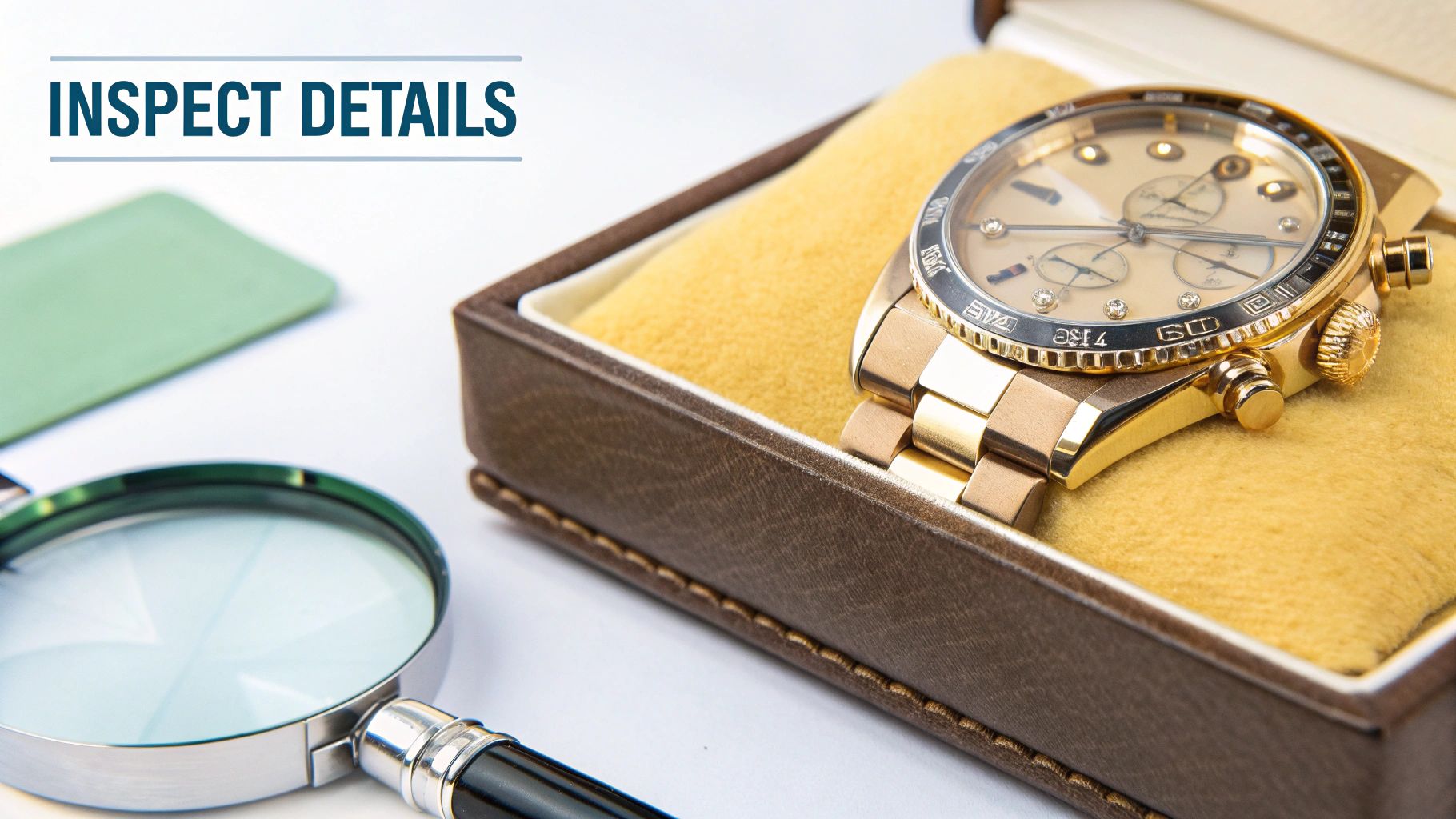
Let's walk through a practical inspection, breaking down the four pillars: the case, dial, bracelet, and movement. Once you get the hang of this, you’ll be able to analyze any listing with a whole new level of confidence, quickly separating a prime example from one that’s best left alone.
The Case Condition Is King
The watch case tells the story of its life. You're hunting for sharp, well-defined lines and edges—especially on the lugs, which are the "horns" where the bracelet connects. A case that's either unpolished or has only been minimally polished keeps its original factory geometry, a detail highly prized by collectors.
Over-polishing is the single biggest enemy of value. It's what happens when a watch gets buffed too aggressively during servicing, rounding off those crisp edges and making the whole case look soft and tired. This can seriously tank a watch's desirability, and worst of all, it's irreversible.
- What to Look For: Sharp, defined bevels on the lugs. The grain on brushed surfaces should be uniform and clear.
- Red Flags: Soft, rounded lug edges. Crown guards that look melted or indistinct. A finish that seems overly shiny and just lacks texture.
Your best move is to always compare the watch to high-resolution photos of a brand-new or known-original example of the exact same model. The difference will jump right out at you once you know what you’re looking for.
Scrutinizing the Dial and Hands
The dial is the face of the watch, and its originality is absolutely critical. It’s not uncommon for a watch to have its dial swapped out during a service decades after it was made. While a "service dial" isn't an automatic dealbreaker, it can definitely impact the value, particularly for vintage pieces.
For instance, a vintage Rolex Submariner from the 1960s should have a matte dial with tritium lume plots that have aged into a beautiful, creamy patina. If you see one with a glossy dial and bright white markers that look brand new, that's a dead giveaway of a later service replacement. The real key here is consistency—the hands and dial markers should always look like they’ve aged together.
For a deeper dive into these kinds of tells, our guide on how to tell if your Rolex is real is packed with valuable insights.
A watch with all-original parts, even with minor signs of honest wear, is almost always more valuable to a collector than a watch that has been heavily restored with non-original components. Provenance and originality are paramount.
The Importance of "Box and Papers"
Hearing a dealer talk about "box and papers"—often called a "full set"—is about more than just some fancy packaging. These documents provide crucial provenance, connecting the watch to its original point of sale and helping confirm its authenticity. A watch with a full set can command a price premium of 10-30% over an identical "naked" watch.
So, what makes a complete set?
- The Original Inner and Outer Boxes: These should be period-correct for the watch's production year.
- The Warranty Card or Certificate: This is the golden ticket, stamped by the original authorized dealer with the date of sale.
- Instruction Manuals and Booklets: These add to the overall completeness.
- Hang Tags: For Rolex, both the red chronometer tag and the green model tag are highly desirable.
While going for a naked watch is a fantastic way to get into a great timepiece for less money, there's no denying that a full set provides a direct link to its history and significantly boosts its long-term investment potential.
Watch Condition Grading Checklist
To help you put all this together, here’s a simplified checklist you can use to assess a watch's condition. Dealers often use terms like "Mint," "Excellent," or "Very Good," and this table will help you understand what they’re actually looking at.
| Component | What to Look For | Potential Red Flags |
|---|---|---|
| Case | Sharp lugs, defined bevels, even brushing/polishing | Rounded edges, deep scratches, pitting, signs of over-polishing |
| Dial | Original finish, even patina, intact lume plots | Discoloration, moisture damage, replaced "service dial" |
| Hands | Matching patina with dial markers, original shape | Mismatched aging (re-lumed), corrosion, incorrect replacements |
| Crystal | Clear and free of deep scratches or chips (minor swirls are okay) | Deep gouges, cracks, heavy scuffing, incorrect acrylic/sapphire type |
| Bezel | Crisp clicks (if rotating), original insert with matching patina | Scratched/faded insert, stiff or loose rotation, dents |
| Bracelet | Minimal stretch, tight clasp, correct end links for the model | Excessive droop/stretch, non-original links, damaged clasp |
Remember, no pre-owned watch is perfect. The goal is to find a piece that shows honest, even wear consistent with its age, not one that's been poorly restored or neglected. This checklist gives you a consistent framework for every inspection.
Checking the Bracelet and Numbers
Don't forget the bracelet. You’ll want to check for "stretch," which is the wear between the links that makes a bracelet sag. A simple test is to hold the watch case sideways and see how much the bracelet droops. A little bit of sag is perfectly normal on older watches, but a lot of stretch can signal a life of heavy wear.
Finally, always verify the reference and serial numbers. The reference number identifies the model, while the serial number is unique to that one watch and can help you pinpoint its production year. Any reputable dealer will gladly provide these numbers and confirm they match the paperwork if you're looking at a full set. This last check connects all the dots, giving you peace of mind that the watch is exactly what it claims to be.
Understanding Pricing and Market Value
Figuring out the price of a pre-owned luxury watch can feel like chasing a moving target. But it’s less about guesswork and more about understanding what the market truly values. Unlike a brand-new watch with a sticker price, the pre-owned world is alive and dynamic. A watch's price is a direct reflection of its history, how badly people want it, and where it sits in the larger collecting community.
It all starts with the brand. A name like Rolex, Patek Philippe, or Audemars Piguet carries an incredible amount of weight. Decades of prestige and quality engineering create a high floor for their prices right out of the gate. But it goes deeper than that. The specific model and its rarity play a massive role. You'll almost always see a limited-edition or discontinued reference command a premium over a standard model. It’s simple supply and demand.
Key Drivers of a Watch's Market Price
So, what actually goes into that final price you see? It's a combination of factors, and knowing them will give you a much sharper eye when you’re browsing.
We've already talked about physical condition, which is obviously a huge piece of the puzzle. But the presence of the original “full set”—the box, papers, tags, and anything else it came with—can easily add a 10% to 30% premium.
This isn't just about having the original packaging. It's about provenance. That paperwork is a verifiable, direct link to the watch’s origins, which gives collectors a huge boost of confidence and pushes its market value way up. A watch with its papers is simply a more complete, more desirable piece of history.
A common mistake I see new buyers make is using public marketplace listings as a price bible. Those sites are often flooded with wildly aspirational asking prices, not what watches are actually selling for. This can give you a completely warped idea of a watch’s real-world value.
This is where a trusted independent dealer is your best asset. They aren't just guessing; their prices are rooted in real-time data from actual, completed sales. They see the subtle things a general listing can't show you—the quality of a recent service, the originality of a bezel insert, or the unique patina on a vintage dial—and they price the watch accordingly.
Value Retention and Future Appreciation
For many of us, a luxury watch is more than just a beautiful object; it’s a tangible asset. This is where the ideas of value retention and appreciation really come into play. Some watches are legends not just for holding their value, but for climbing significantly over time, turning a passion into a genuinely smart financial move.
This is especially true in the pre-owned market. Watches from top-tier brands like Rolex, Patek Philippe, and Audemars Piguet are famous for this. A piece with full provenance—box, papers, and service history—can easily command a premium of 10-30%. To put it in perspective, a Rolex Submariner bought pre-owned in 2020 for around $10,000 could easily fetch $18,000 today. That’s an 80% gain, blowing most stock market and real estate returns out of the water.
For a closer look at specific models that have historically performed well, check out our guide on the top 5 Rolex models that retain and increase their value.
A Smart Approach to Negotiation
Alright, let's talk about negotiation. While you might find a little wiggle room, it's best to think of this as building a relationship, not just haggling. A reputable dealer has already priced their watch fairly based on its condition, completeness, and the current market.
Instead of just demanding a discount, start a conversation. You could ask about their best price for a wire transfer versus a credit card, as the saved processing fees can sometimes open up a small discount. The real goal isn't to "win" the negotiation. It's to build a connection with an expert who can be your go-to source for years to come. Trust me, a good relationship with a dealer is worth far more than saving a few hundred dollars on one watch.
Protecting Your Investment After the Purchase
So, you've done it. The hunt is over, the deal is closed, and that beautiful timepiece is finally yours. While the natural first instinct is to strap it on and admire it, the first few days of ownership are absolutely critical for protecting your investment. Getting this part right is what separates a simple transaction from the start of a confident, long-term ownership experience.
The moment that box arrives, your role shifts from buyer to custodian. This new chapter starts with an immediate, thoughtful inspection to make sure the watch in your hands is the exact one you spent so much time researching. It's also about understanding the safety nets your dealer has in place—namely, a solid warranty and a fair return policy.
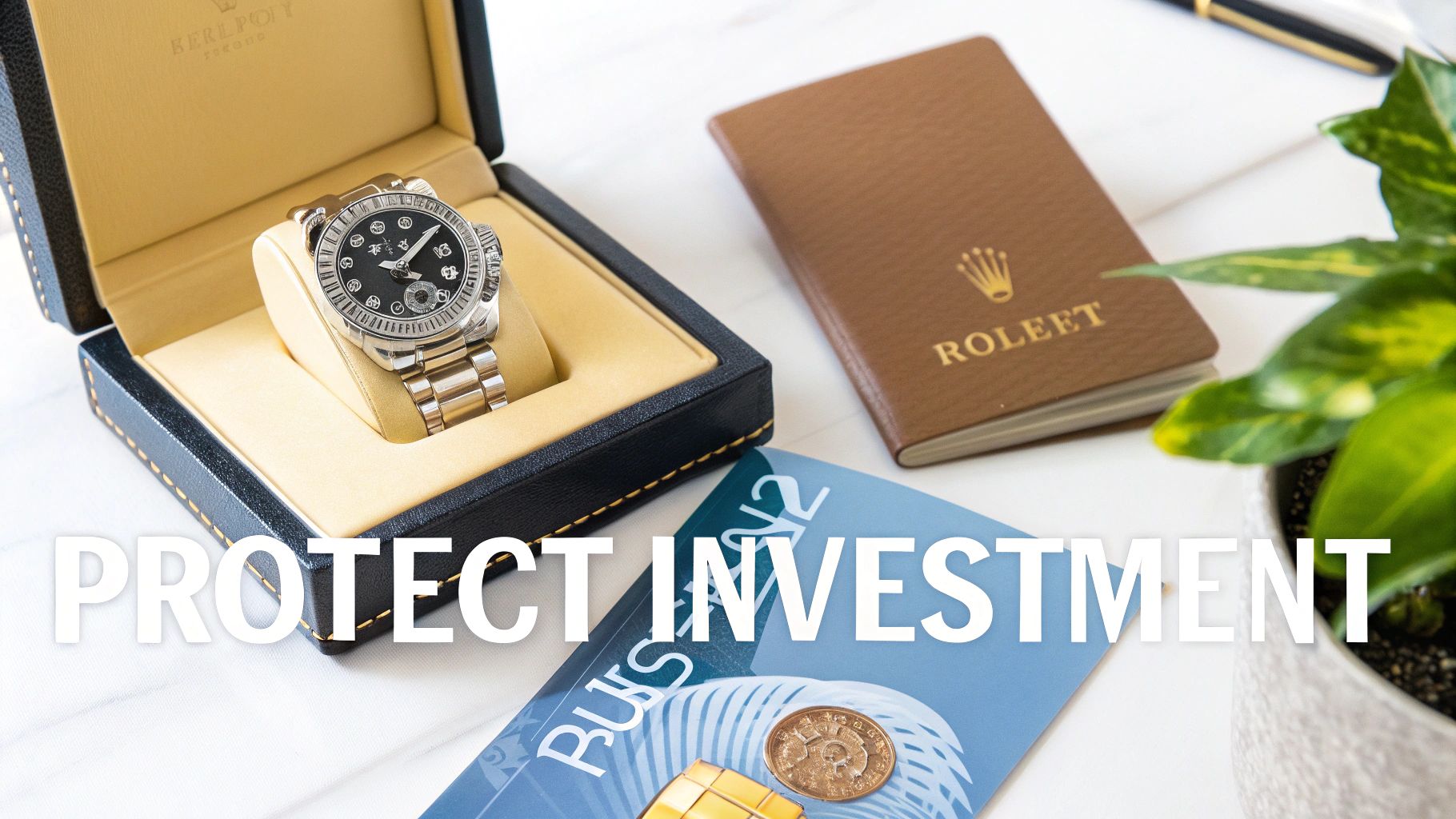
Honestly, these post-purchase protections are non-negotiable when you're working with a reputable seller. They're a direct reflection of the dealer's confidence in their inventory and their commitment to you. Without them, you're flying without a net.
Your Immediate Post-Arrival Checklist
Before you even think about sizing the bracelet or sending a picture to your friends, pause and give the watch a final, careful look-over in good light. I know the excitement is high, but a calm, methodical check right now is your best defense against any potential issues.
Here’s what you should do right away:
- Document the Unboxing: This might feel a little over the top, but trust me on this. Filming or taking photos as you open the package provides undeniable proof of the watch's condition the moment it arrived. If there was a shipping mishap, this footage is invaluable.
- Verify the Details: Pull up the original listing photos and compare them side-by-side with the watch you're holding. Double-check that the reference and serial numbers match what was on the invoice.
- Test the Functions: Gently wind the watch. Set the time and date. If it’s a chronograph, run the pusher sequence—start, stop, and reset. Everything should feel crisp and operate smoothly.
This isn't about hunting for microscopic scratches with a loupe. It's about confirming you received the right watch in the condition described, with all its functions working as they should. If anything seems off, stop. Contact the dealer immediately, before you wear the watch or remove any of its protective tags or stickers.
Understanding Warranties and Return Policies
A dealer-backed warranty is one of the single biggest advantages of buying from a pro versus a private party. While the length can vary, a one-year warranty that covers the mechanical movement is a solid industry benchmark. This is your shield against any unexpected functional problems that weren't caused by a drop or a knock.
Just as important is the return policy. Any dealer worth their salt will offer a clear, no-fuss return window, usually somewhere between three to seven days. This gives you a crucial grace period to live with the watch, get it checked by your own watchmaker if you want, and just make sure it feels right on your wrist.
A clear and fair return policy is the ultimate sign of a dealer's integrity. It shows they are fully confident in the authenticity and quality of their watches and are not afraid to stand behind their product.
Think of this policy as your safety valve. It gives you an out if the watch isn't what you expected, removing that final layer of risk and allowing you to buy with complete peace of mind.
Long-Term Care and Maintenance
Once you're past that initial inspection window, your focus can shift to enjoying and preserving your timepiece for the long haul. Keeping a fine watch in top shape is an ongoing practice, but it's simpler than you might think. Good habits ensure it runs perfectly and holds its value for decades.
A few key practices will make all the difference:
- Proper Storage: When it's not on your wrist, keep the watch in its original box or a dedicated watch case. This protects it from dust, moisture, and accidental bumps.
- Avoiding Shocks and Magnetism: Be mindful of wearing a mechanical watch during high-impact sports. Also, keep it away from strong magnetic sources like large speakers, tablets, or certain clasps—magnetism can wreak havoc on its accuracy.
- Regular Servicing: A mechanical watch is a tiny, intricate engine that needs to be cleaned and re-lubricated. Plan on a full service every 5 to 10 years, depending on the manufacturer's recommendation. To ensure it gets the best care, you can learn more about professional watch servicing and keep it running like new.
By following these simple guidelines, you’ll do more than just buy a used luxury watch. You’ll become a true, confident collector who knows exactly how to protect and enjoy their investment for a lifetime.
Common Questions About Buying a Pre-Owned Luxury Watch
Even after doing all your homework, pulling the trigger on a pre-owned luxury watch can feel like a huge step. It's totally normal to have some last-minute questions. Let's run through a few of the most common ones we hear, just to shore up your confidence before you make your move.
Think of this as your final gut-check. Getting these details right is what separates a good buy from a great one and makes sure the whole experience is as satisfying as the watch on your wrist.
Is It Really Safe to Buy a Used Luxury Watch Online?
Absolutely, but with one massive caveat: your safety depends entirely on who you buy from. The trick is sticking to established, reputable independent dealers and avoiding anonymous sellers on big, open marketplaces. A real dealer’s entire business is built on their reputation and accountability.
They own every watch they sell, meaning they’ve already put their own money on the line to acquire and vet each piece. You’ll get detailed, high-resolution photos of the actual watch for sale—not generic stock images. Plus, they’ll back it up with the essentials: fully insured shipping, a solid warranty, and a clear return policy.
The real danger comes from unvetted sellers who hide behind vague descriptions or, worse, stolen photos. Vetting your seller is non-negotiable. Look for a physical address, a long-standing business history, and transparent practices.
How Much Does Not Having the "Box and Papers" Really Matter?
Missing the original box and papers can definitely affect the price, usually knocking it down by 10% to 30% compared to a "full set." Collectors are all about provenance, and those original documents are the clearest link to a watch's history.
But here’s the upside: this creates a fantastic opportunity for anyone who cares more about the watch than the packaging. A "naked" watch is the exact same piece of incredible engineering. You get the model you've been dreaming of for a much better price, and as long as you're buying from a trusted dealer, its authenticity is still 100% guaranteed.
A full set is a collector's dream, but a naked watch from a trusted dealer is a savvy buyer's move. You're buying the asset, not the accessories, and the dealer's guarantee is your ultimate safety net.
How Can I Spot an Over-Polished Watch?
Over-polishing is a deal-breaker for serious buyers because it permanently strips away the watch's original factory character. It literally erases the crisp, sharp lines of the case, leaving the edges looking soft, rounded, and almost melted. This is something you want to run from.
To spot it, get a good look at the lugs (the "horns" where the strap or bracelet attaches). They should have sharp, well-defined angles and chamfers. The crown guards should be distinct, not looking like they’ve been blended into the case. If the watch has a brushed finish, the grain should be clean and uniform, not blurry or strangely shiny.
Here’s a great pro tip: pull up high-quality photos of a brand-new or known unpolished version of the same model online. Put them side-by-side with the watch you're considering. The difference will jump right out at you. A good dealer will always be upfront about a watch's polishing and service history.
What’s the Real Difference Between a Dealer and a Marketplace?
This is probably one of the most critical things to understand. A dealer owns every single watch they sell. They've invested their own capital, reputation, and expertise into finding, authenticating, and preparing each piece. When you buy from them, you're buying from them, and they are on the hook for the entire transaction.
A marketplace, on the other hand, is just a digital classifieds board. It connects thousands of private, often unvetted sellers with buyers. The marketplace doesn't own the inventory and usually relies on hit-or-miss third-party authentication services, if they offer them at all. This creates a "buyer beware" environment where accountability is murky at best.
Bottom line: choosing a dedicated dealer over a marketplace gives you a level of security, expertise, and after-sale support that isn't just better—it's in a completely different league.
Ready to find the perfect timepiece with complete confidence? At Perpetual Time, every watch in our collection is owned, authenticated, and guaranteed by our in-house experts. We make sure you get exactly what you expect, every time. Explore our curated selection of certified pre-owned luxury watches and discover a transparent, secure, and rewarding way to buy.


