Cart
0

Before you even think about grabbing a jeweler's loupe, some of the most telling signs of a counterfeit Rolex are right there in front of you. Learning how to tell if your Rolex is real often starts with three simple things you can check with your own senses: how it feels in your hand, what it sounds like, and how the second hand moves. These first impressions are your best defense against the vast majority of fakes out there.
The First Impression: Weight, Sound, and Feel
A genuine Rolex is a masterpiece of engineering, built from top-tier materials, and it absolutely feels like it. The moment you pick one up, you'll notice its weight. Real Rolexes are milled from a solid block of metal—usually their proprietary 904L "Oystersteel" or precious metals like 18k gold. This gives the watch a solid, balanced heft that just feels right on the wrist.
In contrast, fakes are often made from cheaper 316L steel or plated alloys. They almost always feel lighter, sometimes even hollow, and the weight distribution just feels off.
Next, bring it close to your ear and listen. This is a dead giveaway for many fakes. A real Rolex movement is a finely tuned mechanical engine that runs almost silently. In a quiet room, you might catch a faint, high-frequency whirring, but you should never, ever hear a loud, obvious tick-tock. That distinct ticking is the signature of a cheap quartz movement used in low-quality replicas.
The flowchart below breaks down this simple "Feel, Listen, Look" process.
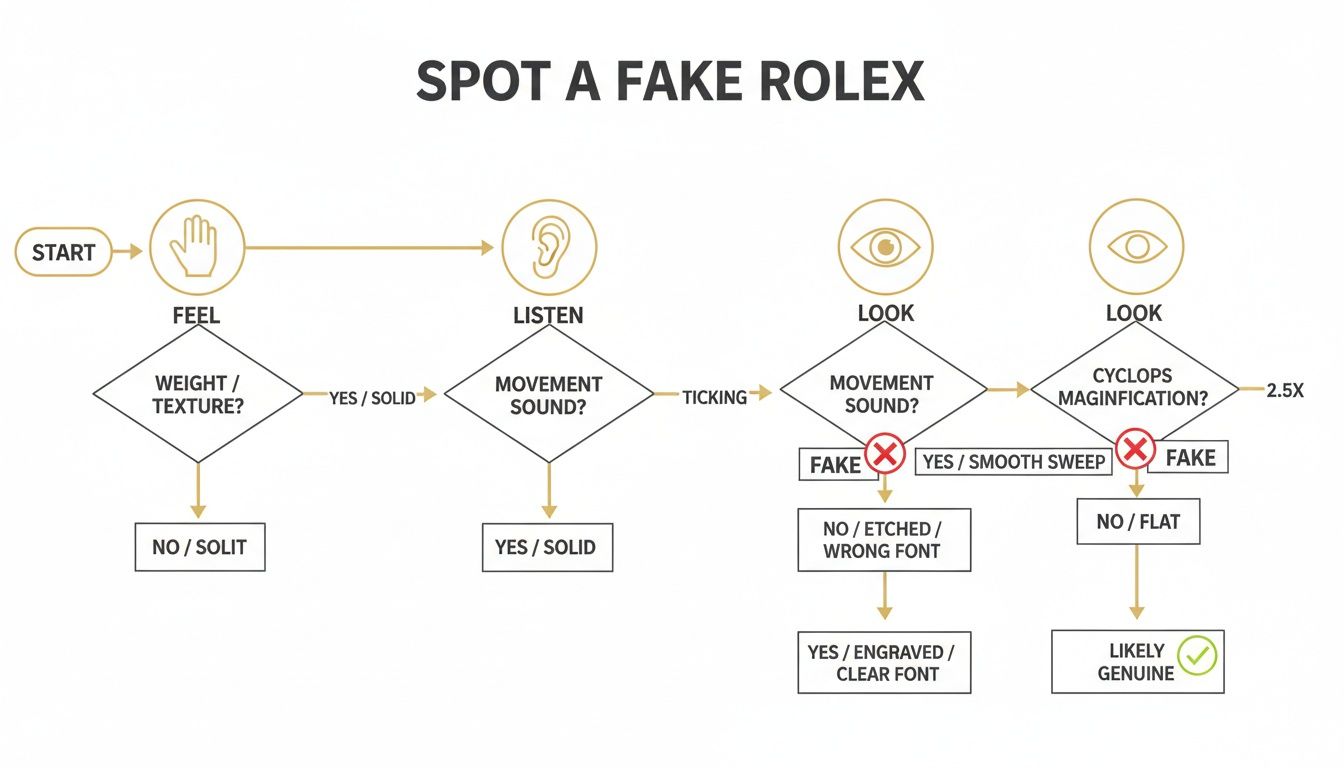
As you can see, your own senses are the first and most powerful tools you have for weeding out an obvious counterfeit.
The Signature Sweep of the Second Hand
The last part of this initial check is all about watching the second hand. A true Rolex automatic movement creates a beautifully smooth, gliding sweep across the dial. This is because genuine Rolex movements beat at a rapid 28,800 vibrations per hour (vph), which means the second hand makes eight tiny movements for every single second. To the naked eye, it looks like one continuous, flawless motion.
Even the so-called "super clones" can't quite get this right. According to professional authenticators, around 80% of these high-end fakes can be detected either by listening closely or through professional timing tests.
A fake, on the other hand, usually has a jerky, stuttering movement. You can often see the hand "tick" or jump from one second marker to the next.
Key Takeaway: A real Rolex feels heavy, sounds quiet, and its second hand sweeps smoothly. A fake often feels light, ticks loudly, and its second hand stutters. Trust your initial instincts—if something feels off, it probably is.
Here’s a quick table to summarize what you should be looking for right away.
Quick Guide: Real vs. Fake Rolex Initial Checks
| Feature | Genuine Rolex Indicator | Common Fake Indicator |
|---|---|---|
| Weight & Feel | Substantial, solid, and well-balanced heft. | Noticeably lighter, hollow-feeling, or poorly balanced. |
| Movement Sound | Nearly silent, with a faint, high-frequency whir at most. | A distinct and audible tick-tock sound. |
| Second Hand Motion | A smooth, sweeping glide around the dial. | A jerky, stuttering, or "ticking" movement. |
Mastering these foundational checks is crucial. If a watch you're examining fails these simple tests, you can be almost certain it's a counterfeit without needing to dig any deeper. To get a real feel for what genuine quality is like, it helps to handle an authentic piece. Exploring a collection of Rolex unisex certified watches can give you that essential benchmark.
Get Your Magnifying Glass: Scrutinizing the Dial and Crystal
If the weight and feel of a watch are its first impression, the dial is its face—and it tells you everything you need to know. This is where Rolex's fanatical attention to detail truly shines, and it's almost always where counterfeiters, even the good ones, cut corners. The real secrets to spotting a fake are often hiding in plain sight, right on the dial.
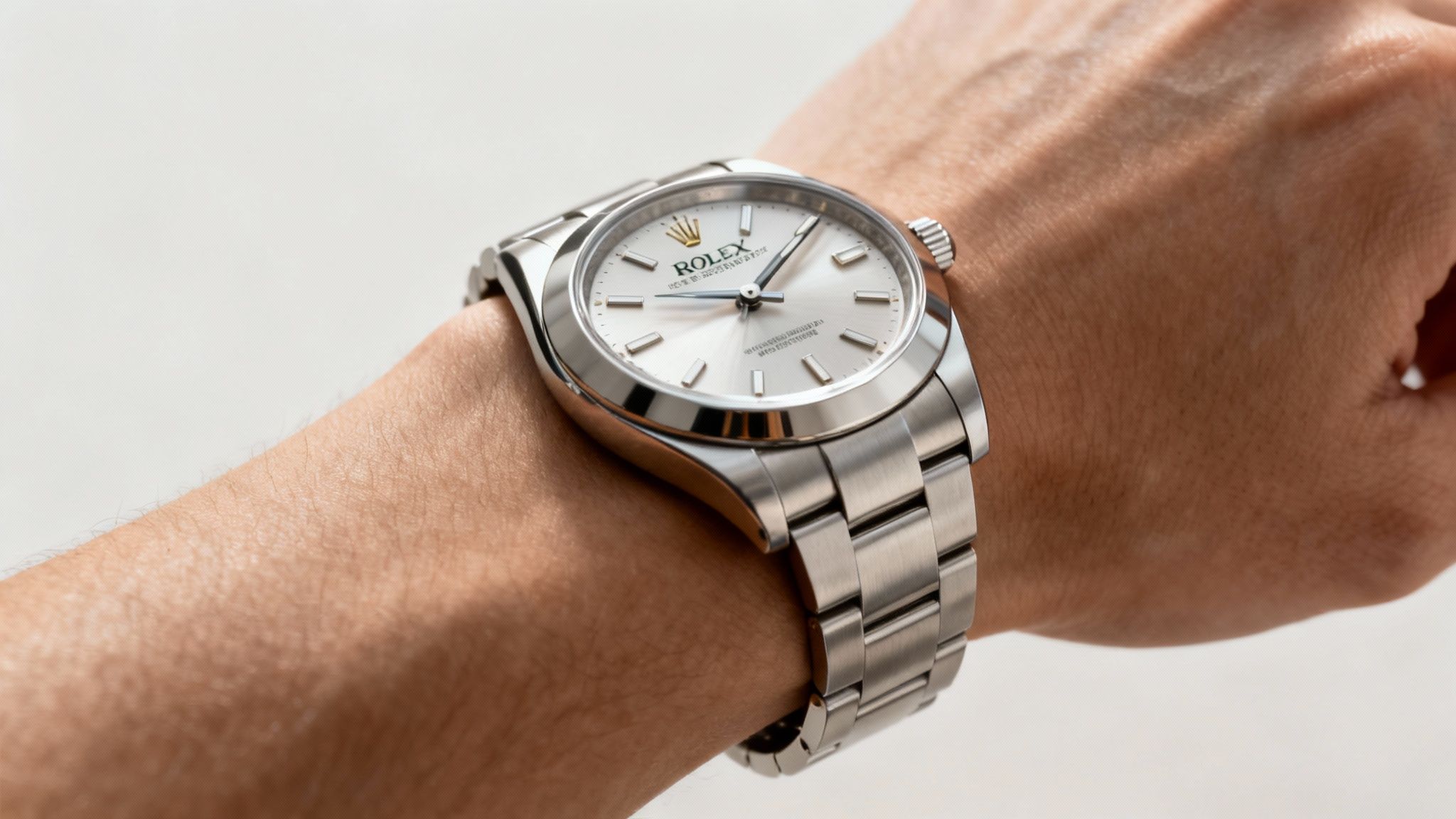
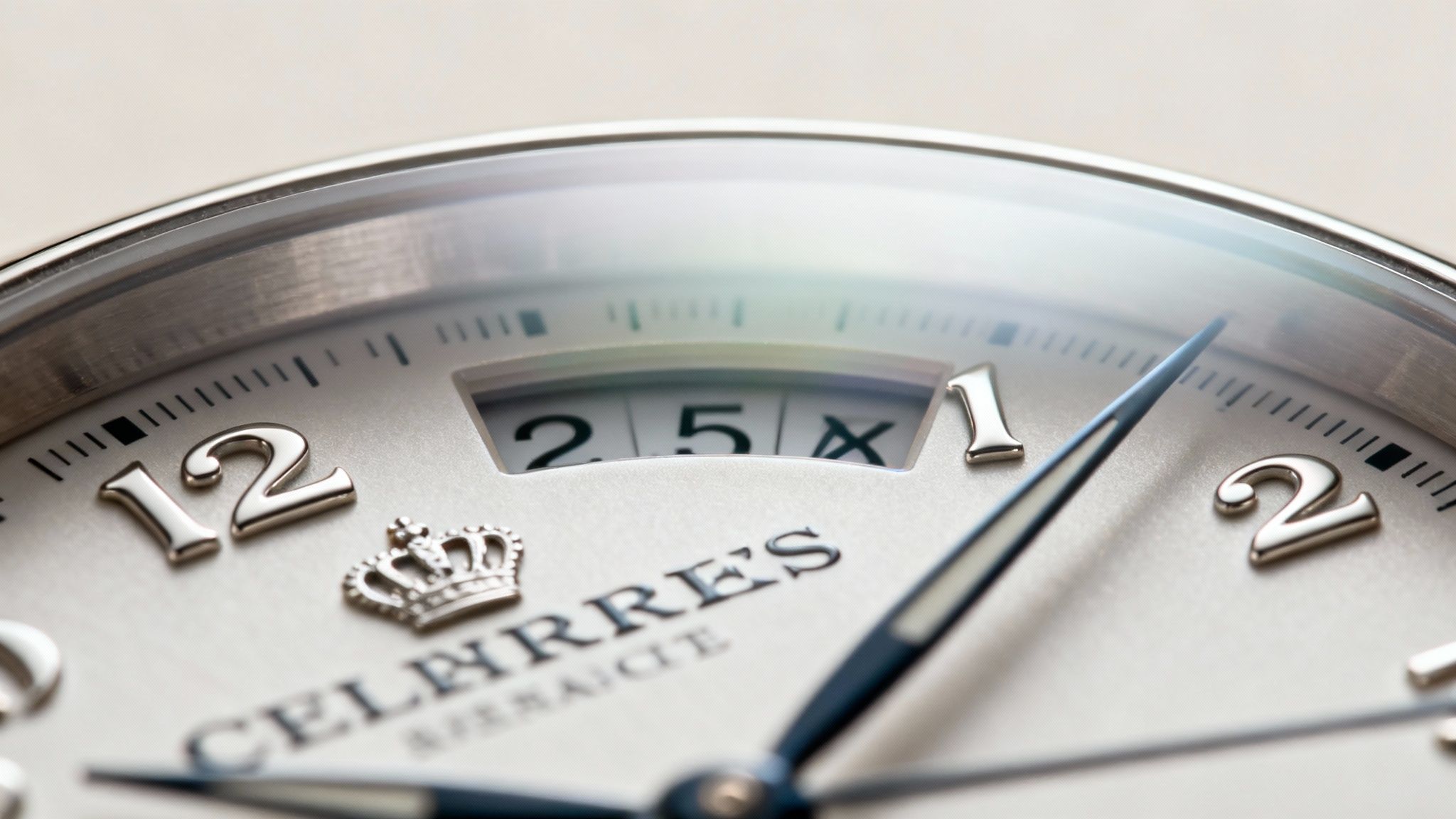
The first, and arguably most telling, detail to inspect is the iconic Cyclops lens that sits over the date window. Rolex didn't add this just for looks; it serves a very specific purpose: making the date pop. A genuine Cyclops magnifies the date by a precise 2.5x, making the numerals appear bold, crisp, and perfectly framed within the date aperture.
This is a detail that fakes consistently get wrong. Their magnification is often laughably weak, maybe 1.5x if you're lucky, resulting in a tiny, unimpressive date. You might also notice the lens itself is misaligned, looks a bit cloudy, or feels poorly attached.
The Cyclops: Your First and Best Litmus Test
Seriously, if you only check one thing, make it the Cyclops. Its precise 2.5x magnification is a hallmark of authenticity that counterfeiters find incredibly difficult to replicate. On fakes, the date magnification often hovers around 1.5x to 2x, or you'll see other tells like a slightly off-center lens or a lack of the anti-reflective coating found on modern Rolex models produced after the early 2000s.
It's no surprise that authentication platforms reported rejecting 27% of watches they inspected in the first half of a recent year, with Rolex models making up the bulk of the fakes. A huge number of those rejections started right here, with a failed Cyclops check. You can read the full research about these authenticity issues to get a better sense of the scale.
Don't just look at it—feel it. Run your finger over the crystal. A real Cyclops is a distinct, smoothly rounded bump. On many fakes, it feels almost flat or has sharp edges.
Pro Tip: Tilt the watch to a sharp angle and look at the date. On a genuine Rolex, the powerful magnification means the date is still legible, even if distorted. On most fakes, the weak lens makes the date virtually disappear when viewed from the side.
Dial Printing and Applied Markers
Okay, now let's zoom in on the dial itself. This is where a good jeweler's loupe is worth its weight in gold. Every single word on a genuine Rolex dial, from the brand name to the "Superlative Chronometer Officially Certified" text, is executed with surgical precision.
The printing is impossibly crisp, with clean, defined edges. Under a loupe, you can often see a subtle three-dimensional quality to the ink, as if it was stamped onto the dial with immense pressure. You will never find smudges, fuzzy letters, or sloppy spacing. Counterfeiters use cheap pad printing that results in lettering that looks flat, blurry, and uneven—flaws that become glaringly obvious under magnification.
Next, shift your focus to the hour markers. On a real Rolex, these aren't just printed on. They are individual pieces, typically crafted from 18k gold (even on steel models, to prevent any possibility of tarnishing) and applied by hand with painstaking care. They should be perfectly aligned and flawlessly polished.
Here’s your dial checklist:
- Text Quality: Is the printing laser-sharp and slightly raised? Or is it flat and blurry? Any imperfection is a deal-breaker.
- Applied Markers: Confirm the hour markers are separate, applied pieces. They should look like tiny, perfect sculptures, not just paint.
- The Coronet: The Rolex crown logo at 12 o'clock should be an applied piece with intricate details and a high-polish finish. Fakes often have a clunky, poorly defined crown that looks stamped.
The Hidden Coronet in the Crystal
Finally, here's one of the coolest anti-counterfeiting tricks Rolex has up its sleeve. Since the early 2000s, Rolex has been micro-etching a tiny coronet logo directly into the sapphire crystal, right above the 6 o'clock position.
This thing is incredibly hard to see with the naked eye, and that's by design. You'll likely need a flashlight held at an angle to make it catch the light, or a quality loupe to spot it. The logo itself isn't a solid shape; it's composed of dozens of minuscule dots arranged in the form of the crown.
Finding this tiny etching is one of the strongest indicators of a genuine modern Rolex. The laser technology required to do this is far beyond the reach of most counterfeiters. In fact, if the logo is too easy to see, you should be suspicious—Rolex made it subtle for a reason. On a post-2002 model, its absence is a massive red flag.
Decoding Serial and Model Number Engravings
Every Rolex has its own unique fingerprint—a set of numbers etched into the case that tells its story. Getting a handle on these engravings is one of the most powerful tools in your authentication arsenal because it’s a detail counterfeiters almost always get wrong. Think of these numbers as the watch’s birth certificate.
On models made before 2005, you’ll have to pop the bracelet off to find them. The model number, which you might also hear called the reference number, is tucked between the lugs at the 12 o'clock side. The watch's unique serial number sits opposite it, at the 6 o'clock position. For newer Rolexes, they've moved this information to the inner bezel ring, or rehaut, with the serial number clearly visible at 6 o'clock.
The Telltale Quality of the Engraving
This is where the difference between genuine Swiss craftsmanship and a cheap knockoff really shines through. A real Rolex has engravings cut with diamond-tipped precision. The lines are incredibly sharp, deep, and clean. When you catch them in the light, they shimmer beautifully, creating an almost 3D effect.
Fake Rolexes, on the other hand, are usually made with a crude acid-etching process. The result is characters that look sandy, dotted, or pixelated when you look closely. The engravings are often shallow, with blurry edges that just don’t pop. If the numbers look faint, fuzzy, or uneven, you're almost certainly holding a counterfeit.
Expert Insight: An authentic Rolex engraving feels as sharp as it looks. The precision cut creates defined edges, while a fake's acid etching often leaves a faint, almost sandy texture with no real depth or brilliance. It’s a difference you can see and, with a trained eye, almost feel.
Decoding the serial number is a cornerstone of the authentication process. Rolex has used specific systems since the 1920s that tie directly to production years, so a mismatch is a dead giveaway. Fakes often reuse the same serial numbers across different models or apply blurry numbers that don't shimmer under light. It’s a huge issue; in 2023, authentication services flagged over 30% of submitted Rolexes as counterfeit based on serial number discrepancies alone. You can discover more insights about Rolex authentication from industry data on this topic.
Matching Serial Numbers to Production Eras
A serial number does more than just identify a watch; it places it in a specific time period. This is where many counterfeiters slip up. They might stamp a serial number from a 2010s model onto a watch that's meant to look like it's from the 1980s. A quick cross-reference can expose a forgery in seconds.
Knowing the serial number system is crucial for spotting these anachronisms. The table below offers a quick guide to help you date a potential purchase and identify obvious fakes.
Rolex Serial Number Eras A Quick Reference
| Approximate Era | Serial Number System | Example |
|---|---|---|
| 1954 - Mid 1960s | 6-digit, sequential | 999,999 |
| Mid 1960s - 1987 | 7-digit, sequential | 9,999,999 |
| 1987 - 2011 | Letter prefix + 6 digits | Rxxxxxx, Lxxxxxx, etc. |
| 2011 - Present | Randomized 8-digit | G123A567 |
This historical data is invaluable, especially for vintage and pre-owned pieces. While Rolex switched to a random system around 2011, making newer models harder to date precisely, the older systems provide a clear timeline.
For example, a seven-digit serial number starting with an "R" places the watch's production around 1987. If you see that number on a model that wasn't even released until 2005, you know you’ve found a fake.
Here are a few other things I always check:
- Consistency: Does the serial number's era match the watch's other features? Think dial style, bracelet type, and movement. Everything should align.
- Uniqueness: Counterfeiters are lazy and often reuse the same few serial numbers over and over. A quick Google search of the serial number can sometimes reveal if it's a known fake.
- Rehaut Alignment: On modern Rolexes with the engraved rehaut, the "ROLEXROLEXROLEX" text should line up perfectly with the minute markers. The serial number at the bottom should be dead-center at 6 o'clock. Any misalignment is a major red flag.
Pay Attention to the Bracelet, Clasp, and Crown
The parts of a watch you touch the most—the bracelet, the clasp, and the winding crown—are where Rolex's fanatical engineering becomes something you can actually feel. Counterfeiters might get the look right from a few feet away, but they almost never nail the tactile experience. In my experience, learning how to tell if your rolex is real often comes down to simply trusting your sense of touch.
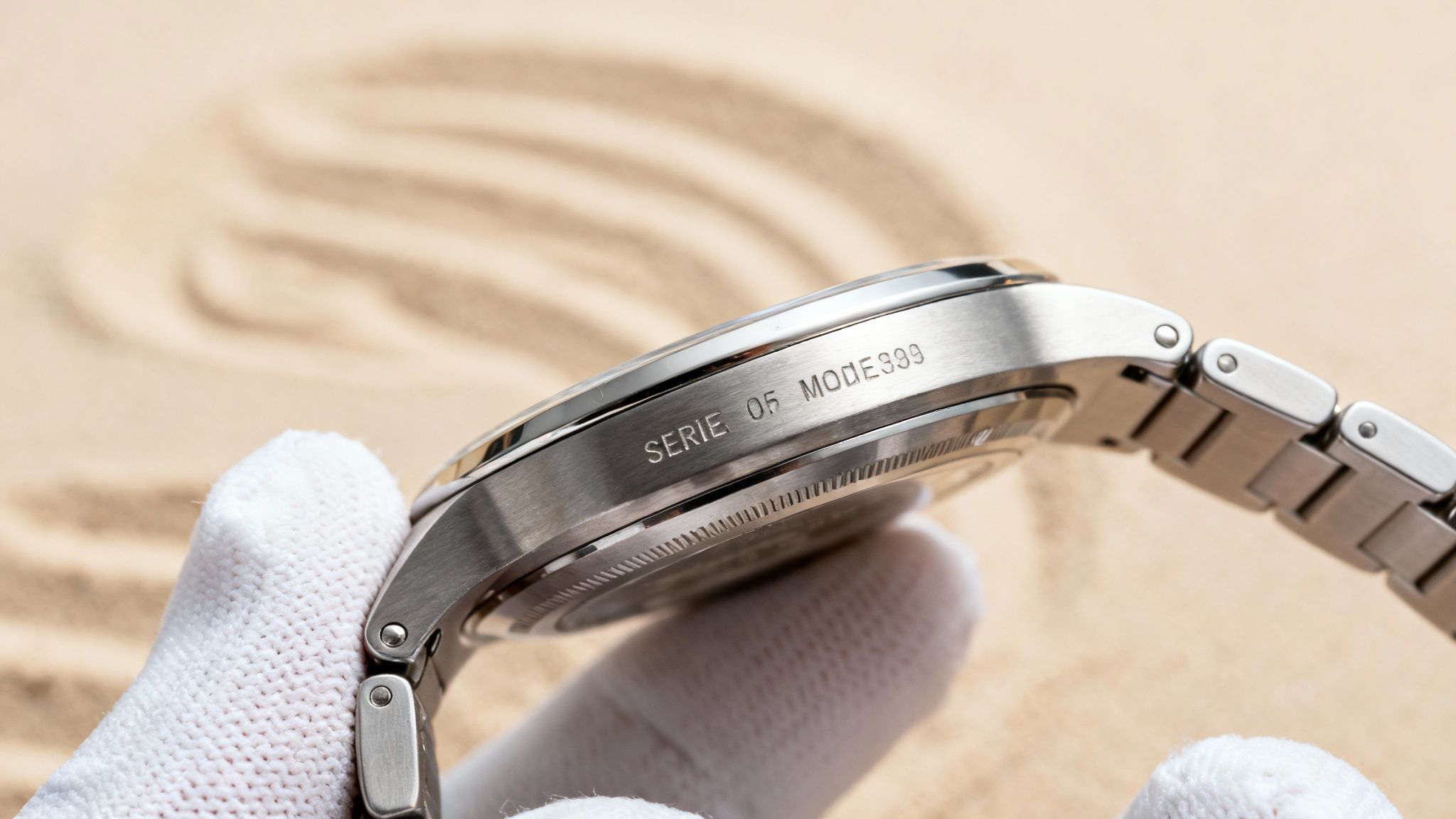
Just start by handling the bracelet. Whether it's the classic Oyster, the dressier Jubilee, or the prestigious President style, a genuine Rolex bracelet feels incredibly solid and fluid. The links are machined with immense precision, allowing them to articulate smoothly without any sharp edges or that cheap, tinny rattle you find on knockoffs. It should feel like a single, cohesive piece of high-end jewelry, not a jumble of loosely connected parts.
Fakes, on the other hand, often feel flimsy and sound cheap. Give the watch a gentle shake; a jangly, hollow sound is a massive red flag. Then, run your fingers along the edges of the links. Counterfeit bracelets frequently have unfinished, sharp edges that scream poor manufacturing quality.
The Decisive "Click" of the Clasp
The clasp is another dead giveaway. A real Rolex clasp is a small marvel of mechanical engineering. When you close it, you should hear and feel a satisfying, secure "click" that feels both solid and effortless. There's no wiggling, no forcing it—it just works, every single time.
Now, open the clasp and look closely at the engravings inside. The Rolex logo and any other markings should be deep, crisp, and flawlessly clean. Counterfeiters often use cheap stamping or shallow laser etching, which results in logos that look flat, blurry, or lack the sharp definition of the real deal. The tiny coronet on the flip-lock of a Submariner or GMT-Master is a perfect spot to check for this detail.
Pro Tip: Don't forget to test the micro-adjustment systems, like the Easylink extension on many modern Oyster bracelets. A genuine one operates with a smooth, precise action. Fakes often feature clunky, poorly-made mechanisms that are either a pain to use or feel like they're about to snap off.
Here are a few specific things I always check on the clasp:
- Logo Quality: The Rolex coronet on the outside of the clasp should be an applied piece of metal, not just stamped in. Look for well-defined points and a high-quality finish that matches the rest of the clasp.
- Engraving Depth: All markings inside the clasp should be deeply and cleanly engraved. If the text looks "sandy" or shallow, be suspicious.
- Mechanical Feel: The folding arms of the clasp should move without any resistance and align perfectly when you close them. Any grittiness or misalignment is a major cause for concern.
The Crown and Its Vital Waterproofing Seals
Finally, let's look at the winding crown. This is your gateway to the watch's movement and a critical part of its water resistance. Unscrew it. The action should feel buttery smooth and consistent, never gritty or loose.
Examine the Rolex coronet logo on the end of the crown—it should be perfectly crafted with sharp, defined details. Just below it, you'll see markings that indicate the watch's sealing system: a dash for a Twinlock system or three distinct dots for the more robust Triplock. These systems are the heart of the Rolex Oyster case's legendary durability. To really appreciate the history here, you can dive into the evolution of the Rolex Oyster case and its waterproof design.
When you screw the crown back in, it should engage the threads cleanly and tighten down snugly against the case. A crown that feels wobbly, cross-threads easily, or doesn't feel like it's sealing tightly is an unmistakable sign that you're not holding a genuine Rolex. These tactile checks are incredibly powerful because they test the actual engineering of the watch, not just its surface-level appearance.
Checking the Caseback and Internal Movement
While the dial and bracelet give you plenty of clues, the caseback and the movement tucked away inside are where the real secrets lie. Flip the watch over. What do you see?
With just a couple of rare vintage exceptions, a genuine Rolex caseback is intentionally plain. It’s a solid piece of steel, smoothly polished or brushed, and that's it. You won't find engravings, logos, or a see-through window. Counterfeiters love to add flair here, often slapping on a logo or fitting a glass back to show off a crude, fake movement. If you see a clear caseback on a modern Submariner or Datejust, it's a dead giveaway you're holding a fake.
Peeking Inside at the Movement
Now, for what’s hiding behind that solid steel back: the movement. I have to be clear here—opening a Rolex is a job for a professional watchmaker with the right tools. But knowing what they’re looking for is your final line of defense.
A real Rolex movement isn't just a machine; it’s a work of art. The finishing and engineering are on another level. Here’s what an expert looks for:
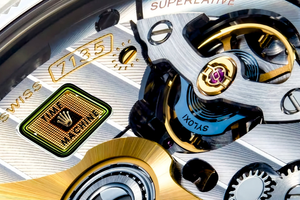
- Signature Colors: Authentic Rolex calibers have distinct, colored components. The best example is the red or purple anodized reversing wheels in the self-winding mechanism. Fakes almost never get these colors or the quality of the finish right.
- Immaculate Finishing: Every single part inside a real Rolex, down to the tiniest screw, is perfectly finished. You'll see beautiful patterns like perlage (circular graining) on the plates and bridges. There are absolutely no rough edges or tool marks.
- Precise Engravings: Just like on the case, the engravings on the movement bridges—like the caliber number and brand name—are incredibly sharp, deep, and clean.
Distinguishing a Real Caliber from a Clone
Even the so-called "super fakes" that look perfect on the outside fall apart under this kind of scrutiny. A fake movement is all about shortcuts. A watchmaker will spot cheaper metals, plastic parts where there should be steel, and a total lack of the fine finishing that defines a Rolex.
Expert Insight: The real difference is in the details you can't see. A genuine Calibre 3135, for instance, is a legendary workhorse known for its toughness and reliability. A clone might look similar at first glance, but an expert will immediately spot the inferior materials, construction, and performance.
A common trick is to take a generic Asian-made movement and simply stamp "Rolex" on the rotor. An experienced watchmaker can identify the base caliber in seconds and expose the fraud.
Knowing this is your power. It tells you why a professional inspection is non-negotiable. If you have any doubt at all, getting an expert to service or inspect your watch is the only way to get a definitive answer and real peace of mind. The movement never lies.
Why Expert Authentication Is Your Best Investment
Let's be honest, even with a sharp eye and a good guide, spotting a fake Rolex is getting harder every year. We're now dealing with "super fakes" that can mimic the look, the weight, and even the smooth sweep of the second hand with incredible accuracy.
This is exactly why getting a professional to look at the watch isn't just an optional final step—it’s the most important thing you can do to protect your money.
Relying on what you can see on the surface is a huge gamble. An experienced watchmaker goes deeper, using specialized tools and years of hands-on experience to spot things the counterfeiters can't replicate. This is where you move from making an educated guess to getting a definitive answer.
Going Beyond What You Can See
Real, professional authentication is about uncovering the truth hidden inside the watch. A certified watchmaker will run a few key tests that are impossible to do at home, and the results don't lie.
These non-negotiable checks include:
- Timegrapher Analysis: This machine listens to the heartbeat of the watch's movement. It measures things like amplitude, beat rate, and beat error, giving a clear picture of its health. A genuine Rolex movement has a very specific performance signature that clone movements just can't match.
- Pressure Testing: This is the only way to be 100% sure a watch is water-resistant. It checks that all the seals and gaskets are doing their job, a hallmark of the Rolex Oyster case that fakes almost always fail.
The peace of mind you get from knowing your timepiece is authentic is priceless. An expert’s seal of approval turns a potential risk into a certified asset.
At the end of the day, the safest way to buy a Rolex is to go through a dealer who stakes their entire reputation on authenticity. When you browse a collection of certified pre-owned watches from a trusted source, you're buying confidence. Every single watch has already been through this exhaustive professional inspection, so you don't have to.
Frequently Asked Rolex Authentication Questions
Navigating the world of pre-owned Rolex watches can feel like walking through a minefield. But once you have clear answers to a few key questions, you'll feel much more confident. Most buyers, whether they're new to this or seasoned collectors, run into the same handful of concerns.
Let's tackle the most common questions we hear every day. Getting these answers straight will help you make smarter, safer decisions.
Can a Jeweler Be Fooled by a “Super Fake” Rolex?
The short answer is: it’s highly unlikely if they know what they’re doing. Today’s “super fakes” can be shockingly good and might even fool someone with a quick glance. But they almost never stand up to the scrutiny of a trained watchmaker or a certified authenticator.
Experts look far beyond the obvious. They’ll pop open the caseback to inspect the movement, and that's where the fakes almost always give themselves away. The finishing is rough, the materials are cheaper, and the intricate mechanics just aren't there.
They also use specialized tools to verify the exact weight, the metal composition (like Rolex’s proprietary 904L steel), and the precision of the engravings. A quick look from a general jeweler might not be enough, but a multi-point inspection from a specialist will spot a fake every time.
How Much Do Box and Papers Add to Authenticity?
Having the original box and papers is a huge plus. It can boost a Rolex’s value by 10% to 20% or more, and it provides a strong layer of provenance. The warranty card is key here, as it has the watch’s serial number, which must perfectly match the number engraved on the watch.
But be careful. Counterfeiters have gotten incredibly good at faking boxes and papers, too. While their presence is a great sign, you should never rely on them alone for authentication. The watch itself is the ultimate source of truth and must always pass a thorough inspection.
A genuine watch without papers from a trusted dealer is always a safer investment than a questionable watch with seemingly legitimate paperwork.
Is a Green Sticker on the Caseback a Reliable Sign?
Not anymore. That green holographic sticker on the caseback was a hallmark of older Rolex models, mostly from before 2007. It featured a hologram of the Rolex coronet and the watch's reference number.
While it was a decent indicator back in the day, counterfeiters learned to replicate it. Plus, these stickers just wear off over time with normal use. Rolex eventually replaced it with a simple clear sticker after moving the serial number to the inner bezel ring (the rehaut).
So, you should never use a green sticker to judge a modern Rolex. On a vintage piece, it's a small detail that only an expert can properly evaluate in context. And if you see one on a brand new model? That’s a massive red flag.
At Perpetual Time, we eliminate the guesswork. Every single watch we sell undergoes a rigorous, multi-point inspection by our in-house experts to guarantee its authenticity, so you can buy with absolute confidence. Discover our collection of certified pre-owned Rolex watches.