
Cart
0
If there's one golden rule in the world of pre-owned Rolex watches, it's this: buy the seller, not the watch. The single most important decision you'll make is choosing a trusted, independent dealer who owns their inventory and authenticates everything in-house. This is your best defense against the fakes, "Frankenwatches," and outright scams that plague open marketplaces.
Your Smart Start to Buying a Pre-Owned Rolex
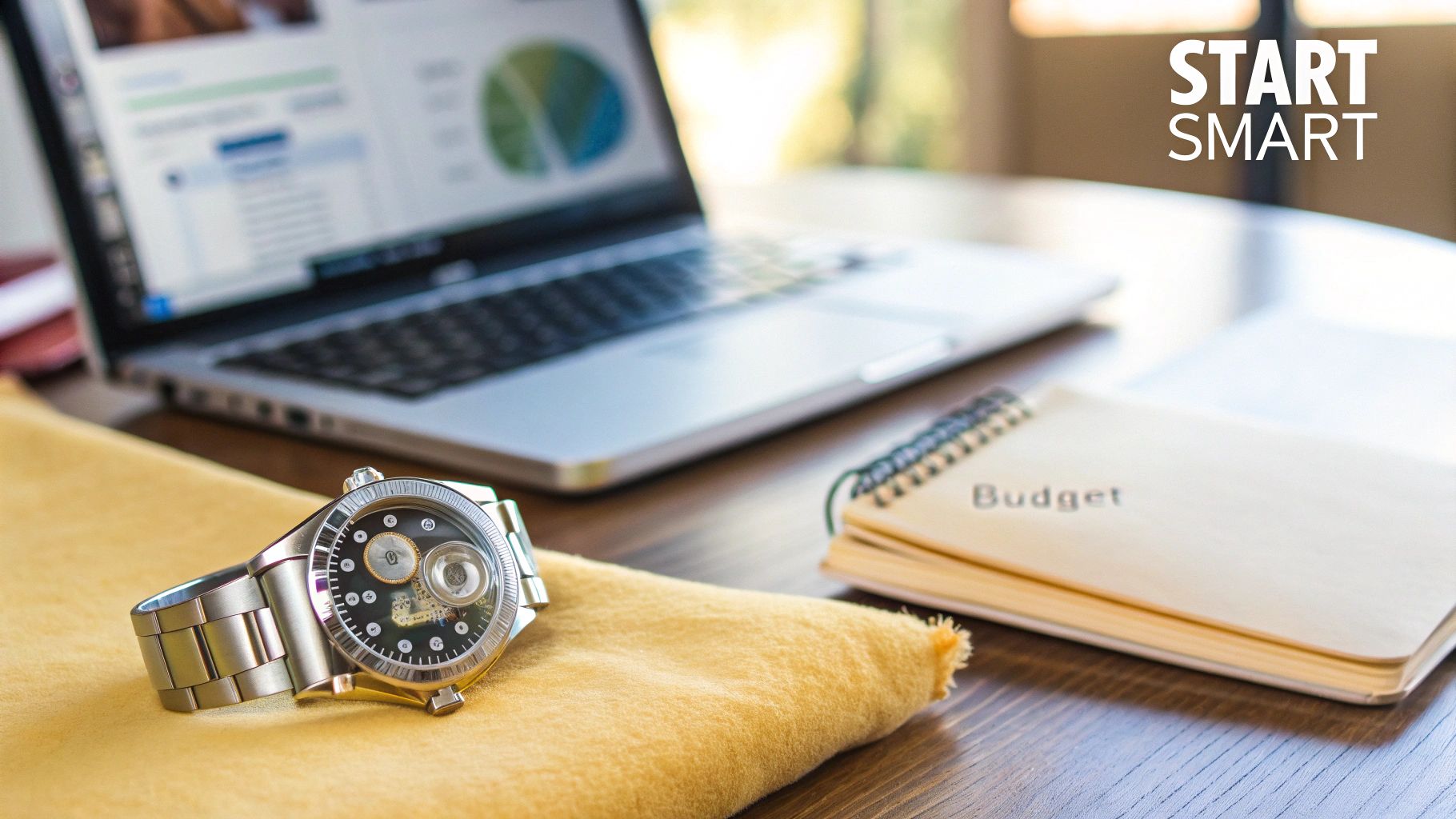
Stepping into the world of used Rolex is a genuinely exciting moment, whether this is your first "real" watch or the latest addition to a growing collection. But before you get lost in the sea of listings, a little prep work goes a long way. It all boils down to two things: figuring out your "why" and setting a realistic budget.
First, get clear on your motivation. Is this watch a reward for a huge personal or professional milestone? Are you looking for a tough, reliable daily driver? Or are you hunting a specific reference number as a potential investment? The answer steers your entire search. A rugged Submariner is a brilliant choice for everyday wear, while a classic Datejust is the perfect way to mark a special occasion.
Setting a Realistic Budget
Once you know why you're buying, it's time to figure out what you're comfortable spending. The pre-owned Rolex market isn't static; it breathes with supply, demand, and collector trends. This isn't just a hobby anymore—for many, it's a serious asset class.
The pre-owned luxury watch market is not just about passion; it's a significant financial landscape. Understanding the factors that drive value is the first step toward making a purchase you'll be happy with for years to come.
The market's growth has been nothing short of explosive. Consider this: the average price of a pre-owned Rolex shot up from roughly $2,000 in 2010 to a projected $13,426 by 2025. That's a mind-boggling 550% increase. This kind of volatility is exactly why buying from reputable dealers who stand behind their watches is non-negotiable. For a closer look at what's driving these numbers, you can explore the pre-owned luxury watch trends for 2025.
Focusing Your Search on Key Models
With a budget in mind, you can start the fun part: exploring the icons. If you’re not sure where to begin, a few legendary models offer fantastic entry points into the Rolex family.
To help you get started, here's a quick look at some of the most sought-after models on the secondary market.
Quick Guide to Popular Pre-Owned Rolex Models
| Rolex Model | Key Features & Appeal | Typical Pre-Owned Price Range (Approx.) |
|---|---|---|
| Submariner | The quintessential dive watch. Famous for its bulletproof build, timeless design, and incredible value retention. | $9,000 - $20,000+ |
| GMT-Master II | Instantly recognizable with its two-tone "Pepsi" or "Batman" bezel. A pilot's watch that tracks multiple time zones. | $14,000 - $25,000+ |
| Datejust | The classic, elegant Rolex. Comes in endless combinations of sizes, metals, and dials, making it a versatile choice. | $6,000 - $15,000+ |
| Daytona | The holy grail for many collectors. A legendary chronograph with a rich motorsport history and extremely high demand. | $25,000 - $50,000+ |
This is just a starting point, of course, but familiarizing yourself with these pillars of the Rolex catalog will give you a solid foundation.
By taking the time to define your purpose, set a firm budget, and get to know the key models, you shift from being a casual window-shopper to a truly informed buyer. Now you're ready to find the right watch for you.
Where to Find Your Perfect Pre-Owned Rolex
Figuring out where to buy a used Rolex is just as critical as picking the right model. You’ve got a few main paths to choose from: specialized independent dealers, massive online marketplaces, or even private sellers. Each route comes with its own unique blend of risks and rewards, and knowing the difference is key to a purchase you'll be happy with for years to come.
For most people, and especially for a first-time buyer, the safest bet is a trusted independent dealer who owns their inventory. A business like this stakes its entire reputation on the quality and authenticity of its watches. They buy a watch, have their in-house experts pop the hood to inspect and verify everything, and only then do they list it. This process is your best defense against the Wild West of the pre-owned market.
Independent Dealers vs. Online Marketplaces
On the other side of the coin are the huge online marketplaces like Chrono24 or eBay. The selection can feel infinite, which is tempting, but the risk shoots up right alongside it. Think of these sites as digital classifieds—they connect you with thousands of sellers, but they don't actually own or authenticate the watches themselves.
This setup can lead to some serious headaches:
- "Frankenwatches": These are the nightmares of the watch world. A seller might slap together a watch using a genuine Rolex case, but with a fake dial and an incorrect bracelet. It looks real at a glance, but it's a hodgepodge of parts worth a fraction of what you paid.
- Unvetted Sellers: Sure, there are rating systems, but it's not hard for a shady seller to game the system or just open a new account after being caught. You're often buying from a total stranger with very little to back you up if things go south.
- Deceptive Photos: It’s amazing what a little clever lighting can hide. Sellers might use old stock photos or take pictures that conveniently obscure deep scratches, dings, or signs of a botched polishing job. What you see online isn't always what shows up at your door.
A simple truth of watch buying: if the person selling you the watch hasn't physically handled, inspected, and guaranteed it, you're taking a gamble. The small premium you might pay at a reputable dealer isn't a fee—it's insurance for your peace of mind.
The Private Seller Puzzle
You can sometimes snag a fantastic deal buying directly from a private individual, but this is the riskiest path by far. Unless you're a seasoned pro who can confidently inspect a watch inside and out, it's a minefield. There's no warranty, no return policy, and absolutely no one standing behind the watch's authenticity.
Here’s a scenario I’ve seen play out too many times: You meet a private seller for a vintage Submariner. It looks great, the price is right, and you seal the deal. A month later, it stops ticking. You take it to a watchmaker, who tells you the movement is riddled with cheap, non-genuine parts. At that point, you’re stuck. A good dealer would have caught that from a mile away.
Your Pre-Purchase Seller Checklist
No matter where you're looking, you need to go in armed with the right questions. A seller with nothing to hide will welcome your due diligence. If they get defensive, vague, or annoyed, that's a bright red flag telling you to walk away.
Be direct and ask:
- "Are these photos of the exact watch I'm buying?" Demand current, high-res pictures showing every angle—the case, dial, bracelet, and clasp. No stock photos.
- "What's the service history on this piece?" A full, documented history isn't always realistic for older watches, but a good seller should at least be able to tell you when they last had it serviced.
- "Can you walk me through its condition in detail?" Get specific. Ask about scratches, polishing, and whether every single part is original to that watch.
- "What's your return policy and authenticity guarantee?" Any legitimate business will have a clear, written policy that protects you if the watch isn't what they claimed.
In the end, learning how to buy a used Rolex is about prioritizing the seller’s reputation over a tempting price. Paying a bit more to a trusted source that provides a warranty and certifies their pieces isn't an extra cost—it's an investment in confidence. For a safe and transparent experience, starting your search with a collection of certified pre-owned watches from a dedicated dealer is the smartest move you can make.
Getting Hands-On: How to Assess a Rolex for Authenticity and Condition
You've found a promising watch from what looks like a solid seller. Now comes the most critical part of the whole process: putting on your detective hat and inspecting the watch yourself. This isn't about becoming a certified watchmaker in an afternoon. It's about knowing the common tell-tale signs and red flags that separate a gem from a dud.
Rolex is famously obsessive about the small details. Counterfeiters, on the other hand, often nail the overall look but stumble on the finer points. Your job is to know exactly where to look for those mistakes.
Start with the Case and Lugs
First, look at the watch's architecture—the case itself. When a Rolex leaves the factory, it has incredibly sharp, precise lines and a specific, lustrous finish. The biggest enemy of a vintage or pre-owned Rolex is the polishing wheel.
Pay close attention to the lugs, which are the four "horns" that connect the case to the bracelet. On an unpolished or lightly polished watch, these should have sharp, well-defined edges. If they look soft, rounded, or uneven, that’s a dead giveaway that the watch has been aggressively polished over the years to buff out scratches. While a little polishing is fine, too much can literally wear away the metal, permanently changing the watch's original, intended shape and tanking its value.
Examine the Dial and Hands with a Jeweler's Loupe
The dial is the face of the watch, and it’s often where fakes completely fall apart. Rolex printing is, in a word, perfect. Even under magnification, every letter should be flawless.
Get a loupe and scrutinize the text on the dial—the brand name, the model, everything. The letters must be crisp, perfectly spaced, and evenly formed. Any sign of fuzzy edges, weird font weights, or sloppy application is a huge warning sign.
Next, check the luminous material (we call it "lume") on the hands and hour markers. On a genuine Rolex, the lume is applied with machine-like precision. Look for any unevenness, bubbling, or lume that spills over the edges of the markers. While you're at it, scan for any discoloration or tiny spots on the dial, as this could point to moisture damage from the past—a repair bill you do not want.
The journey to acquiring a used Rolex is a path with several forks in the road. You can navigate online marketplaces, work with trusted dealers, or buy from private sellers, but each route has its own set of risks and potential rewards.
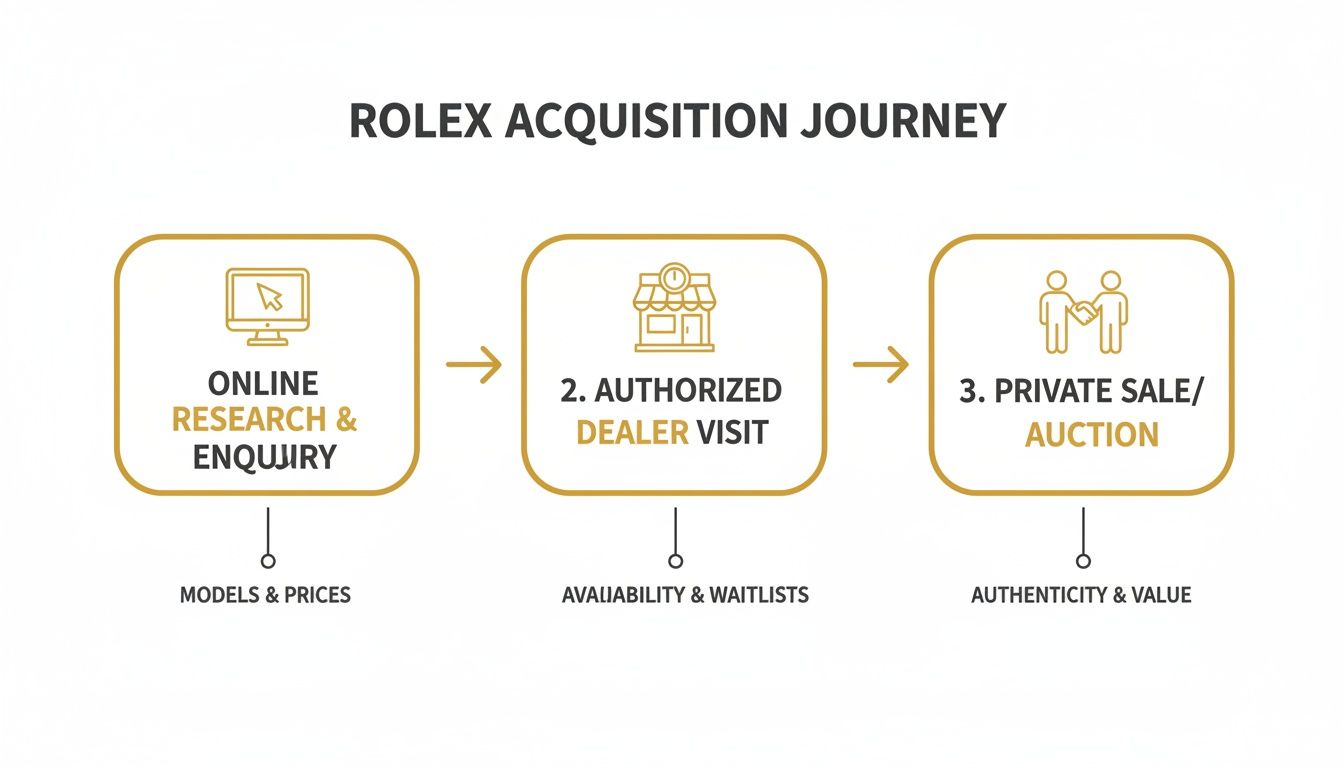
This is precisely why dealing with a specialist who authenticates every single piece of their inventory is, by far, the safest bet for most buyers.
Check the Bracelet and Clasp Integrity
A Rolex bracelet is an engineering marvel, but it’s also the part of the watch that takes the most abuse. The most common issue you'll see, especially on older models with hollow links, is bracelet stretch.
Here’s a quick way to check for it: hold the watch case level, with the dial facing the sky, and let the bracelet hang down. See how much it droops? A significant sag means the pins and links are worn out.
Beyond stretch, test the clasp. It should snap shut with a secure, satisfying click. Look closely at the engravings, especially the iconic Rolex coronet. They should be deep and clean. Lastly, do a little homework to verify that the end links and the clasp code match the watch's reference number and production year. It's not uncommon to see mismatched parts on a "Frankenwatch" pieced together over time.
While these visual inspections are your first line of defense, remember that the best modern fakes, or "superfakes," can be terrifyingly convincing. The only absolute proof of authenticity is found by looking at the movement inside the case.
Magnification and Engravings: The Final Tells
Two more quick checks can give you some peace of mind. First, the "Cyclops" lens over the date window. A real Rolex Cyclops magnifies the date by exactly 2.5x, making it pop and fill the entire lens. Most fakes only manage about 1.5x magnification, which leaves the date looking small and flat.
Second, if you're looking at a modern Rolex made since the mid-2000s, check the rehaut. That's the inner metal ring between the dial and the crystal. You should see "ROLEXROLEXROLEX" engraved around it, with the watch's serial number lining up perfectly at the 6 o'clock position. The engraving should be incredibly sharp and precise—not faint, shallow, or sloppy.
Here’s a quick checklist to keep in your back pocket:
- Case Lugs: Are the edges sharp and defined, or are they soft and rounded from over-polishing?
- Dial Text: Is the printing perfectly crisp under magnification?
- Lume Application: Is the lume applied neatly inside the markers?
- Bracelet Stretch: How much does the bracelet sag when you hold the watch horizontally?
- Cyclops Lens: Does the date magnification feel like a powerful 2.5x?
- Rehaut Engraving: (On modern models) Is the engraving sharp and perfectly aligned at 6 o'clock?
While these hands-on tips are essential, nothing beats a professional inspection of the movement. This is why buying a pre-certified watch from a trusted dealer who has already done this work for you is the smartest way to go. For an even more detailed breakdown, our guide on how to tell if your Rolex is real dives into more advanced techniques.
Getting a Grip on Pre-Owned Rolex Pricing and Value
Ever find yourself scrolling through listings for a Rolex Submariner, completely baffled by why two watches that look identical are thousands of dollars apart? You’re definitely not alone. The pre-owned Rolex market is a world of its own, where a watch’s value is a complex mix of its physical state and the tiny, subtle details that collectors go crazy for.
Nailing down these factors is the secret to spotting a fair price and making a purchase you won't regret. It's never just about the model name; it’s about the unique history and condition of that specific watch in front of you.
What Really Drives the Price
A pre-owned Rolex's value is like a puzzle with several key pieces. The big three are always its condition, its specific reference number, and its originality. A vintage piece with a sharp, unpolished case is always going to fetch a premium over one that's been worn hard and buffed smooth over the decades.
The reference number is just as critical. A Submariner 16610 and a vintage 1680 are both "Submariners," but they come from different eras, use different materials, and have completely different levels of collector demand. This creates a huge gap in their market value. Even a tiny detail, like a rare "Swiss only" dial found on watches from a single year, can easily add thousands to the price.
The Power of "Box and Papers"
In the watch world, you'll hear the term "full set" thrown around constantly. This simply means the watch comes with its original box, warranty papers (or card), instruction manuals, and hang tags. Essentially, it's the watch's birth certificate and all its original packaging.
A full set establishes the watch's history and proves its origin. While a watch tells time just as well without them, having the complete package can boost its resale value by 10-25%—sometimes even more for a super collectible model.
If you just plan on wearing and loving your watch forever, finding a great "naked" watch (without box and papers) can be a fantastic way to save some money. But if you're thinking about future value, holding out for a complete set is usually the smarter play.
Market Swings and Pricing Premiums
The pre-owned Rolex market doesn't operate in a bubble. It's directly tied to what's happening at retail and what global demand looks like. We've all seen how certain stainless steel sports models—think the Daytona or the GMT-Master II—trade for way, way more than their original sticker price. It's a classic case of insane demand and very limited supply.
This creates some wild market dynamics. For instance, the steel Daytona 126500 often sells for over $30,000 on the secondary market, which is nearly double what it costs new (if you can even get one). Understanding these premiums is crucial so you know what to expect when you start shopping.
On the flip side, some beautiful solid gold or two-tone models can often be found for prices much closer to their original retail cost. For buyers who love the look and feel of precious metals, these can represent incredible value.
How to Negotiate and Spot a Fair Deal
When you're ready to pull the trigger, of course you want the best price. But negotiating for a high-demand luxury watch isn't like haggling at a flea market. Reputable dealers aren't just guessing; their prices are based on real-time market data from auction results, private sales, and current trends.
Here’s how to approach it:
- A Recent Service Adds Real Value: A watch with paperwork showing a recent, full service from a certified watchmaker can justify a higher price. That service can easily cost $800-$1,200, so having it done already is a huge plus and gives you peace of mind.
- Good Dealers Justify Their Prices: A trustworthy seller should be able to walk you through why a watch is priced the way it is. They'll point to its specific condition, its originality, and how it compares to other similar watches on the market right now.
- Be Realistic With Your Offer: While there might be a little wiggle room, don't expect to get a lowball offer accepted on a hot model. The goal is to pay a fair market price for a fantastic watch, not to find a mythical bargain that probably doesn't exist.
By getting familiar with these pricing fundamentals, you can walk into the market with real confidence. You'll be able to see the true value in a timepiece and know a fair deal when it's in front of you. To learn more about what goes into a Rolex's price tag, read our in-depth guide on the price of a Rolex watch.
Securing Your Watch and Planning for Ownership
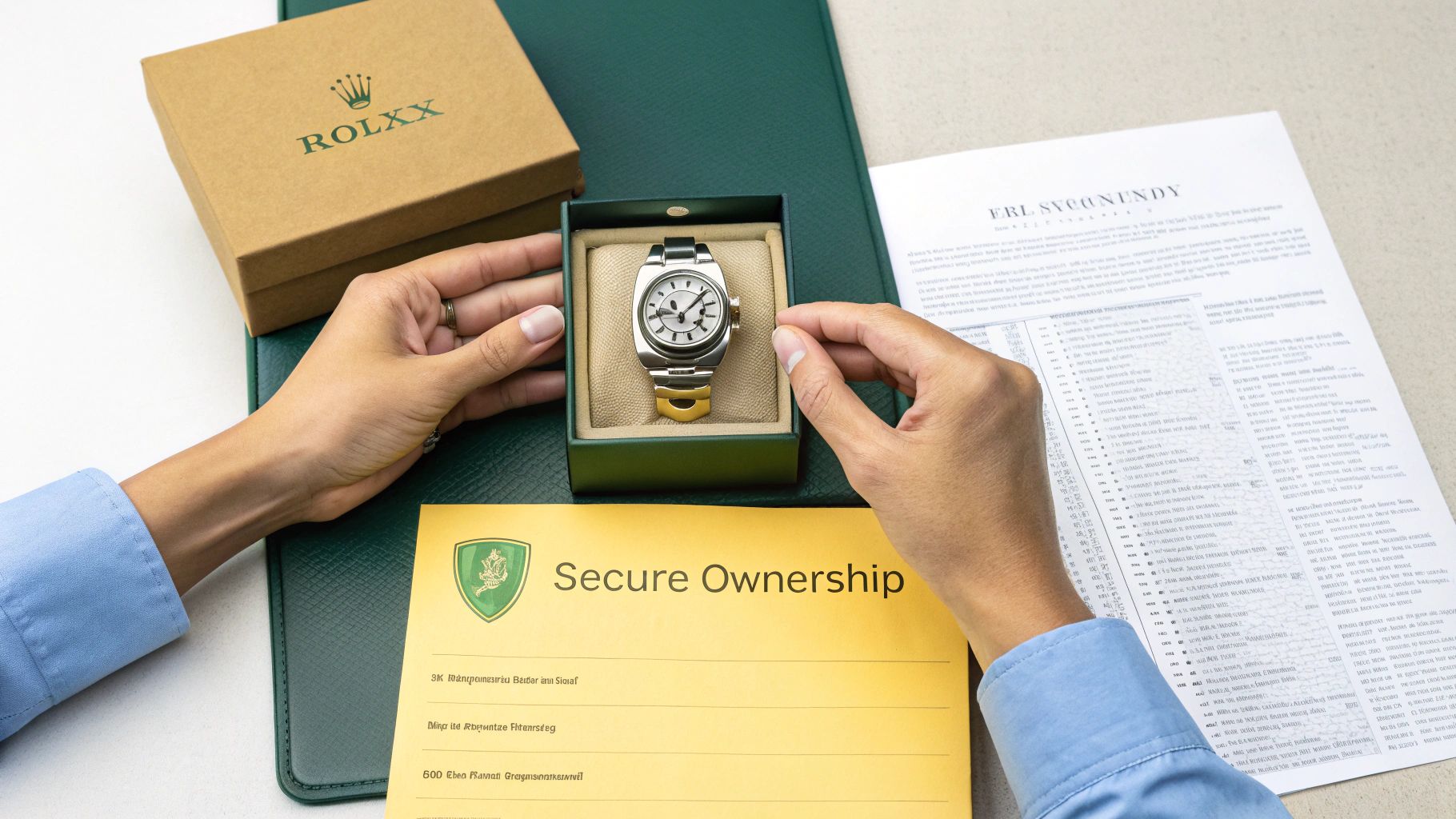
You've done the hard work—the research, the inspection, the negotiation. Now it’s time to bring your watch home. This final stage is all about making the transaction happen safely and setting yourself up for a lifetime of enjoyment with your new timepiece.
Getting these last few steps right is just as critical as your initial research. Any reputable dealer will make this part of the process feel seamless and professional, protecting you and your investment from the moment of payment until the watch is securely on your wrist.
Finalizing the Purchase Securely
When you're dealing with a purchase of this value, especially online, how you pay and how it’s shipped are not minor details. You should absolutely never agree to risky payment methods like a direct cash transfer with a private seller you've never met. A professional dealer, on the other hand, will offer secure, traceable options.
Most established retailers rely on bank wire transfers for high-value sales, which is the industry standard. Paying with a credit card can also add a powerful layer of buyer protection, though some dealers might tack on a small processing fee. No matter how you pay, insist on a formal invoice before you send a single dollar.
Shipping is another area where there's no room for compromise. The watch must be sent via fully insured, overnight shipping that requires a signature upon delivery. This is non-negotiable. Any seller trying to cut corners here is waving a giant red flag.
What to Expect When Your Watch Arrives
The arrival of the package is a big moment, but don't get ahead of yourself. Before you size the bracelet and put it on, take a few minutes for a final, crucial inspection. Unbox it carefully and compare the watch in your hands with the dealer's high-resolution photos.
Here's a quick rundown of what to check right away:
- Document Check: Is all the promised paperwork there? At a bare minimum, you should have a detailed sales receipt. If it was sold as a "full set," look for the original box, papers, dealer's warranty card, and any authentication documents.
- Condition Match: Does the physical condition perfectly mirror the seller's description and pictures? Scan for any nicks or scratches that weren't disclosed.
- Functionality Test: Wind the watch, set the time, and check the date function. Everything should operate smoothly and precisely, just as it's meant to.
The unboxing itself should feel professional. A trustworthy seller packages the watch meticulously, not just to protect it in transit but to show the level of care they've put into the entire sale.
If anything feels off—even slightly—contact the seller immediately. A quality dealer with a straightforward return policy will work with you to make things right.
Long-Term Care and Maintenance
Your journey as a Rolex owner doesn't end here; it's just beginning. A little bit of care and regular maintenance will keep your watch running flawlessly for decades. It's like any high-performance machine—it needs a tune-up now and then to stay in peak condition.
Rolex typically recommends a full service every 5 to 10 years, though this depends on the model and how often you wear it. A service involves a complete disassembly of the movement for cleaning, lubrication, and reassembly to prevent wear on the hundreds of tiny, intricate parts. You can get a better sense of what this entails by exploring a professional watch service process.
Day-to-day care is simple. A quick wipe with a microfiber cloth will keep it looking sharp. And while Rolex Oyster cases are legendary for their water resistance, always double-check that the screw-down crown is fully tightened before any exposure to water.
Finally, get that watch insured. A standard homeowner's or renter's policy usually has very low limits for valuables like jewelry. Adding your Rolex to a separate policy or a "rider" is the best way to protect your new asset against theft, loss, or damage for the long haul.
Answering Your Lingering Questions About Buying a Used Rolex
After walking through the process of finding and vetting a pre-owned Rolex, you probably still have a few questions rolling around in your head. That's completely normal. Let's tackle some of the most common ones I hear from buyers, so you can move forward with total confidence.
Is It Really Safe to Buy a Used Rolex Online?
It absolutely can be, but you have to be smart about it. The safety of buying a Rolex online has nothing to do with the internet itself and everything to do with the seller on the other side of the transaction.
Your safest bet is to steer clear of anonymous sellers on giant marketplaces and stick to established, specialist dealers who actually own the watches they're selling. A reputable online dealer isn't just a middleman; they provide the critical safeguards that protect your investment.
Look for dealers who provide:
- Crystal-clear, high-resolution photos of the actual watch for sale, not just generic stock images.
- An upfront and detailed condition report that highlights any dings, scratches, or wear. Honesty is key.
- A straightforward return policy and, most importantly, an ironclad authenticity guarantee.
The real risk isn't in the online purchase; it's in who you choose to trust with your money.
So, How Much Should I Actually Expect to Pay?
That’s the million-dollar question, isn't it? The truth is, prices for used Rolex watches are all over the map. The final cost boils down to a few major factors: the specific model, its overall condition, its age, and whether it comes with the original box and paperwork.
To give you a rough idea, a classic Datejust from the 90s might be had for under $5,000. On the other hand, a desirable steel Submariner can easily run anywhere from $10,000 to over $25,000, depending on the reference and its condition. Your best move is to diligently research the going rate for the exact reference number you’re after. And always remember, a watch in pristine, unpolished condition with all its original parts will always carry a hefty premium.
One of the biggest mistakes I see is someone comparing the price of a flawless "full set" from a dealer to a beat-up "watch only" example from a private seller. They aren't the same product and will have completely different values.
How Important Are the Original Box and Papers?
While you don't need them to tell time, the original box and papers—what collectors call a "full set"—are a huge deal. They're like the watch's birth certificate, confirming its provenance and completing its history.
Having the full set can boost a watch's value by 10% to 25%, sometimes even more for rare or highly collectible models. If the investment side of things is a top priority for you, then holding out for a full set is a very wise move. However, if you're buying a "keeper" that you plan to wear and enjoy for decades, their absence might not be a dealbreaker, especially if a trusted expert has thoroughly authenticated the watch itself.
What Exactly Is a "Frankenwatch," and How Do I Avoid One?
A "Frankenwatch" is a collector's worst nightmare. It’s a watch that’s been cobbled together from a mix of genuine and aftermarket parts, making it fundamentally incorrect and gutting its value. Imagine a genuine Rolex case but with a fake dial, the wrong hands, and a bracelet from a totally different model—that's a Frankenwatch.
Honestly, the single best way to avoid this trap is to buy from a specialist dealer. These pros have expert watchmakers who meticulously inspect every single component of a watch before it ever goes up for sale. Their deep knowledge is your best defense against winding up with a worthless dud. You're not just paying for the watch; you're paying for their expertise and peace of mind.
At Perpetual Time, we take the risk and guesswork out of the equation. Every single watch in our collection is in our possession and has been rigorously authenticated by our in-house experts. You can explore our curated selection of certified pre-owned timepieces with complete confidence.


