
Cart
0

A vintage Cartier isn't just a watch. It's a wearable piece of design history, a testament to old-world craftsmanship, and frankly, a very smart acquisition. These pieces are fundamentally different from modern luxury watches, offering a tangible connection to a golden age of watchmaking. Getting a feel for that difference is the first step to owning one.
Why Vintage Cartier Watches Are So Captivating
Holding a vintage Cartier is like holding a piece of art history in your hands. Unlike the high-volume production runs of many modern luxury brands, early Cartier watches were born from an entirely different philosophy. This was a time when watchmaking was an intimate, hands-on craft, not a numbers game on an assembly line. That distinction is really the heart of their appeal.
Here's how I think about it: a modern luxury watch is often a feat of high-performance engineering. A vintage Cartier, on the other hand, is a handcrafted sculpture that just so happens to tell time. Everything from the hand-painted Roman numerals to the perfectly balanced case proportions screams "design-first." Aesthetics and artistic harmony were the priorities, not industrial scale. It’s this deep-seated artistry that makes models like the Tank or the Baignoire feel just as fresh and relevant today as they did a century ago.
The Allure of Scarcity and Story
The true value of a vintage Cartier is tied up in two things: its rarity and its story. Before the 1970s, Cartier's output was incredibly small. Some of their most iconic models were made in numbers that would be unthinkable for a major brand today. This inherent scarcity means you’re not just buying a watch; you’re acquiring something that very few people will ever get to own.
Owning a vintage timepiece connects you to every moment it has witnessed. It's not just about telling time; it's about owning a piece of it. Each watch has a unique story defined by its era, its previous owners, and the subtle patina it has earned over decades.
The hunt for the perfect vintage Cartier is also part of the appeal. It’s a rewarding pursuit that demands a good eye and a bit of knowledge—understanding design history, spotting period-correct details, and appreciating the subtle signs of a life well-lived. This process turns a simple purchase into a genuine experience. Of course, the crucial first step is finding a trusted dealer who can guarantee authenticity, ensuring your investment is not just beautiful, but secure and historically sound.
A Journey Through Cartier's Golden Eras
To really get a feel for a vintage Cartier, you have to know the story behind it. Each decade brought something new to the table—different designs, new technology, and unique philosophies shaped by world events. Think of it like walking through a museum; understanding the context of each period helps you see why certain watches are so much more valuable and sought-after than others.
The Era of Ultimate Rarity: 1919-1969
Let's start at the very beginning, with what collectors consider the holy grail period. From 1919 to 1969, Cartier wasn't about mass production. In fact, it was the complete opposite. Major events like the Great Depression and two World Wars meant that extravagant luxuries were few and far between. Cartier’s watch output was incredibly small. Finding a piece from this time is like uncovering a rare manuscript—its value is all about its scarcity.
Just try to wrap your head around this: a global luxury powerhouse was making only a handful of watches a year. It took them an entire decade to produce their first 5,000 timepieces. It then took another 20 years just to hit the 10,000 mark in 1949. Even the Tank, an icon born in 1919, saw fewer than 1,000 examples made in its first two-plus decades. It’s a stark reminder of just how few of these historical treasures are left. You can discover more about this exclusive production history and what it means for today's market.
The infographic below charts the course for any aspiring vintage Cartier owner, from appreciating the fine details of its craftsmanship to confidently verifying its authenticity.
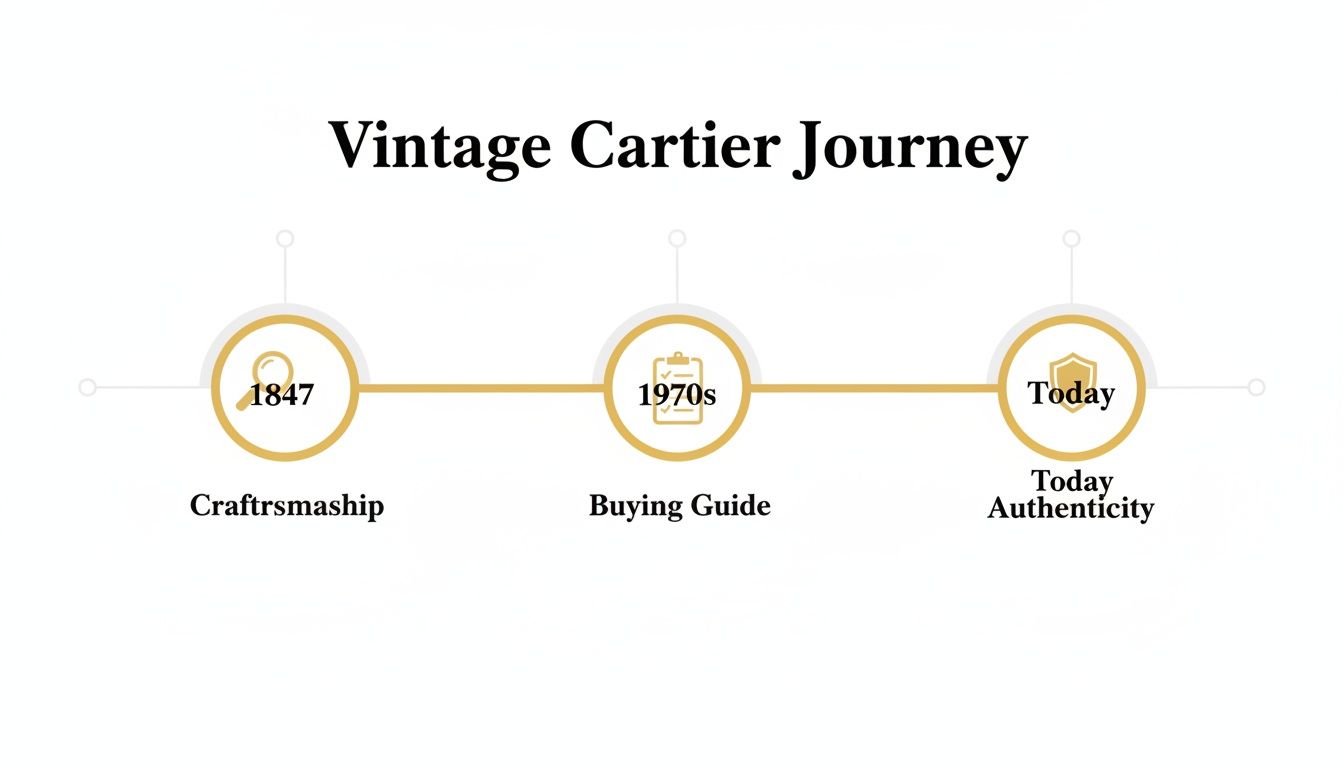
As you can see, buying a vintage Cartier is more than a simple transaction. It's an educated journey where each step builds on the last, leading to a purchase you can be truly proud of.
The Swiss Transformation of the 1970s
The 1970s shook things up for Cartier. The "quartz crisis" was threatening to make traditional watchmaking obsolete, but Cartier didn't just survive; it thrived. They made a brilliant move, partnering with the Swiss movement maker Ebel. This alliance was a game-changer. It allowed them to scale up production without sacrificing an ounce of quality, cementing Cartier's place as a serious force in Swiss horology.
This partnership gave us the legendary Louis Cartier Collection in 1973. It was a lineup of a dozen new models, all dripping with Cartier's signature style:
- Precious Metals: Every case was crafted from solid gold.
- Signature Dials: You'd find those classic crisp white enamel dials with bold black Roman numerals.
- Elegant Hands: The blue "epée" (sword-shaped) hands became an instant hallmark.
- Swiss Movements: Ticking inside were reliable manual-wind calibers from ETA.
This collection masterfully fused Cartier’s Parisian soul with a precise Swiss heart. The watches were not just beautiful; they were built to last.
The Collector-Focused 1990s and Beyond
Fast forward to the 1990s, which brought us another landmark chapter: the Collection Privée Cartier Paris (CPCP). This wasn't just a new line of watches; it was a love letter to Cartier's mechanical roots, created specifically for people who knew and loved fine watchmaking. The CPCP brought back historic designs and powered them with top-tier mechanical movements from giants like Piaget, Jaeger-LeCoultre, and even Audemars Piguet.
Owning a CPCP watch says something. It shows you appreciate not just Cartier's timeless design, but the intricate art of mechanical watchmaking itself. With their limited production runs and superior movements, these pieces are highly coveted for good reason.
You can spot a CPCP piece by the word "Paris" printed on the dial, right under the Cartier name. This series cemented Cartier's reputation among serious collectors and remains a hot ticket today. Getting to know these golden eras—from the almost unobtainable pre-1970s models to the Swiss-powered '70s icons and the mechanically brilliant CPCP—is the first, most important step in finding the right vintage Cartier for you.
Identifying the Most Iconic Vintage Cartier Models
Diving into the world of vintage Cartier is a bit like walking through an art gallery. Each watch isn't just a timepiece; it's a piece of design history, telling a unique story of innovation and style. To really get it, you have to look past the famous name on the dial and learn the distinct personality of each model. This is where you start to develop a true collector’s eye, picking up on the subtle details that define Cartier’s most legendary creations.
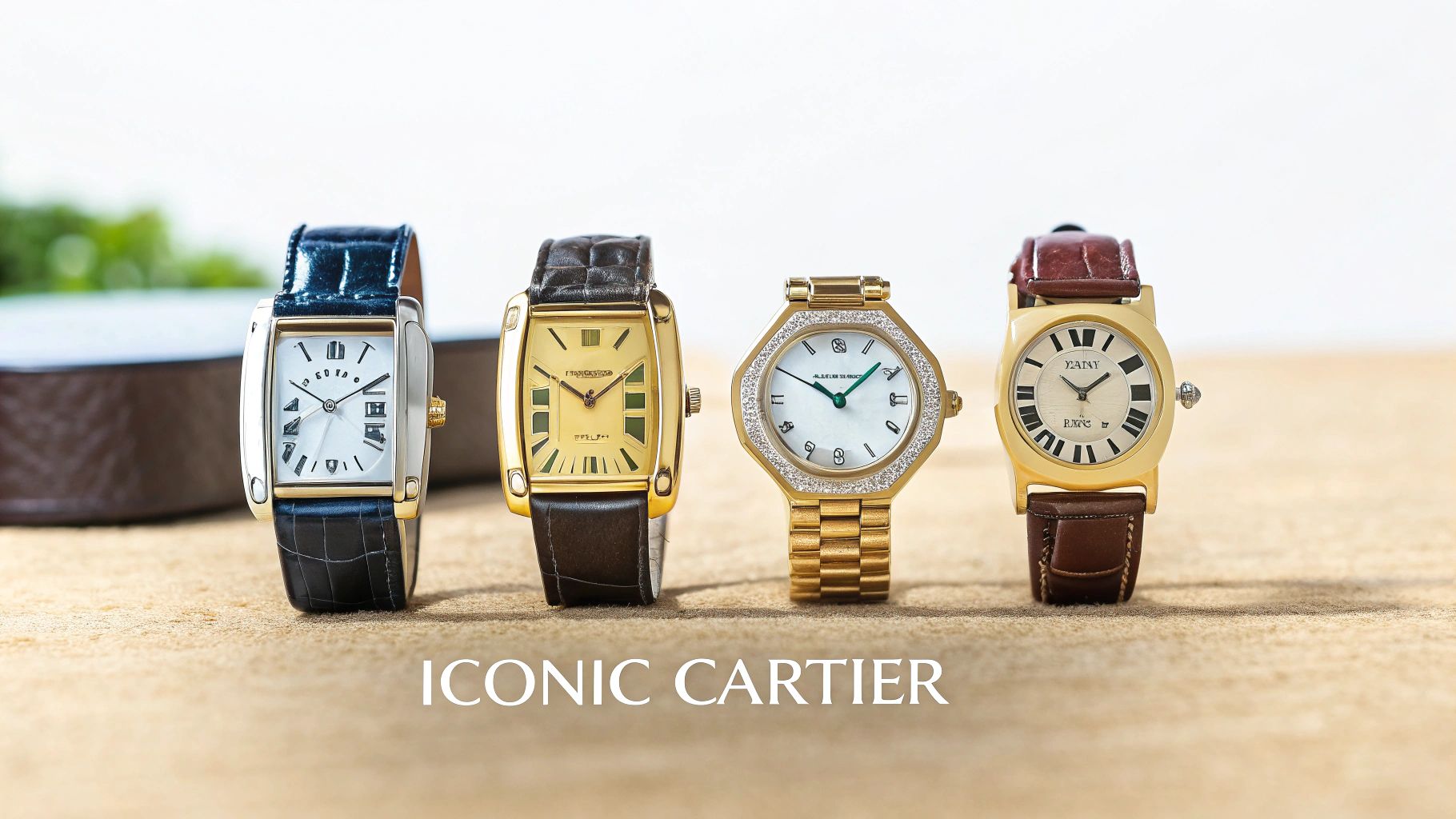
Let's walk through the icons every enthusiast should know, from their fascinating origins to the design signatures that make them instantly recognizable.
The Timeless Cartier Tank
You can't talk about Cartier without starting with the Tank. It's the cornerstone. When it debuted in 1917, its rectangular case—supposedly inspired by the top-down view of WWI tanks—completely broke the mold of round pocket watches. It’s not just a single watch, but a whole family of designs, each with its own distinct feel.
- Tank Normale: This is the original, the blueprint. It's defined by a sharp, flat, and perfectly proportioned case that set the architectural standard for every Tank that came after.
- Tank Louis Cartier: Introduced in 1922, this is the more refined, elegant version. The corners are softer, the lines are a bit more rounded—it’s the embodiment of classic, understated luxury.
- Tank Cintrée: The name means "curved" in French, and that’s exactly what it is. The Cintrée is long, incredibly slender, and dramatically arched to wrap around the wrist. It’s a bold, artistic statement and one of the most sought-after vintage models out there.
The real genius of the Tank is its purity. The design is so clean and perfect that it has stayed basically the same for over a century. That's why for many, it's the quintessential dress watch, looking just as right on the red carpet as it does in the boardroom. If you're curious, you can see just how much Cartier continues to dominate celebrity style by exploring the brand's presence at modern events.
The 1970s really changed the game for Cartier. The brand evolved from a boutique jeweler into a serious watchmaking force. Through a partnership with Ebel in Switzerland, production scaled up, though they kept the high-craftsmanship Paris pieces in limited runs. In 1973, they launched the ambitious Louis Cartier Collection with 12 new gold-cased models, all featuring those classic white enamel dials, Roman numerals, and reliable manual-wind ETA calibers. The Tank Louis (ref. 78086) was the star, with an estimated 15,000 pieces produced, making it one of the more common—yet still highly desirable—models from this era.
Key Vintage Cartier Model Characteristics
To help you get a handle on the main players, this table breaks down the defining features and eras of the most popular vintage models. It’s a quick reference for spotting the differences at a glance.
| Model Name | Defining Feature | Key Production Era | Collector's Note |
|---|---|---|---|
| Tank Normale | The original sharp, flat, rectangular case. | 1917 - 1920s | The ur-Tank. Extremely rare and historically significant. |
| Tank Louis Cartier | Softer, rounded corners on the case brancards. | 1922 - Present | The quintessential classic dress watch. 1970s models are a great entry point. |
| Tank Cintrée | Long, slender, and dramatically curved case. | 1921 - Present | An elegant and highly sought-after model, known for its wrist-hugging form. |
| Baignoire | Graceful, elongated oval "bathtub" shape. | Late 1950s - Present | Embodies Cartier's softer, more feminine design language. |
| Crash | A surreal, distorted, "melted" case shape. | 1967 - Present (in very limited runs) | The holy grail for many. A true piece of avant-garde art with a legendary story. |
| Coussin 'Bamboo' | Square case with a unique, ribbed "bamboo" bezel. | Early 1970s | A deep cut. Its rarity and distinct '70s vibe make it a serious collector's piece. |
This isn't an exhaustive list, of course, but knowing these models inside and out is the foundation for understanding Cartier's vintage catalog. Each has a story that contributes to the brand's legendary status.
Elegant and Unconventional Shapes
While the Tank is a masterclass in clean geometry, Cartier’s other icons show the maison was never afraid to play with form. These models reveal a more whimsical, artistic side of the brand's identity.
"Cartier is not just a watchmaker; it's a sculptor of time. The Baignoire and the Crash are perfect examples of how the brand turns functional objects into pure, wearable art."
Take the Baignoire. The name means "bathtub," and it perfectly captures the elegance of its design. Introduced in the late 1950s, its graceful, elongated oval shape is distinctly feminine and sophisticated. It’s a beautiful example of Cartier's skill in creating soft, organic forms that are just as compelling as their geometric ones.
And then there's the legendary Cartier Crash. Born in the swinging '60s in London, its distorted, surrealist case looks like a watch that literally melted. The story goes that the design was inspired by a Baignoire that was mangled in a car crash. Whether that’s true or just great marketing, the Crash is Cartier at its most avant-garde—a rare and wildly prized piece of horological art.
The Collector's Deep Cut: The Coussin 'Bamboo'
Beyond the big names, there are rarer models that signal a deeper, more specialized knowledge of the brand. The Coussin 'Bamboo' is a perfect example.
Part of that pivotal 1970s Louis Cartier Collection, this square-cased watch has a totally unique ribbed bezel that gives it an incredible texture and presence on the wrist. With an estimated production of just 250 examples, the Coussin 'Bamboo' is a true collector's item. Its scarcity, combined with a bold aesthetic that screams 1970s, makes it a prime target for enthusiasts looking for a vintage Cartier that truly stands out. Spotting a watch like this is what separates a casual buyer from a true connoisseur.
How to Authentate a Vintage Cartier Watch
Knowing how to authenticate a vintage Cartier isn't just a skill; it's your most important line of defense as a buyer. Think of it like a detective examining a crime scene—every tiny detail tells a story, and the clues are all there if you know where to look. With fakes getting scarily good, spotting these tell-tale signs is absolutely non-negotiable.
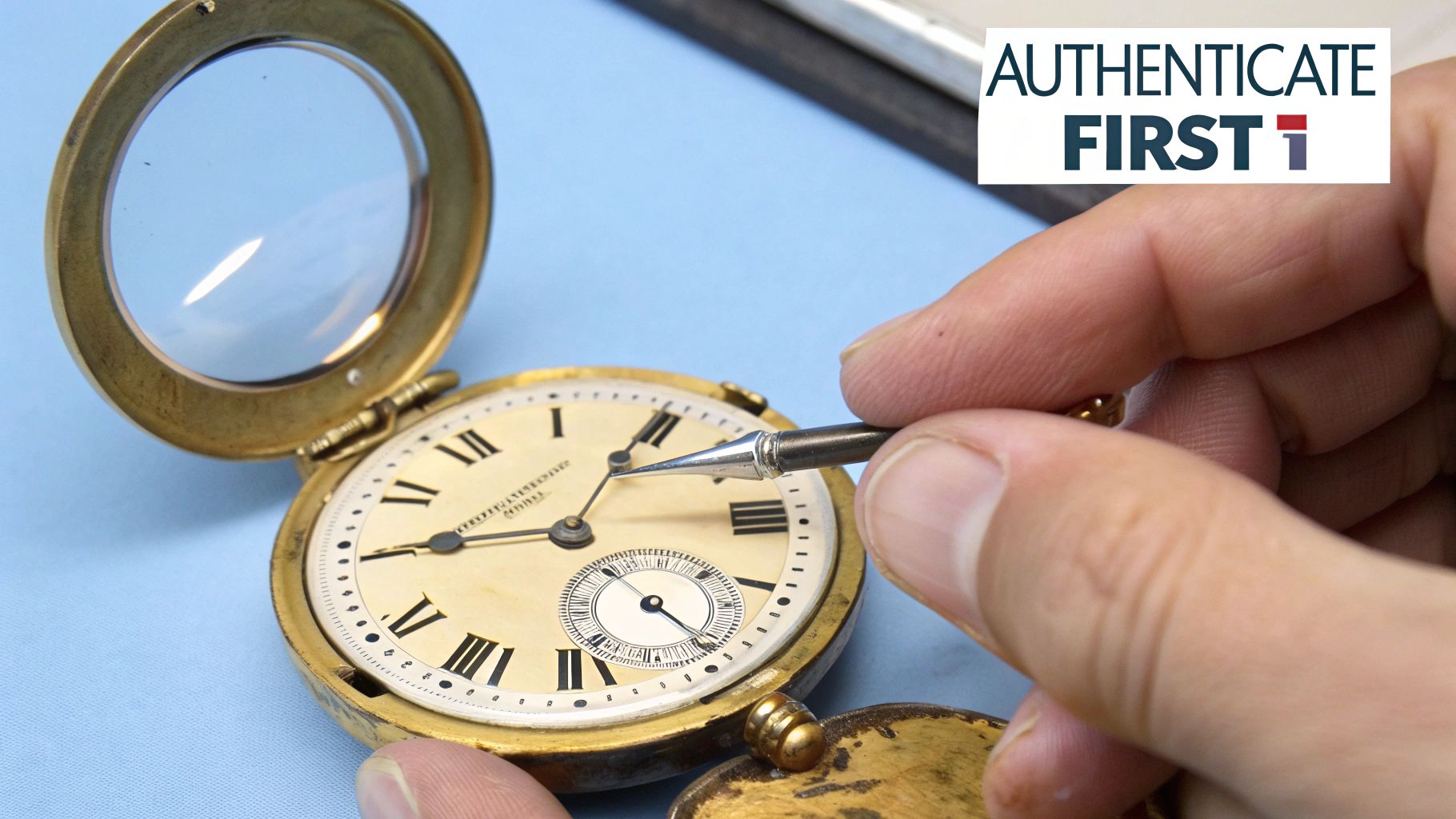
But this process goes beyond just sniffing out a counterfeit. It's about confirming originality. A watch can be made of genuine Cartier parts but be a "Frankenwatch"—a mashup of components from different eras that decimates its value. The dial, case, and movement are all pieces of a puzzle that must fit together perfectly to tell a coherent, authentic story.
Scrutinizing the Dial Details
The dial is the face of the watch, and it’s usually the first place a fake gives itself away. A real vintage Cartier dial has a certain artistic quality that’s incredibly hard to get right. Look closely at the Roman numerals. They should be crisp, finely printed, and perfectly proportioned. If you see sloppy, thick, or uneven printing, that's a huge red flag.
Then there’s the famous Cartier "secret signature." Starting in the 1970s, Cartier began hiding its name within one of the Roman numerals, usually the 'VII' or 'X'. This micro-printing is so fine you'll likely need a loupe to see it clearly. You can learn more about these Cartier secret inscriptions and why they started doing this. On a post-1970s model, if that signature is missing, blurry, or just looks poorly done, walk away.
Examining the Caseback Engravings
Now, flip the watch over. The caseback is where the watch’s identity is etched in metal. On a vintage Cartier, these engravings should be deep, sharp, and precise. Fakes often have shallow, laser-etched markings that feel flat and lack the satisfying depth of the original factory work.
You need to check for a few key markings:
- Serial Number: This is the watch's unique ID.
- Reference Number: The model number, which must match the watch you're looking at.
- Hallmarks: These are small stamps indicating the precious metal, like 18k or 750 for gold.
These numbers need to be consistent and crystal clear. Any sign of tampering, such as engravings that have been softened by over-polishing or numbers that don't match up, is a serious problem. Think of these engravings as the watch’s fingerprint—they have to be flawless.
"Every detail on a vintage Cartier, from the sharpness of an engraving to the specific blue of its hands, is a testament to its authenticity. A trusted dealer's job is to meticulously verify every single one of these fingerprints, because a collector's confidence depends on it."
This multi-point inspection is exactly why buying from a specialist is so critical. Here at Perpetual Time, every single watch goes through a painstaking review to confirm its serial numbers, hallmarks, and other markings are period-correct and legitimate. It’s the only way to ensure you’re buying a genuine piece of history.
Understanding the Movement Inside
The movement is the heart of the watch. For a vintage Cartier, it tells a fascinating story of collaboration. Unlike many brands today that make everything in-house, Cartier historically sourced its mechanical hearts from some of the best watchmakers in Switzerland. Understanding this history is a vital part of authentication.
Depending on the era, you should expect to find a movement signed by one of these prestigious makers:
- European Watch & Clock Co. (EWC): A joint venture between Cartier and Jaeger-LeCoultre, EWC movements powered many of the most sought-after pre-1970s models.
- Jaeger-LeCoultre: Even outside the EWC partnership, JLC was a go-to supplier for Cartier's high-quality movements.
- Piaget: Famous for their incredibly thin movements, Piaget was the engine behind many of Cartier's most elegant dress watches.
- ETA: In the 1970s, you'll often find reliable Swiss-made ETA movements in collections like the Louis Cartier line.
The key is that the movement inside must match the model and production year. A mismatched movement is an instant deal-breaker, a sure sign of a watch cobbled together from spare parts. An expert can pop open the caseback, identify the caliber, check its finishing, and confirm it’s the correct, period-appropriate engine for that timepiece. This deep level of verification is the only way to guarantee you’re getting a genuine, historically correct, and valuable vintage Cartier.
Gauging the Condition and Value of a Vintage Watch
So you’ve confirmed the vintage Cartier you’re eyeing is authentic. Great. Now comes the real art of collecting: sizing up its condition. This is where the game is won or lost, as two watches that look identical at first glance can be worlds apart in value.
Think of it like buying a classic car. It’s not enough that it’s the right make and model. How well it has been preserved over the decades is what truly sets its price.
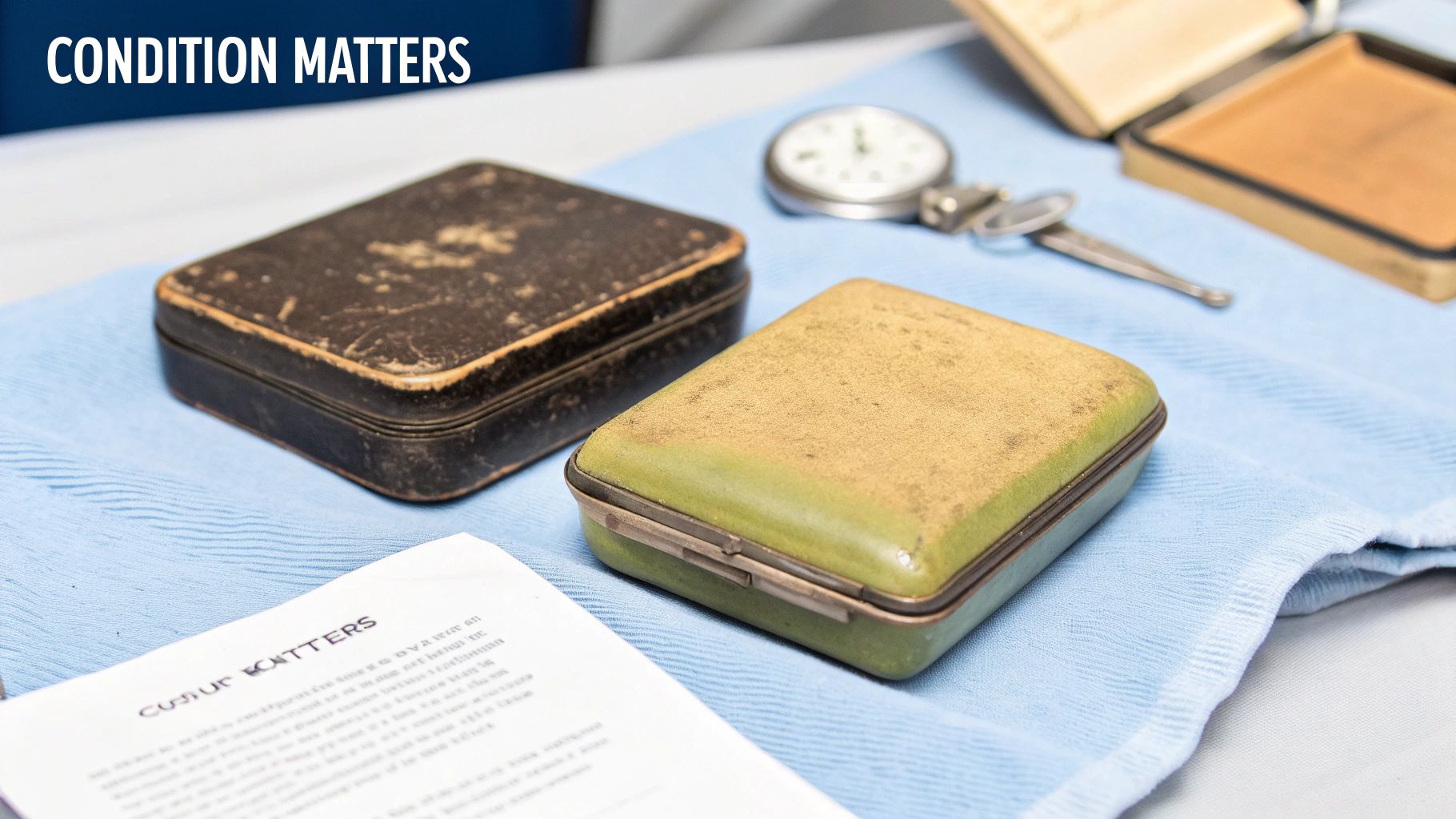
This process is about more than just spotting a few scratches on the crystal. It's a careful inspection of the watch’s originality, its patina, and the subtle story told by its every surface. Getting this right is the key to a smart purchase and a piece you’ll be proud to own for years to come.
Originality and Unpolished Cases Are King
In the vintage watch world, one word rules them all: originality. For a serious collector, this is non-negotiable. It means that every single component—from the dial and hands to the crown and crystal—is the very same one that left the Cartier workshop all those years ago. A watch with all its original parts is a true time capsule, and that's where the real value lies.
A hot-button issue is always case polishing. A light touch-up might seem harmless, but heavy-handed polishing is a cardinal sin. It literally grinds away the metal, melting the sharp, elegant lines and crisp angles that are the soul of a Cartier design. An unpolished case, even with some honest wear and tear, keeps its factory-intended shape and is always the more valuable find.
Patina vs. Damage: Knowing the Difference
As a watch ages, its dial can develop a beautiful, even coloration called patina. Maybe a once-bright white dial has turned a warm, creamy color. To an enthusiast, this isn't a flaw—it's character. It's the visual proof of a life lived, a unique fingerprint that can never be faked.
But you have to learn to separate this desirable aging from outright damage. Here’s what to run from:
- Water Damage: Any signs of stains, spots, or bubbling on the dial.
- Cracking: Visible fissures or spiderweb-like cracks in the lacquer or enamel.
- Redials: A dial that has been crudely repainted. They often look too pristine for their age and almost always lack the "secret signature."
A watch with a clean, original dial showing honest patina will always be more sought-after than one with a damaged or clumsily restored face. The goal is always a well-preserved original.
The Power of Provenance and a "Full Set"
A watch's backstory, or provenance, can send its value soaring. This could be anything from old service papers to documentation proving it belonged to someone notable. These details anchor the watch to a specific moment in history, giving it a soul and a story that collectors crave.
This brings us to the holy grail: the "full set." This is a watch that comes complete with its original box and paperwork. Finding a vintage piece with these accessories is the gold standard and can easily add 20-30% or more to its value. They offer an extra layer of confidence about the watch's origins and make for a far more complete collector's item. To dig deeper, check out our guide on the finer points of buying used luxury watches.
The magic of vintage Cartier often lies in its limited production, which creates true investment-grade pieces. Take the Collection Privée Cartier Paris (CPCP) Tanks from the 1990s. Many of these were made in batches of just 100. A pristine example with solid provenance can sell for 20-50% above the market average, making a well-vetted vintage piece a very smart buy.
Thinking about a vintage Cartier as more than just a watch makes sense when you compare it to other alternative assets. Understanding the dynamics of art as an investment, for instance, can offer great perspective on how rarity and condition drive value in any collectibles market.
Finding and Buying Your Perfect Vintage Timepiece
You've done the homework. You know the history, you can spot the iconic models, and you understand what goes into a proper authentication and condition check. This knowledge is your foundation for making a smart, secure purchase.Now it's time to put that knowledge to work. The single most important decision you'll make from here on out is where you buy. Choosing between a random private seller and a trusted, established dealer is really a choice between risk and assurance. A reputable partner provides the safety net every buyer needs.
The Value of a Trusted Partner
Working with a specialist like Perpetual Time takes the anxiety and guesswork completely out of the equation. We aren't a marketplace simply connecting buyers and sellers; every vintage Cartier watch we sell is part of our own inventory. This means we have total control over the quality and authenticity of every single piece.
Here’s what that really means for you:
- Rigorous Inspections: Before any watch is listed, it goes through a multi-point evaluation. We meticulously check its movement, case, dial, and overall originality.
- Transparent Reporting: What you see is exactly what you get. We provide detailed condition reports and high-resolution photos of the actual watch, never stock images.
- Guaranteed Authenticity: Our entire reputation is built on the promise that every watch is genuine, period-correct, and precisely as described.
Your purchase should be an exciting moment, not a leap of faith. A good dealer does all the heavy lifting and due diligence so you can simply enjoy the experience of owning a piece of history.
This approach gives you a secure framework for your investment. If you'd like to dive deeper into our process, you can read our guide on what makes a certified pre-owned Cartier a smart choice.
Once you've found that perfect watch, keeping good records is essential, especially as your collection grows. You might want to explore specialized watch collection inventory systems to help manage your acquisitions. Whether you're ready to start browsing or just want to talk to an expert, your journey to owning a vintage Cartier begins here.
Your Vintage Cartier Questions, Answered
Stepping into the world of vintage watches is exciting, but it naturally comes with a lot of questions. When you're considering a piece as special as a Cartier, you want to be sure you're making the right move. Here are some of the most common questions we get from collectors, with answers straight from our experience.
Is a Vintage Cartier Watch a Good Investment?
The short answer is yes, a vintage Cartier can be a fantastic investment. But it’s not a simple yes or no. The real value lies in the details.
Models from Cartier’s early days, especially from the pre-1970s era when production numbers were tiny, have seen incredible appreciation. Think about it: you have iconic design, the power of the Cartier name, and true rarity all wrapped up in one watch. That’s a combination that keeps collectors coming back, which drives demand and value.
Of course, not all vintage Cartiers are created equal. The investment potential is completely tied to its authenticity, condition, and originality. A watch with a crisp, unpolished case and its factory-original dial is in a different league entirely. To make a smart investment, you absolutely have to buy from a source that has done the hard work of verifying every single component.
What Do "Box and Papers" Mean, and Do They Really Matter?
You'll hear "box and papers" all the time in the watch world. It simply refers to the original packaging and official documents the watch came with when it was sold new—the warranty card, certificates, and maybe even the original receipt. For a vintage Cartier, having this full package is a massive bonus.
We've seen a "full set" increase a vintage watch's value by 20-30%, sometimes even more. The papers are a form of provenance; they help anchor the watch to a specific time and place, which is exactly what collectors love.
While a great watch is still a great watch without them, finding one with its complete original set is the collector's ideal.
How Should I Care for My Vintage Cartier Watch?
A vintage Cartier needs a little more TLC than a modern timepiece. It’s a piece of history, and treating it with respect is key to preserving its beauty and function for years to come.
Here are a few ground rules we always share:
- Water is the Enemy: Assume your vintage watch has zero water resistance. Modern seals and gaskets just weren't a thing, so keep it dry to protect the delicate dial and movement.
- Watch Out for Magnets: We're surrounded by magnets in laptops, speakers, and phones. A strong magnetic field can throw off the timing of a mechanical movement, so be mindful of where you set your watch down.
- Wind with Care: If you have a manual-wind model, make it a gentle daily ritual. Wind it slowly until you feel a bit of resistance, and then stop. Never force it.
Beyond that, regular servicing is non-negotiable. We recommend a full movement service every 5-7 years from a watchmaker who genuinely specializes in vintage pieces. They’ll have the knowledge and, crucially, the right touch for parts that are often impossible to replace.
What Are the Biggest Red Flags When Buying?
Learning to spot the red flags is probably the most important skill you can develop. The number one rule? If a deal looks too good to be true, it is. Every time.
Beyond that, train your eye to look for these warning signs:
- A "Redial": The dial looks too perfect, too white, or too new for a watch that's decades old. This often means it has been repainted, which collectors frown upon.
- Over-polishing: The case edges look soft and rounded instead of sharp and defined. Aggressive polishing wears away the original shape of the watch.
- Poor Engravings: The engravings on the caseback seem blurry, shallow, or just off. Cartier's markings are famously crisp and precise.
- Vague Sellers: Be wary of anyone using stock photos or giving evasive answers about the watch's service history or provenance.
The easiest way to sidestep these issues is to work with a reputable dealer. A trusted expert will give you detailed condition reports, high-resolution photos of the actual watch for sale, and an ironclad guarantee of authenticity. It takes the guesswork completely out of the equation.
At Perpetual Time, our entire reputation is built on trust and transparency. Explore our curated collection of authenticated vintage timepieces and find your perfect piece with complete confidence. https://perpetualtime.com


