
Cart
0

A vintage Rolex is far more than just an old watch. It's a tangible piece of history, defined by the materials, manufacturing quirks, and unique signs of aging that tell the story of its era. Generally, we're talking about watches produced before the 1980s, which feature charming characteristics like acrylic crystals and tritium lume that you just won't find on their modern cousins.
What Makes a Rolex Watch Truly Vintage
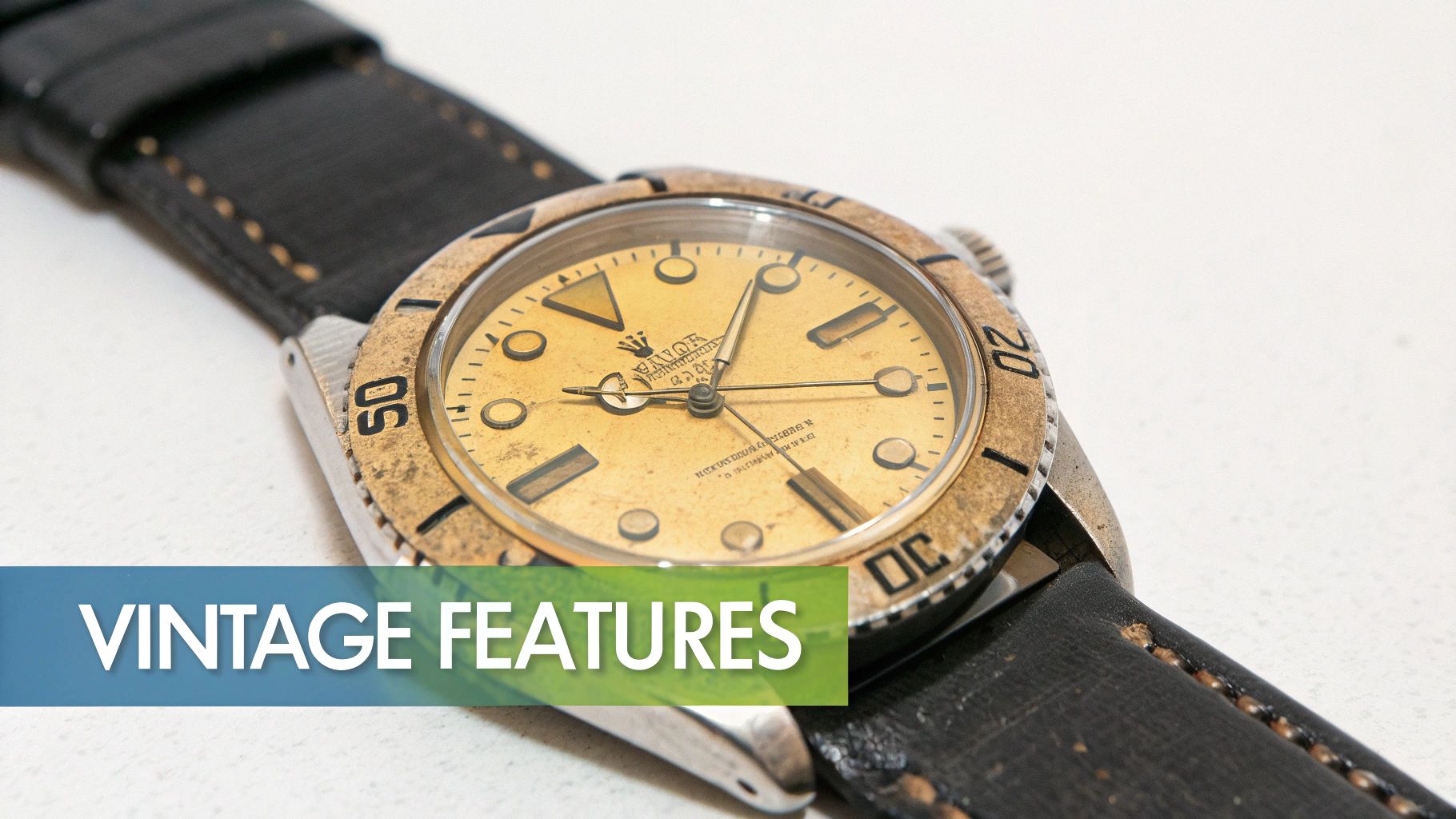
In the world of watch collecting, "vintage" isn't just a synonym for "old." It points to a distinct chapter in watchmaking, a time when these timepieces were purpose-built tools, crafted with materials and techniques that have long since been updated. Getting to know these differences is the first real step in understanding what makes these watches so special.
Think of it like comparing a classic car from the 1960s to a brand-new model. The new car is flawless, packed with technology, and reliable. But the classic has soul. It has mechanical quirks you learn to love, a distinct smell, and a design that screams of its time. The exact same holds true for a vintage Rolex. Its charm and a huge part of its value come from its originality and history, not from looking like it just left the factory.
The Defining Characteristics
So, what are the specific traits that give a vintage Rolex its unique personality? The differences are often subtle, but to a collector, they’re everything. These details are the fingerprints of a bygone era of Rolex manufacturing.
A few of the most important tells include:
- Acrylic Crystals: Long before scratch-resistant sapphire became standard, Rolex used domed acrylic (often called Plexiglas) crystals. They have a distinct warmth and create a beautiful distortion around the edge of the dial that collectors absolutely love.
- Matte and Gilt Dials: Modern Rolex watches have glossy, lacquered dials with applied white gold markers. Go back a few decades, and you’ll find gorgeous matte black dials with painted luminous plots or even earlier "gilt" dials, where the text is printed in a shimmering gold leaf.
- Tritium Lume: Before 1998, the glow-in-the-dark material on the hands and hour markers was tritium. Over the decades, this mildly radioactive compound ages, developing a unique patina that can range from a light cream to a deep, warm pumpkin orange.
- Hollow-Link Bracelets: Bracelets on older models feel completely different. They were often made with folded or hollow links, making them much lighter and giving them a signature rattle that is worlds away from the solid, heavy-milled construction of today.
A vintage Rolex is a tangible connection to a different era of craftsmanship. Each faded bezel, creamy lume plot, and scuffed acrylic crystal is a testament to its history and a mark of its authenticity.
Vintage vs Modern Rolex at a Glance
To make these distinctions crystal clear, it helps to see them side-by-side. The table below breaks down the key philosophical and material differences between a classic vintage Rolex and its modern equivalent.
| Attribute | Vintage Rolex (Pre-1980s) | Modern Rolex (Post-1980s) |
|---|---|---|
| Crystal | Domed acrylic (Plexiglas) | Flat, scratch-resistant sapphire |
| Lume | Tritium (ages to a patina) | Super-LumiNova/Chromalight (ages minimally) |
| Bezel Insert | Aluminum (fades over time) | Ceramic (Cerachrom) (fade-proof) |
| Bracelet | Hollow or folded links, stamped clasp | Solid links, milled clasp |
| Case | Thinner lugs, smaller proportions | Thicker "Maxi" case, more robust build |
| Dial Finish | Matte, gilt, or radial finishes | Glossy, lacquered finishes |
| Aesthetic | Tool-watch focus, signs of aging are prized | Luxury focus, designed for perfection |
Understanding these points is the key to appreciating why two watches that look similar at a glance can have vastly different values and appeal to entirely different collectors.
More Than Just a Timepiece
Collecting vintage Rolex is really about learning to embrace the story told by these imperfections. That subtle fade on a Submariner's bezel from inky black to a "ghost" gray isn't damage—it's a badge of honor. The even, creamy aging across all the tritium markers on a GMT-Master isn't a flaw; it's the visual proof of a life well-lived.
This mindset is everything. While a modern watch is judged on its perfection, a vintage piece is celebrated for its character. This foundational knowledge helps you speak the language of collectors and truly understand what makes these watches so coveted. As you dive deeper and explore things like the Rolex Oyster case evolution, you'll gain an even greater respect for these incredible historical artifacts.
Iconic Vintage Rolex Models Every Collector Knows
When you first dip your toes into the world of vintage Rolex, you'll quickly realize it's a bit like walking into a hall of fame. While there are hundreds of references to discover, a few titans stand out—watches that were true tools for pioneers of the skies, the deep seas, and the racetrack. Getting to know these icons is the first real step to understanding what makes vintage Rolex so special.
Each of these timepieces tells a story. They weren't just made to look good; they were designed for a specific job, and their features are a direct reflection of that purpose. As you learn their histories and the lingo collectors use, you start to see them less as just watches and more as historical artifacts you can wear on your wrist.
The Submariner Ref. 5513: The Definitive Dive Watch
Ask someone to picture a classic vintage Rolex watch, and odds are they're imagining something that looks a lot like the Submariner Ref. 5513. This watch had an incredible production run, spanning from 1962 all the way to 1989, and it’s arguably the most pure "tool watch" Rolex ever built. It was a no-nonsense, time-only diver, designed for one thing: to be tough and easy to read deep underwater.
For collectors, the 5513 is an absolute playground. Its long life means it’s full of subtle variations that get enthusiasts excited. Early examples had what we call "gilt" dials, where the text was printed in a glossy, almost golden font. Later on, they switched to the matte black dial with stark white text that became the industry standard. Its beauty is in its simplicity—it’s the dive watch, boiled down to its very essence.
The Daytona "Paul Newman" Ref. 6239: The Racing Chronograph
You simply can't talk about iconic vintage Rolex without bringing up the Daytona, specifically the legendary "Paul Newman" versions. The reference 6239, introduced in 1963, was one of the very first Daytonas. For years, its quirky "exotic" dial, with an Art Deco-style font and little squares in the subdials, made it the odd one out.
These dials, made by a company called Singer, were actually unpopular for a long time and tended to sit unsold in jewelers' cases. That all changed when the actor and race car driver Paul Newman was famously seen wearing one. The rest, as they say, is history.
The "Paul Newman" Daytona is the ultimate example of how collector taste can turn a watch's fate around. What was once an overlooked design is now one of the most coveted vintage watches on the planet, fetching astronomical prices whenever a good one comes up for auction.
This story teaches a core lesson in vintage collecting: a watch's value is a powerful mix of rarity, history, and the undeniable magic of a great backstory.
The GMT-Master Ref. 1675: The Pilot's Companion
Built for the golden age of jet travel, the GMT-Master Ref. 1675 was Pan Am's answer to a pilot's problem: how to track two time zones at once on long-haul flights. Produced from 1959 to 1980, its most famous feature is the vibrant two-tone bezel insert, affectionately known to collectors as the "Pepsi" bezel. That red and blue design wasn't just for looks; it gave pilots a quick visual cue to distinguish between daytime (red) and nighttime (blue) hours back home.
Just like the Submariner 5513, the 1675 evolved quite a bit over its 21-year run. The earliest models had smaller GMT hands and gilt dials, while later versions got bigger hands for better legibility and the familiar matte dial finish. The aluminum bezel was also famously prone to fading in the sun, creating unique and beautiful "ghost" or pinkish "fuchsia" tones that collectors absolutely love today. This model perfectly captures that blend of rugged function and timeless style that makes this hobby so addictive.
Recognizing these iconic models is a great first step, and for those interested in their financial performance, you can learn more about which Rolex models retain and increase their value in our detailed guide.
How To Spot a Fake and Authenticate a Vintage Rolex
Jumping into the world of vintage Rolex is an incredible experience, but it’s not without its pitfalls. The biggest challenge? Telling the difference between a genuine piece of history and a clever fake or a cobbled-together “Frankenwatch.” Authentication isn't just a quick glance; it's a careful, methodical process of making sure every single part of the watch belongs together. Honing this skill is the best way to protect yourself from a very expensive mistake.
Think of yourself as a detective. You’re looking for clues—the serial number, the font on the dial, the style of the bracelet—and checking to see if they all tell the same, consistent story. A true vintage Rolex is a time capsule, and every component should match its production date. If something feels off, it’s a red flag that demands a closer look.
Start With The Numbers
Your first step, always, is to check the watch's serial and reference numbers. These two sets of digits are like the watch's birth certificate and passport, and they absolutely have to make sense together.
- Reference Number: You'll find this tucked between the lugs at the 12 o'clock position. It tells you the exact model (for example, 1675 for a GMT-Master).
- Serial Number: This is found between the lugs at the 6 o'clock position. This unique number helps you pinpoint the watch's production year or period.
The magic is in cross-referencing these two. Let's say the serial number dates the watch to 1968, but the reference number is for a model that Rolex didn't release until 1975. That’s a massive problem. Pay attention to the engravings themselves, too. They should be sharp, crisp, and clean. Mushy or shallow numbers are a dead giveaway of a counterfeit case.
Scrutinize The Dial and Hands
The dial is the face of the watch, and it’s where many fakes and bad restoration jobs give themselves away. Originality is everything here. You have to look closely at the dial's finish, the quality of the printing on the Rolex logo and text, and how the luminous material was applied.
On a genuine vintage piece, the old tritium lume on the hour markers and hands should have aged together into a matching creamy patina. This is something that only happens over decades. If the hands glow like a torch while the dial markers are dead, you can bet the hands are modern replacements. That kind of mismatch is a huge red flag for a serious collector and kills the watch's value. To learn more about spotting these details, you can read our guide on how to tell if your Rolex is real.
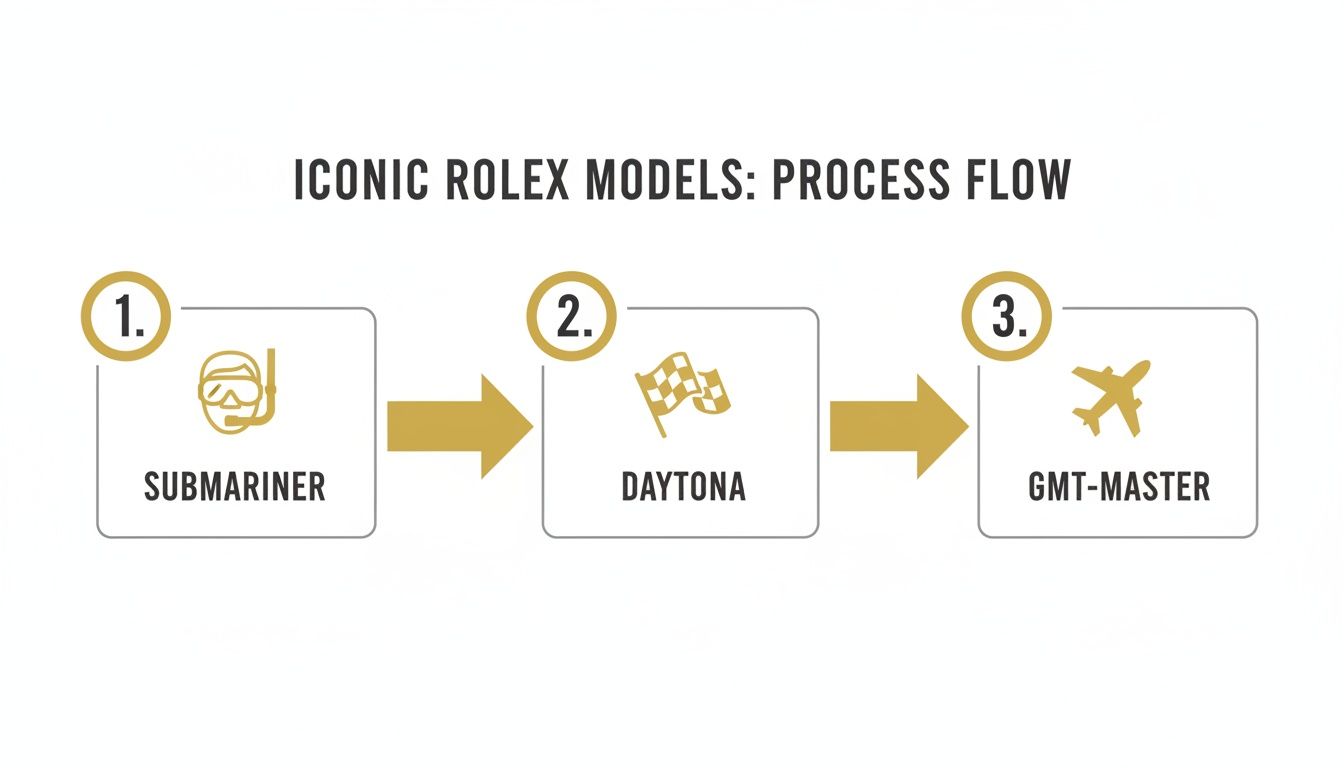
Every model has its own unique quirks that must be correct for its era, from the Submariner's famous dive bezel to the GMT-Master's signature 24-hour hand.
Common Red Flags To Watch For
As you inspect a potential vintage Rolex, keep a running checklist of common issues in your head. Learning to spot these warning signs can be the difference between a great find and a bad investment.
One of the biggest traps for new collectors is the "Frankenwatch"—a timepiece built from a jumble of genuine and aftermarket parts from different models and years. It might have real Rolex parts inside, but it’s not an original, collectible watch.
Here are a few of the most common problems to look out for:
- Over-Polished Case: Take a hard look at the lugs. They should have sharp, defined edges. If they look soft and rounded, it means the case has been polished too aggressively over the years, stripping away metal and ruining its original factory lines.
- Incorrect Replacement Parts: Be wary of modern service replacement dials or hands on an older watch. These parts often use brilliant white Super-LumiNova instead of the old, creamy tritium and have a different finish that just looks wrong on a vintage piece.
- Mismatched Lume: As we mentioned, the lume on the hands and the dial needs to look like it has aged together. Any major difference in color or glow is a clear sign that something has been replaced along the way.
- Stretched Bracelet: Check the bracelet for sag. A little bit of stretch between the links is normal with age, but a bracelet that droops severely is not only uncomfortable but can be very expensive to replace.
For serious collectors, knowing how to photograph jewelry properly can be a huge help, as high-quality, detailed images are essential for verifying a watch remotely. Of course, the surest way to get an authentic vintage Rolex is to work with a trusted dealer like Perpetual Time. Every watch we offer has already passed these rigorous checks before it ever sees our showroom.
Understanding the Investment Potential of Vintage Rolex
It’s one thing to love the history and mechanics of an old watch, but let’s be honest—many of us are also fascinated by the investment side of vintage Rolex. It's a world where tangible assets can do more than just sit in a vault. Unlike a new car or even most modern watches that start losing value the moment you buy them, the right vintage Rolex has proven time and again to be a powerful store of wealth.
This isn't just random luck. It all comes down to the classic economic duo: scarcity and demand. The simple truth is, they aren't making any more of these watches. The supply is fixed forever. Meanwhile, as more people around the world discover the magic of vintage timepieces, the pool of buyers keeps growing. This constant pressure of more people chasing a finite number of great watches naturally pushes their value up over the long haul.
The Key Drivers of Financial Value
Now, this doesn't mean every old Rolex is a golden ticket. Far from it. Think of it like collecting fine art—the specific artist, the era it came from, and its unique story all play a massive role in its value. A watch's potential as a serious investment depends on a special mix of ingredients.
Here’s what truly moves the needle:
- Rarity: This is the big one. If a watch was only made for a short period or in very low numbers—think of certain early "Paul Newman" Daytonas—its value is almost guaranteed to be high. It’s pure supply and demand.
- Historical Significance: Was this model a game-changer? The very first Submariners, for instance, literally set the standard for every dive watch that followed. That kind of historical weight carries a serious premium.
- Exceptional Condition: Originality is everything in the vintage world. A watch that still has its original dial, hands, and bezel, housed in a case that hasn't been over-polished, will always be worth dramatically more than one pieced together with service parts.
- Provenance: This is the story behind the watch. If you can trace its history, especially to a famous owner or a significant event, its value can go through the roof. This is a huge reason why the original box and paperwork add so much to the price tag.
The investment potential of a vintage Rolex lies in its unique ability to be both a store of value and a source of immense personal enjoyment. It’s an asset you can wear and appreciate daily while it potentially grows in worth.
This isn't just collector talk; the numbers back it up. A fascinating data point is the staggering performance of models from the 1960s, which have delivered an incredible 45% five-year annualized return. That blows the 30% return on their modern counterparts out of the water. This is based on real-world results from top auction houses like Christie’s and Phillips, where legendary references consistently hammer for six figures.
A Balanced View on Investing
While the stories of massive returns are exciting, it’s crucial to keep a level head. The market can and does have its ups and downs, and not every vintage piece will perform like a superstar. To get a better sense of the overall landscape, it's worth researching what makes for good investment watches across different brands.
At the end of the day, the best advice is always to buy something you genuinely love. Zero in on the iconic models that speak to you, and find the absolute best example you can afford. That way, you’re guaranteed to own a piece of watchmaking history you’ll treasure for years. Any financial upside is just the cherry on top. To learn more, check out our guide on the factors that influence the resale value of a Rolex watch.
How to Find and Secure Your Vintage Rolex
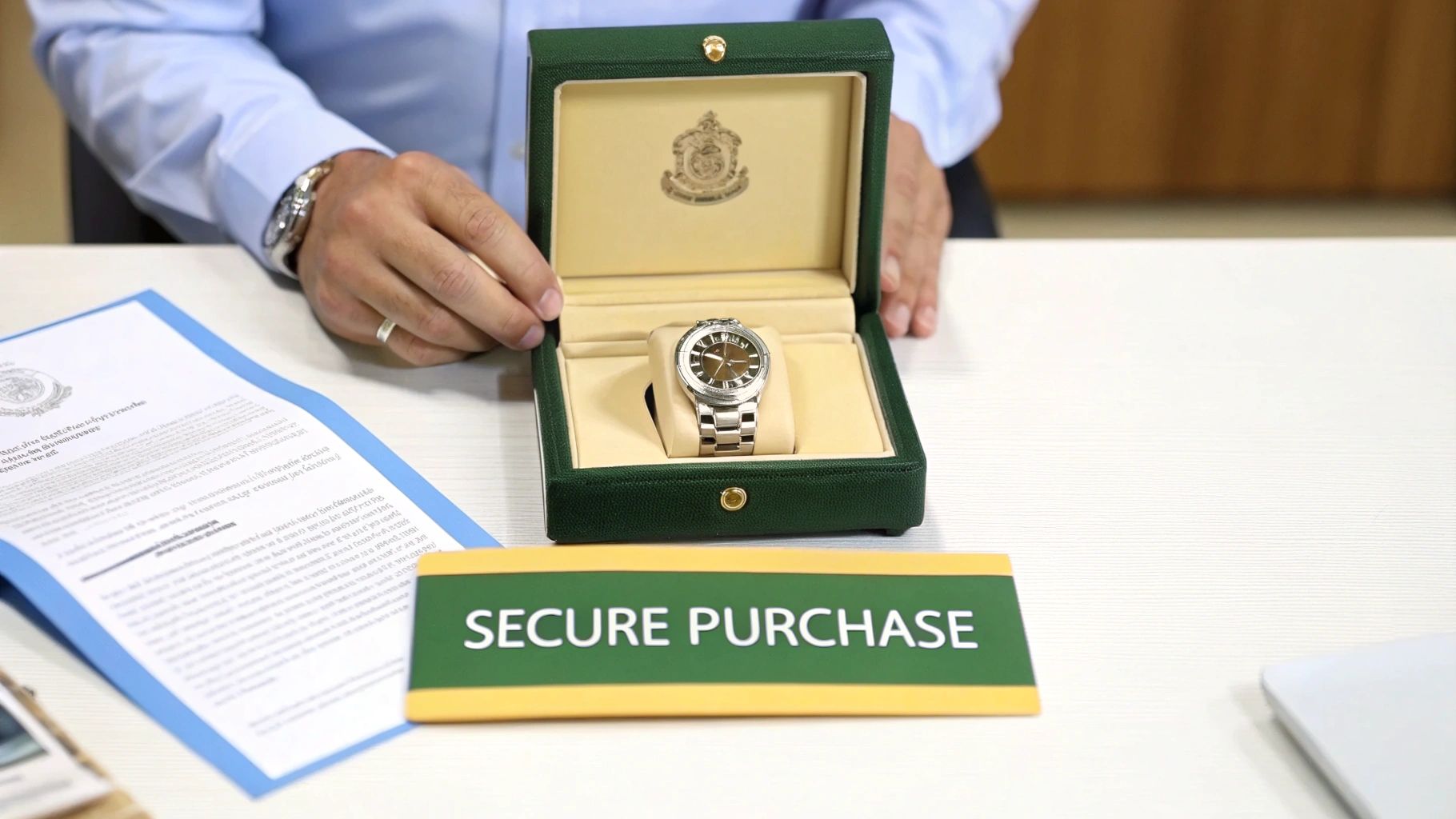
Alright, so you've done your homework and know what you're looking for. The next big question is where to find it. This is where things can get tricky. Navigating the world of vintage Rolex dealers and sellers can feel like walking through a minefield, and the path you choose is just as important as the watch itself. Your peace of mind—and your investment—hangs in the balance.
You'll find these watches everywhere from high-end auction houses and online platforms like eBay to private collectors and specialized dealers. Each route has its own quirks. A private sale might look like a great deal on the surface, but it's easily the riskiest, leaving you completely on your own to verify the watch with almost no way to get your money back if something goes wrong.
The Different Buying Channels
Getting a handle on your options is the first step toward making a purchase you feel good about. Let's break down where most collectors find their next timepiece.
- Auction Houses: This is where you’ll find some of the rarest watches on the planet. The downside? The buyer's premium can easily add 20-25% to the final hammer price, and you’re usually bidding on a watch you've never actually held in your hands.
- Online Marketplaces: The selection is endless, but these sites are swimming with fakes, "Frankenwatches," and pieces that are flat-out misrepresented. The entire burden of authentication falls on you.
- Private Sellers: Buying directly from a fellow enthusiast can be a great experience and can sometimes unearth hidden gems. However, this route demands a high level of trust and personal expertise, and there’s absolutely zero buyer protection.
- Specialized Dealers: This is, by far, the safest bet, especially if you're just getting into vintage collecting. Trusted dealers offer a hand-picked inventory of watches they've already authenticated.
In this market, expertise and trust are everything. It’s interesting—while the prices for modern Rolexes can seem all over the place, vintage models have shown incredible stability. Even as new retail prices jump, many vintage classics can be found for less than their brand-new counterparts, creating a really compelling opportunity for collectors.
The Dealer Advantage: A Safer Path
Choosing a reputable independent dealer who owns their own inventory provides a layer of security that other channels just can't touch. At a place like Perpetual Time, we aren't just a middleman—every single watch we list is our property. That ownership model means we have skin in the game, giving us every reason to guarantee a watch's authenticity and condition.
A trusted dealer's reputation is built on the quality and authenticity of every watch they sell. Their rigorous, multi-point inspection process acts as your first and best line of defense against a bad investment.
Before a vintage Rolex watch ever gets a price tag, it goes through an exhaustive evaluation. This isn't just a quick once-over; it's a deep dive into the watch's mechanical soul and cosmetic history.
Our Verification Process Includes:
- Serial and Reference Number Verification: We check that the numbers are authentic and that all the watch's parts are correct for its specific production era.
- Movement Inspection: Our watchmakers open the case back to verify the movement is genuine, meticulously checking its condition, originality, and function.
- Dial and Bracelet Scrutiny: We inspect every detail for originality, keeping a sharp eye out for any signs of relumed dials, refinished cases, or incorrect replacement parts.
This kind of transparency, backed by insured shipping and expert support, is the most secure way to own a genuine piece of watchmaking history. For more practical advice, check out our guide on how to buy a used Rolex safely.
Your Vintage Rolex Questions, Answered
Even after you've done your homework, stepping into the world of vintage Rolex can feel a little intimidating. There are always a few nagging questions that pop up. Let's tackle some of the most common ones we hear, giving you the clear, straightforward advice you need to collect with confidence.
Can I Actually Wear a Vintage Rolex Every Day?
You absolutely can, but with a bit of common sense. These watches were originally built to be tough-as-nails tools, meant to handle daily life. The thing is, they just don't have the modern bells and whistles like scratch-proof sapphire crystals or the deep-sea water resistance ratings we take for granted today.
So, yes, make it your daily driver! Just be mindful of your environment. Try to avoid hard knocks, skip wearing it for a pickup basketball game, and definitely don't take it swimming unless a trusted watchmaker has just serviced and pressure-tested it. Treat it with a little respect, and a vintage Rolex is one of the most stylish and reliable companions you could ask for.
How Big of a Deal Are the Original Box and Papers?
In the collecting community, they’re a huge deal. Having the "full set," as it's called, can bump up a watch's value by 20-30%, and sometimes much more for a particularly rare reference. The box and papers are the watch's birth certificate—they provide provenance and confirm its story right from the start.
A watch on its own, without the accessories, can be a fantastic and more accessible way to get into the hobby. But for serious collectors and investors, a full set is the holy grail. It’s a crucial piece of the watch's history and desirability.
Any reputable dealer will be completely upfront about what comes with the watch, so you’ll know exactly what you’re getting.
How Often Does My Vintage Rolex Need a Service?
A good rhythm to follow is to get your vintage Rolex serviced every 5 to 7 years. Older movements really do benefit from more frequent attention than their modern cousins. Regular servicing makes sure the lubricating oils haven't dried up and all the gaskets are still doing their job protecting the watch from dust and moisture.
Finding a watchmaker who specializes in vintage Rolex is non-negotiable. They live by the golden rule: preserve originality. A true expert will service the movement meticulously without swapping out original parts or over-polishing the case—two things that can absolutely kill a watch's character and its value.
What's All This Talk About "Patina"?
Patina is just a beautiful word for the natural aging you see on a watch's dial, hands, and hour markers over many decades. Before the late 1990s, Rolex used a luminous material called tritium, which gracefully changes color over time. It can shift from its original bright white to a warm, inviting cream, a rich yellow, or even a deep pumpkin orange.
Collectors go crazy for this honest aging because it's a visible badge of honor, proof of the watch's age and originality. You just can't fake it. Think of patina as the watch's unique fingerprint, telling the story of where it's been and making it a true one-of-a-kind piece.
At Perpetual Time, we live and breathe this stuff. Our whole mission is to connect collectors with authenticated, exceptional timepieces. Ready to find your piece of history? Explore our curated collection of vintage and pre-owned luxury watches today.


