Luxury Watches That Hold Value A Guide to Smart Collecting
It's a common myth that any expensive watch is automatically a good investment. The reality is quite different. Only a small fraction of luxury watches that hold value—or even increase in price—are born from a very specific recipe of heritage, rarity, and world-class craftsmanship. These aren't just gadgets; they're functional pieces of art, engineered to last for generations.
Why Some Luxury Watches Hold Their Value
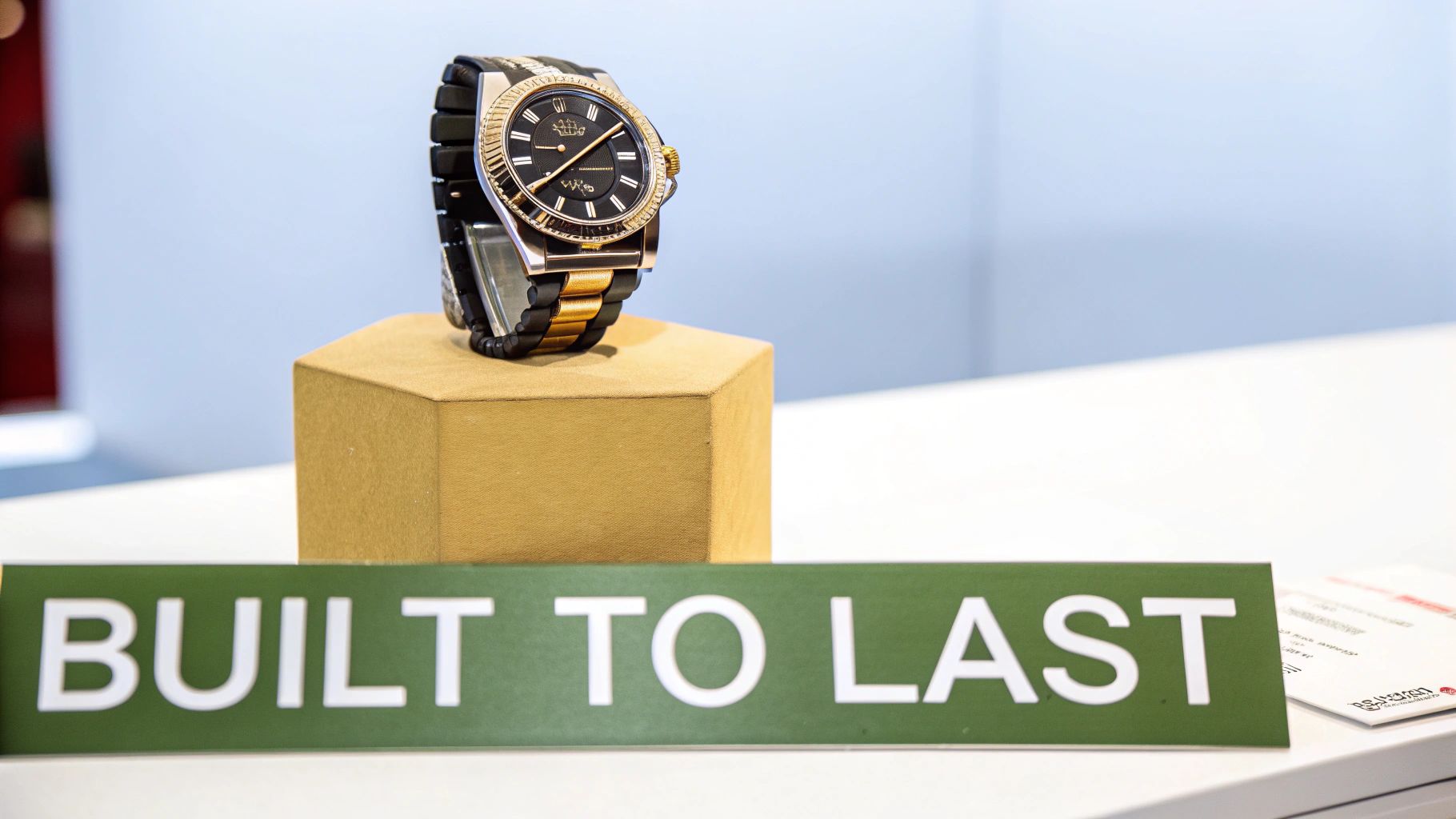
Have you ever wondered why one six-figure watch becomes a collector's dream while another depreciates the second you walk out of the store? It’s not random chance. Certain timepieces are designed from day one to retain their worth, built on a foundation of clear, identifiable factors.
Think of these factors as the four legs of a sturdy table. If even one is wobbly, the entire structure is compromised.
Getting to know these pillars is your first step toward making a truly smart purchase. It’s what separates a casual buyer from an informed collector who can spot real, enduring value when they see it. These are the elements that elevate a simple high-end watch into a genuine, investment-grade asset.
The Four Pillars of Lasting Value
At the core of any watch that holds its own in the market, you'll find four key elements working together. Here's a quick look at what they are and why they matter so much.
The Four Pillars of Watch Value Retention
A quick overview of the essential factors that determine if a luxury watch will appreciate or hold its value over time.
| Pillar | Why It Matters for Value | Brands That Excel |
|---|---|---|
| Legendary Brand Heritage | A long, storied history builds trust and desirability. Collectors are buying into a legacy of innovation, not just a timepiece. | Rolex, Patek Philippe, Vacheron Constantin |
| Calculated Production Scarcity | Watchmakers strategically limit production to keep demand higher than supply. This controlled rarity makes certain models highly sought-after. | Audemars Piguet, F.P. Journe |
| Impeccable Material Quality | From proprietary steel alloys to precious metals and ceramics, the best materials ensure the watch is built to last and function flawlessly for decades. | A. Lange & Söhne, Omega |
| Unwavering Market Demand | Iconic designs, cultural relevance, and a reputation for reliability create a constant desire that keeps resale prices strong and stable. | Rolex, Cartier, Patek Philippe |
These four pillars are the bedrock of value. When a watch ticks all these boxes, it has the potential not just to be a beautiful accessory, but a store of value. You can see this dynamic play out dramatically in the world of high-stakes auctions, which we explore in our deep dive into the auction records set by rare luxury watches.
The Role of Market Leaders
In the luxury watch world, a few names consistently lead the pack in value retention. Rolex, for instance, is famous for models that trade well above their retail price on the secondary market, even when the broader economy is shaky.
While many brands are discounted the moment they're pre-owned, only the "Big Three"—Rolex, Patek Philippe, and Audemars Piguet—routinely defy that trend. This elite status is a testament to their mastery of the four pillars. To learn more, check out these excellent insights on secondary watch market trends on barringtonwatchwinders.com.
A trusted dealer serves as your authenticator, verifying these foundational elements. This ensures you're acquiring not just a timepiece, but a genuine asset with proven potential to hold its value.
This expert verification is absolutely essential. The market is complex, and spotting a true gem requires a trained eye for authenticity, condition, and provenance. That’s why working with a specialist like Perpetual Time offers such crucial peace of mind. We ensure every watch we handle meets the strict criteria that define a sound investment.
Exploring the Brands That Define Value
While a lot goes into a watch's value, the name on the dial is often the most powerful promise of quality, heritage, and long-term desirability. Some brands just carry more weight, a reputation earned over decades—or even centuries—of getting it right. They don't just make timepieces; they create assets.
It's a bit like the art world. Plenty of artists are talented, but only a handful like Picasso or Monet see their work consistently fetch staggering prices. In the watch world, names like Rolex, Patek Philippe, and Audemars Piguet have that same kind of gravity. They’re the cornerstones of any serious conversation about luxury watches that hold value.
Getting to know what makes these giants tick is the first step toward making a smart purchase. Each has its own story, its own playbook for creating enduring demand.
Rolex: The King of Brand Control
When it comes to holding value, no one plays the game better than Rolex. Their success is no accident. It’s the result of a meticulously crafted, century-long strategy built on two pillars: making indestructible "tool watches" and maintaining iron-fisted control over supply and image.
From the Submariner, originally built for deep-sea divers, to the GMT-Master for pilots, Rolex built its legend on timepieces that could handle anything you threw at them. That legacy of pure, unadulterated reliability created a level of trust that you just can't buy.
- Masterful Supply Management: Rolex famously keeps production of its most popular steel sports models tight. This ensures demand consistently outpaces supply, which in turn fuels an incredibly strong secondary market.
- Timeless Design DNA: A Rolex from 50 years ago is instantly recognizable and doesn't look out of place next to a brand-new model. This design consistency means their watches never really go out of style, securing their appeal for generations.
This one-two punch of real-world utility and managed exclusivity makes Rolex a perpetual powerhouse. To dive deeper into what makes these designs so iconic, you can check out our guide on leading luxury watch brands in modern timekeeping.
The Holy Trinity: Patek Philippe and Audemars Piguet
At the absolute summit of watchmaking, you'll often hear three names spoken with a special kind of reverence: Patek Philippe, Audemars Piguet, and Vacheron Constantin. Together, they’re known as the "Holy Trinity," representing the peak of artistry and mechanical genius.
Patek Philippe is, for many, the final word in fine watchmaking. As a family-owned company since 1839, it has an unbroken line of creating some of the most complex and beautifully finished movements ever conceived. Owning a Patek isn't just about having a watch; it's about holding a piece of horological history in your hands.
This reputation for absolute, uncompromising quality means that Patek Philippe models—especially legends like the Nautilus and the Calatrava—are some of the most coveted luxury watches that hold value on both the auction block and the private market.
Standing alongside Rolex and Patek as one of the "Big Three" is Audemars Piguet, a titan of bold design and fearless innovation. The brand turned the watch world upside down in 1972 with the Royal Oak, a stainless steel watch that cost more than most gold ones. That audacious move single-handedly invented the luxury sports watch category and cemented AP's place in pop culture forever.
Other Key Players on the Mount Rushmore of Value
While the Swiss giants tend to grab the headlines, they aren't the only brands crafting investment-worthy timepieces. Others have built their own incredible legacies on unique strengths and an unwavering commitment to quality.
A perfect example is the German powerhouse A. Lange & Söhne. Relaunched in 1990 after the fall of the Berlin Wall, the brand quickly earned a reputation for meticulous engineering and jaw-dropping finishing that many argue surpasses even its top Swiss rivals. Its movements are famous for their three-dimensional architecture and exquisite hand-decoration, making them true works of mechanical art.
These brands prove that retaining value isn't exclusive to one country or one style. It’s born from a deep respect for history, an obsession with quality, and a crystal-clear vision of what makes a watch not just good, but truly timeless.
The Four Factors That Drive a Watch’s Price
While a big brand name sets the stage, the real market value of a watch comes down to a much more specific checklist. Think of it like a classic car. You could have two vintage Porsche 911s from the exact same year, but they could have wildly different price tags. The make and model are just the beginning; the real story is in the details—the mileage, the service history, the originality.
It's the same world with luxury watches. A name like Rolex or Patek Philippe certainly gets you in the door, but four key factors are what ultimately separate a good buy from a great one. Getting a handle on these drivers is what turns a casual buyer into a sharp collector, giving you the ability to spot the subtle details that create real, lasting worth.
These elements are at the heart of how we evaluate every timepiece at Perpetual Time. Learn to see a watch through this lens, and you'll be able to analyze luxury watches that hold value just like a seasoned pro.
Scarcity and Production Numbers
At its core, the luxury watch market runs on the oldest rule in the book: supply and demand. When a watch is tough to find, its value shoots up. This scarcity can be by design, like a numbered limited edition, or it can happen completely by accident.
For instance, a "limited edition" of 500 pieces is an obvious collectible. But some of the most sought-after watches today are what we call "sleepers"—models that were quietly discontinued after only a short time in production. These often fly under the radar for years until collectors suddenly realize just how few are out there, and their value skyrockets.
Condition and Originality
For any serious collector, originality is everything. A watch in good, honest, original condition is almost always worth more than one that’s been polished to death or fixed up with aftermarket parts. This is where the small stuff becomes the big stuff.
- Unpolished Case: Collectors hunt for cases with their original sharp edges and factory finish. Polishing might make a watch look new by removing scratches, but it also strips away metal, softening the watch’s intended lines and tanking its value to a purist.
- Original Dial and Hands: The dial is the face of the watch, and its authenticity is non-negotiable. A dial that has been refinished or replaced can slice a watch's value in half. The same goes for the hands and even the crown.
- Matching Numbers: Checking that the serial and reference numbers are correct for the production period is a crucial step in confirming a watch's authenticity and originality.
A well-kept watch that’s free from major dings, deep gouges, or non-factory alterations will always fetch a higher price. But more than that, originality is the ultimate currency in the collector’s world.
Provenance and Completeness
Provenance is just a fancy word for the watch’s documented history. The gold standard for establishing this is having the original "box and papers." This complete set usually includes the presentation box, the warranty card or certificate, instruction manuals, and maybe even the original hang tags.
Having a full set accomplishes two things. First, it’s a powerful tool for authentication, helping to prove the watch is the real deal and not a "Frankenwatch" cobbled together from different parts. Second, it adds to the story and collectibility of the piece—something people will pay a serious premium for. A watch with its full set can be worth 15-25% more than the very same model without it. We dive deeper into this in our guide to investing in luxury watches.
Materials and Movement
Finally, what a watch is made of—both outside and in—plays a massive role in its value. Sure, precious metals like gold and platinum add intrinsic worth, but the watch's mechanical heart, the movement or "caliber," is often the main event.
An "in-house" movement, one designed and built entirely by the watch brand itself, is a true sign of high-end watchmaking. It shows a level of technical mastery and investment that separates the great brands from the good ones. Collectors prize the craftsmanship and exclusivity of in-house calibers, especially those with complex features (known as complications). These are the elements that ensure a watch isn't just a pretty accessory, but a feat of micro-engineering designed to be passed down for generations.
Iconic Models That Consistently Outperform
It’s one thing to talk theory, but seeing it play out in the real world is where it all clicks. Some timepieces have become absolute legends, not just for their looks or the name on the dial, but because they are perfect examples of every value driver working together in concert. These aren't just popular watches; they are market-defining assets.
When you look closely at these icons, you start to see the formula. They blend brand power, historical weight, intentional scarcity, and timeless design into a potent mix that keeps demand far ahead of supply.
Let's break down a few of these titans to see how they earned their blue-chip status. Each one tells a different story, proving there are multiple paths to the same destination: enduring value and collector desire.
The Rolex Submariner: The Indestructible Benchmark
If you had to pick one watch to define "holding value," the Rolex Submariner would be it. First hitting the scene in 1953 as a tool for professional divers, its reputation for being utterly bulletproof became the stuff of legend. The Submariner is the quintessential "tool watch" that gracefully transitioned into a global status symbol, spotted on everyone from military divers to James Bond.
Its ability to retain value is a masterclass in consistency.
- Unwavering Demand: The Submariner's design is practically a pillar of the watch world. Its classic, do-anything look has barely changed in decades, which keeps it perpetually in style and in demand.
- Brand Powerhouse: As a flagship for Rolex, it rides the wave of the brand's unmatched reputation and meticulous control over production, which keeps the pre-owned market incredibly strong.
The Submariner isn't just a watch; it's the gold standard. For a deeper dive into how this model and others from the brand perform, check out our analysis of the top Rolex models that retain and increase their value.
Patek Philippe Nautilus & Audemars Piguet Royal Oak: The Game Changers
Back in the early 1970s, two watches came along and created an entire category from scratch: the luxury sports watch. Designed by the visionary Gérald Genta, the Audemars Piguet Royal Oak (1972) and the Patek Philippe Nautilus (1976) shattered all the rules. They introduced stainless steel watches as ultra-luxury items, priced higher than many solid gold pieces of the era.
Their incredible value today is fueled by that revolutionary design and extreme scarcity.
These models are textbook examples of how a bold, audacious design—when backed by a "Holy Trinity" brand—can ignite decades of intense collector desire. Their looks are unmistakable; the Royal Oak’s octagonal bezel and the Nautilus’ porthole-shaped case are instant signifiers of watchmaking prestige.
Production numbers for these steel icons are kept incredibly low, creating waitlists that can span years. This bottleneck naturally pushes buyers to the pre-owned market, where prices often climb to double or even triple the retail price, cementing their status as true investment-grade timepieces.
The Omega Speedmaster: A Legacy Written in the Stars
Value isn't always about tight supply control or precious metals. Sometimes, the most powerful asset a watch can have is an incredible story. The Omega Speedmaster Professional, known forever as the "Moonwatch," is the perfect illustration. It cemented its place in history in 1969 as the first watch worn on the Moon.
That one-of-a-kind provenance gives the Speedmaster a special kind of value that simply can't be manufactured or copied. While it's far more accessible than a Nautilus, its historical importance ensures a fiercely loyal following and stable, long-term value. It's a powerful reminder that a watch can become part of a moment much bigger than itself.
A Strategic Guide to Buying and Selling Watches
Diving into the pre-owned watch market is where a collector’s savvy really shines. Whether you're hunting for your first grail watch or parting with a piece that’s been on countless adventures, a smart approach is non-negotiable. It’s the only way to protect your investment and walk away happy.
For buyers, the options can seem endless and a bit daunting. You’ve got private online marketplaces with a massive selection, but they also come with huge risks, from convincing fakes to sellers who vanish after the sale. On the flip side, established dealers offer a peace of mind you just can't get from a peer-to-peer deal.
This is where patience becomes your best friend. Seriously. Rushing a purchase is the fastest way to overpay for a watch or, worse, miss a critical flaw. Take your time, do the homework, and get a feel for the fair market value of the specific reference you’re after.
Smart Strategies for Buyers
When you’re ready to pull the trigger, your number one goal is confidence. You need to be absolutely sure about the watch's authenticity, its true condition, and its price. This is where the path forks: do you go with a private seller or a professional dealer?
A private sale might dangle the carrot of a lower price, but it often comes with hidden—and potentially expensive—risks. There’s no authenticity guarantee, no mechanical warranty, and very little you can do if the watch isn't what you were promised.
- Dealer Authentication: A reputable dealer like Perpetual Time takes all the guesswork out of the equation. Our team performs meticulous, multi-point inspections, checks serial numbers against factory records, and provides a 100% authenticity guarantee.
- Price Transparency: We don't just pull numbers out of thin air. Dealers use current market data, which helps you know you're getting a fair price, not just paying what an emotional seller thinks their watch is worth.
- Condition Reporting: A professional listing gives you the unvarnished truth. You'll get detailed, honest notes on the watch's condition, so you know exactly what to expect—from minor bracelet stretch to whether the original box and papers are included.
This chart shows just how enduring some of these designs are, tracking their evolution from tool-watch roots to modern classics.
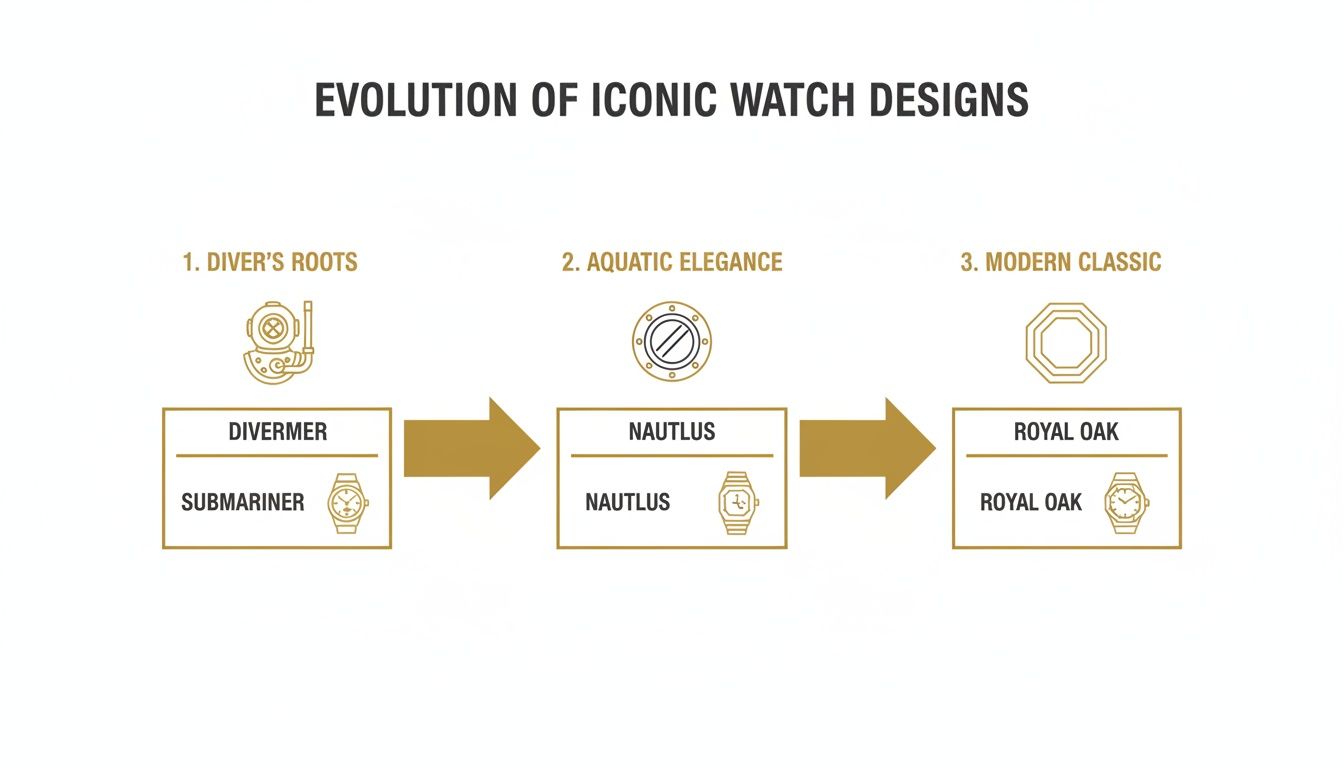
You can see how foundational aesthetics, like the Submariner's diver DNA, have shaped the entire watch world for decades.
Maximizing Returns for Sellers
If you're looking to sell, the goal is simple: get the best possible price while making the whole process safe and painless. You can try to time the market, but what’s far more important is getting your watch ready for its next owner.
Presentation is everything. A professional cleaning can work wonders, and having the complete set—the box, warranty card, and any extra links—can add significant value to your final offer. These details matter to serious collectors.
Selling through a trusted retailer offers a secure, straightforward way to unlock your watch's actual market value. You get to skip all the headaches of dealing with anonymous buyers, potential scammers, and the nightmare of insured shipping.
When you work with a professional dealer, you get a fair offer based on real-time data from the front lines of the market. The entire process is discreet, secure, and professional, offering a level of assurance a private sale can't begin to match. For more insights, our in-depth guide to buying used luxury watches is a great place to continue your research.
At the end of the day, whether you’re buying or selling luxury watches that hold value, it all comes down to certainty. A careful, dealer-vetted process delivers the authentication, transparency, and security you need to navigate the market with total confidence. It transforms what could be a stressful gamble into a genuinely rewarding experience, built on a foundation of trust.
Answering Your Watch Investment Questions
Diving into the world of watch collecting, especially with an eye on value, is bound to bring up some questions. It's totally normal. Whether you’ve been doing this for years or are just starting to get serious, you need clear, straightforward answers.
Let's cut through the noise and get right to the practical details that make a real difference. Think of this as moving from simply admiring beautiful watches to strategically building a collection with lasting worth.
Are All Rolex Models a Good Investment?
It’s a common myth that slapping any Rolex on your wrist is like putting money in the bank. While the brand is an undisputed titan of value retention, the story is a lot more nuanced than that. Not all Rolexes are created equal on the secondary market.
The models that consistently hit home runs are almost always the stainless steel sports watches. We're talking about the heavy hitters: the Submariner, GMT-Master II, and the Daytona. The hunger for these pieces is so intense that it completely overwhelms the supply from authorized dealers. This imbalance creates a red-hot pre-owned market where prices don't just hold—they often blast past retail.
On the flip side, you have models made from precious metals or certain Datejust configurations. They’re fantastic watches, of course, but they don’t typically appreciate with the same ferocious pace. They cater to a different buyer. This is a crucial lesson for any collector: the specific reference number, the material, and even the dial color can make a world of difference in a watch's financial journey.
What Is the Most Important Factor for Resale Value?
You can talk about brand and model all day, but when it comes down to the actual price a watch will fetch, one thing stands above all else: its condition and originality. This is the hill collectors will die on, and for very good reason.
Think about it like this: you have two identical vintage cars. One was beautifully restored with a new engine and a modern paint job. The other is completely untouched, original factory paint, all matching numbers. To a true enthusiast, the second car is the holy grail.
This idea is even more powerful in the watch world.
- Unpolished Cases: Serious collectors will pay a massive premium for a case that has never met a polishing wheel, keeping its sharp, original factory edges intact.
- Original Parts: The dial, hands, and bezel have to be correct for the watch's production era. A "service dial" from a later repair can crush the value of a vintage piece.
- Completeness: A very close second is having the original box and papers. This is the watch's birth certificate, its provenance. It can easily add 15-25% to its value.
How Can I Avoid Buying a Fake Watch?
With high-quality fakes getting scarily good, the single best way to protect yourself is to buy exclusively from a reputable, certified pre-owned dealer. I know the prices on peer-to-peer marketplaces can look tempting, but they are a minefield of risks that can turn your dream purchase into an absolute nightmare.
A professional dealer offers a safety net you just can't get from a stranger online. It’s not just about spotting an obvious fake; it's about a deep, component-level guarantee of authenticity.
A trusted dealer's rigorous process is your best defense. It involves a multi-point inspection, authentication by trained watchmakers, and a written guarantee that lets you sleep at night.
As an insider tip, look for dealers who own their inventory, like we do at Perpetual Time. This model shows a much deeper commitment and expertise than a consignment platform that just connects two parties without taking on any risk themselves. When a dealer has put their own money on the line for a watch, you better believe they've vetted it down to the last screw.
Is It Better to Buy New or Pre-Owned for Investment?
This really boils down to your strategy and, frankly, your connections. Buying a new "hot" model from an authorized dealer (AD) means you get it at retail price, which is fantastic. The catch? You're up against multi-year waitlists with zero guarantee you'll ever get the call.
The certified pre-owned market, however, offers the one thing the AD can't: immediate access. You can completely sidestep the infamous waitlists and buy a watch whose value has already been proven by the open market. For the most sought-after models from Rolex or Patek Philippe, going pre-owned is often the only realistic path.
From a pure investment standpoint, the certified pre-owned market often makes a more compelling argument. You're buying a proven asset at its current market value—which, for the most desirable pieces, is often well above the original retail price. This is the very definition of one of the luxury watches that hold value. The key, as always, is making sure you buy from a trusted source that certifies everything they sell.
At Perpetual Time, every watch in our collection is owned by us and has passed a rigorous, multi-point inspection to guarantee its authenticity and quality. Explore our curated selection of certified pre-owned timepieces with the confidence that comes from working with true specialists. Visit us today at perpetualtime.com.