Discover: are rolex watches a good investment
So, is a Rolex a good investment? Let's cut right to it.
Yes, many Rolex models can be a fantastic investment. But—and this is a big but—it’s not a sure thing. The best way to think about it is as a wearable asset. It's something you can actually enjoy on your wrist while its value, in many cases, quietly grows, often outperforming more traditional investments.
Why a Rolex Can Be More Than Just a Watch
When you start asking if a Rolex is a solid investment, you have to look past the beautiful design and incredible engineering. You need to approach it like you would any other asset, whether it's real estate, stocks, or art. The Rolex market is a unique financial ecosystem, fueled by a powerful mix of scarcity, brand prestige, and a deeply passionate global demand.
Unlike a stock certificate sitting in a digital account, a Rolex offers a unique perk: you get to wear it and enjoy it. The real question isn't just about buying a luxury watch; it's about understanding what makes one specific model a high-performing financial piece while another is simply a nice timepiece. This guide will get past the hype and give you a clear, data-driven perspective.
We’ll dig into the core pillars that hold up a Rolex’s value:
- Brand Power: Rolex has spent over a century building an ironclad reputation for quality, durability, and exclusivity. That history creates a powerful, built-in demand that doesn’t get shaken by passing fads.
- Scarcity by Design: The company is famous for its deliberately limited production. This ensures that for the most sought-after models, there are always more buyers than there are watches, which naturally pushes prices up on the secondary market.
- A Tangible Asset: In a world of digital currencies and volatile markets, a Rolex is a physical object. It’s a store of value you can hold in your hand, making it feel more secure than paper assets for many people.
To help you quickly grasp these concepts, here's a summary of the key factors that drive Rolex investment potential.
Rolex Investment Potential at a Glance
This table breaks down the essential elements that determine a Rolex's value as an asset, giving you a quick reference guide.
| Factor | Why It Matters for Investment Value | Key Takeaway |
|---|---|---|
| Brand Prestige & History | Rolex is a universally recognized symbol of success and quality, creating consistent global demand that supports its value. | The brand's reputation acts as a safety net, protecting it from market volatility. |
| Scarcity & Production | Limited production of high-demand models (like the Daytona or GMT-Master II) creates a supply shortage, driving secondary market prices well above retail. | Scarcity is the primary engine of appreciation. The harder a watch is to get, the more it's likely to be worth. |
| Model Popularity | Professional steel sports models consistently outperform other categories due to their versatility, durability, and iconic status. | Stick to the icons. Models like the Submariner, Daytona, and GMT-Master II have the strongest track record. |
| Condition & Completeness | The watch's physical condition and the inclusion of the original box, warranty card, and booklets ("box & papers") significantly impact its value. | A complete set in excellent condition will always command the highest price and be easier to sell. |
| Material & Rarity | While steel models are the most popular, precious metals (gold, platinum) and rare dial configurations (e.g., "Stella" or "Paul Newman") can be major value drivers. | Rarity, whether through material or a unique feature, can turn a great watch into a grail-level investment. |
Ultimately, investing in a Rolex is a game of details.
Why Nuance Is Everything
It's absolutely critical to understand that not every watch with a crown on it is a golden ticket. The investment potential can swing wildly from one model to another. A steel Daytona might double in value, while a less common dress watch might barely keep pace with inflation.
A Rolex is one of the few luxury purchases you can make that can bring you joy for decades while it appreciates. It truly merges the passion of collecting with smart financial planning.
Things like the watch's condition, its service history, and especially whether it comes with its original box and papers are non-negotiable. These elements can easily add or subtract thousands of dollars from its final value.
This guide is designed to give you a solid framework for making a smart decision. We'll look at real historical price data, pinpoint the models most likely to gain value, and walk you through the practical steps of buying and selling to protect your investment. Whether you're a seasoned collector or just starting to think about your first serious watch, you’ll get the insights you need to navigate this exciting market with confidence.
Looking Back at Rolex's Historical Performance
To really understand if a Rolex is a smart investment, you can't just look at today's prices. You have to look back. Think of it like analyzing a blue-chip stock—the history reveals patterns of growth, stability, and resilience that hint at what the future might hold. For decades, Rolex has shown an uncanny ability not just to hold its value, but to grow it, often significantly.
This isn't some recent social media-fueled trend, either. Long before the market boom of the last few years, iconic Rolex models were already on a steady upward climb, consistently outpacing inflation and, in many cases, outperforming traditional investments like stocks and bonds. This long-term track record is the bedrock of its reputation as a "wearable asset."
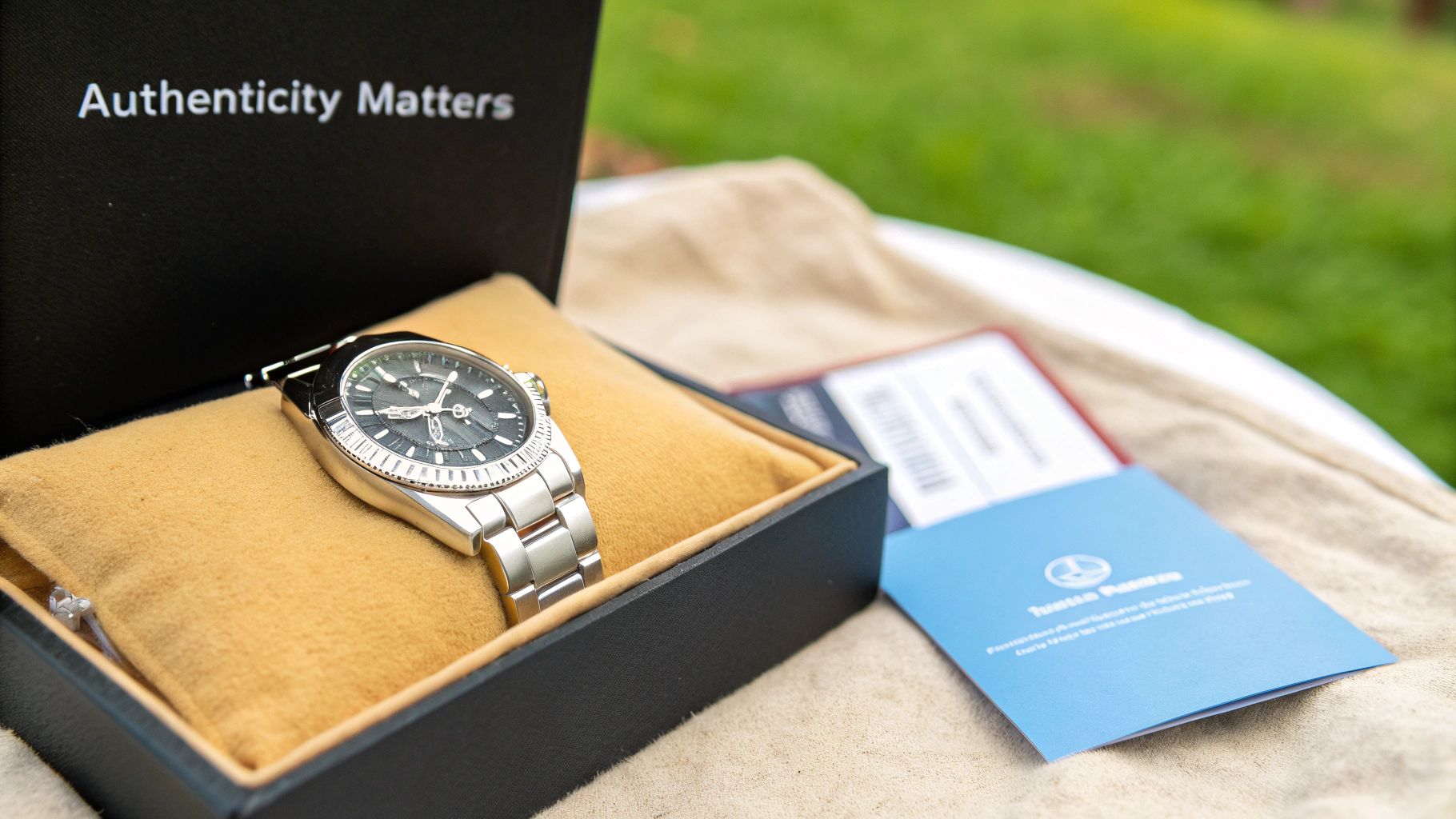
The image below breaks down the three pillars that support a Rolex's value: it's a luxury item you can actually wear and enjoy, it has real potential for financial growth, and its authenticity is paramount.
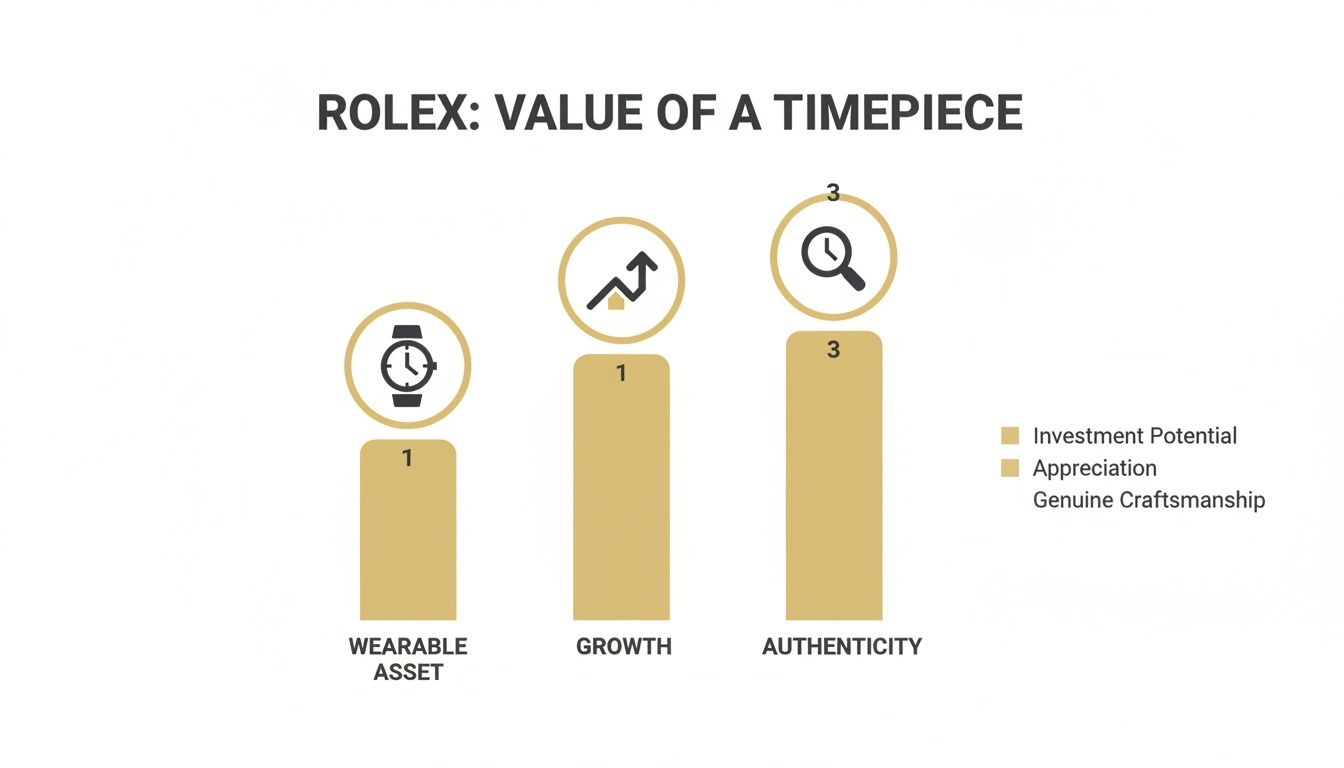
These three elements work in harmony, creating a powerful investment that you can actually wear on your wrist every single day.
The Stories the Data Tells
The numbers don't lie, and the story they tell about Rolex is a compelling one. A deep dive into market data, analyzing over 50,000 Rolex transactions, shows 15-year returns on popular models ranging from an impressive 200% to over 500%. That kind of performance has, in many instances, left more conventional assets in the dust.
And this growth isn't just for a few ultra-rare vintage pieces locked away in a safe. Even some of the most recognizable and accessible models have shown incredible strength.
- The Rolex Datejust: During the post-pandemic market surge, this collection hit a peak appreciation of 763%. While the market has since settled, that boom created a whole new, higher baseline for the model's value.
- The GMT-Master II: Since 2010, this iconic travel watch has shot up by 506%. Average resale prices peaked near $24,000 and have held strong, staying above $20,000 today. The intense demand for specific versions like the "Pepsi" and "Batman" just keeps fanning the flames.
These numbers highlight a core truth about investing in Rolex: markets will always have their peaks and valleys, but the long-term trajectory has been consistently, reliably upward.
Resilience Through Every Economic Cycle
One of the most compelling arguments for a Rolex as an investment is how it behaves when the economy gets rocky. While stock markets tumble and currencies fluctuate, hard assets like a Rolex often become a safe harbor for investors' money.
The luxury watch market has shown less volatility than real estate, stocks, and bonds. Between January 2019 and September 2024, the watch market’s volatility was just 3.90% annually, the lowest of any major asset class.
This stability isn't an accident. It’s a direct result of the brand's disciplined approach to supply and its unwavering global demand. Rolex intentionally doesn't flood the market to meet short-term hype, a strategy that inherently protects the value of every watch already out there. When other markets get shaky, the desire for a Rolex often stays strong, preserving—and sometimes even increasing—its value. To get a better handle on this, it helps to understand both retail and secondary market pricing, which we cover in our guide to the price of a Rolex watch.
This proven history of resilience is why so many collectors and investors trust the Rolex name. It’s not just about chasing quick profits during a market high; it's about owning an asset that has demonstrated, time and again, its ability to weather economic storms and come out the other side with its value intact. That's what separates a simple luxury good from a truly sound investment.
Why Not All Rolex Models Are Created Equal
If you're thinking about buying a Rolex as an investment, it's easy to assume any watch with the crown on the dial is a sure bet. But that’s a common misconception. The reality is much more nuanced, a bit like the classic car market. A rare, high-performance Ferrari will appreciate very differently than a standard production luxury sedan, and the same principle applies here.
To navigate the Rolex market successfully, you have to understand the two main families of watches: the purpose-built Professional (or sports) models and the elegant Classic models. They both represent the pinnacle of watchmaking, but their performance as investment pieces couldn't be more different. This distinction is everything.
Knowing which models are the high-flyers and which are the steady-eddies is the first real step to making a smart purchase.
The Reign of Stainless Steel Sports Models
When people talk about Rolex watches skyrocketing in value, they are almost always talking about the stainless steel Professional models. The Submariner, GMT-Master II, and Daytona are the undisputed kings of the secondary market, and it's not uncommon to see them selling for double their original retail price—or much, much more.
So, what's the magic formula? It comes down to a potent mix of heritage, rugged utility, and a very deliberate approach to scarcity by Rolex. These aren't just timepieces; they are legendary tools born from the worlds of deep-sea diving, aviation, and professional motorsport. That backstory creates an incredible aura that collectors can't get enough of.
Rolex also carefully manages production, meaning the demand for these steel sports watches always seems to outpace the available supply. That fundamental imbalance is the engine that drives their incredible appreciation.
- Rolex Submariner: The quintessential dive watch. Its design is timeless, its build is bulletproof, and it’s a foundational piece for any serious collection.
- Rolex GMT-Master II: Instantly recognizable by its two-tone bezel (think "Pepsi" or "Batman"), it’s a global icon of travel and sophistication.
- Rolex Daytona: The brand's legendary chronograph has deep roots in racing, and its extreme rarity has turned it into a "grail" watch for enthusiasts worldwide.
For a closer look at the models that consistently lead the pack, check out our guide on the top Rolex models that retain and increase their value.
Comparing Top Rolex Investment Models
To make sense of the landscape, it helps to compare the key players side-by-side. Each model offers a different path for an investor or collector.
| Model | Typical Investment Profile | Key Value Drivers | Best For |
|---|---|---|---|
| Daytona (Steel) | High-Growth / Speculative | Extreme scarcity, motorsport heritage, "grail" status | The seasoned investor with a high-risk tolerance looking for maximum appreciation. |
| GMT-Master II (Steel) | Strong Growth | Iconic "Pepsi" & "Batman" bezels, travel function, high demand | The collector who wants a recognizable icon with a strong track record of growth. |
| Submariner Date (Steel) | Consistent Growth | Timeless design, brand recognition, robust build | The first-time investor or anyone seeking a blue-chip, "can't-go-wrong" asset. |
| Datejust (Steel/Two-Tone) | Stable / Value Retention | Versatility, vast selection, timeless appeal, lower entry price | The practical buyer looking for a reliable store of value and an everyday luxury watch. |
This table highlights the core differences. A steel Daytona is a high-octane investment, while a classic Datejust is more like a blue-chip stock—steady, reliable, and always in demand.
Steady Growers: The Case for Classic Models
On the other side of the coin are the Classic models, with the Datejust leading the charge. While you shouldn’t expect a Datejust to double in value overnight like a steel Daytona might, these watches represent a stable and far more accessible entry point into Rolex ownership. Think of them as the bedrock of the Rolex world—less drama, but consistently dependable.
The Datejust is perhaps the most versatile watch ever made. Its value lies not in hype-driven scarcity, but in its timeless appeal and unwavering popularity across generations. It's a cornerstone asset that provides steady, predictable appreciation.
The Datejust's investment strength comes from its universal appeal. It's available in an almost endless combination of sizes, metals, and dials, meaning there’s truly a Datejust for everyone. This makes its market incredibly liquid. For a first-time buyer, a pre-owned Datejust is often the perfect start—you get the full Rolex experience with a lower upfront cost and a rock-solid history of holding its value.
How Materials and References Shape Value
Looking beyond the model name, the specific materials and, most importantly, the reference number can dramatically change a watch's value. This is where the details really matter.
As a general rule, stainless steel models have delivered the highest percentage returns, mainly because their lower retail price creates a bigger gap for growth. However, precious metal models in solid gold or platinum often act as a more stable store of wealth, their value closely tied to the commodity itself. Two-tone steel and gold models sit comfortably in the middle, offering a touch of luxury at a more approachable price.
The reference number is even more crucial for a serious investor. This little code tells you everything—the production era, the specific movement inside, and tiny design details that collectors obsess over. A vintage Submariner with a "four-digit" reference is a completely different asset than its modern "six-digit" cousin because of its rarity and place in history. Getting a handle on these nuances is what separates a casual enthusiast from a savvy collector.
Decoding the Anatomy of a High-Value Rolex
Ever wonder why two Rolex watches that look almost identical can have vastly different price tags? The secret is in the details—the little things that elevate a watch from a luxury good to a true investment-grade asset. If you're seriously asking, "are Rolex watches a good investment?" then you need to learn these nuances, because they're what drive a watch's value over the long haul.
Think of it like collecting classic cars. A beautifully restored 1965 Ford Mustang is a fantastic machine. But a '65 Mustang with its original window sticker, every service record, and a clear ownership history? That's in another league entirely. The same principle applies, perhaps even more so, in the world of high-end watches. The story and the completeness of the package are everything.
This is where you start thinking less like a buyer and more like a seasoned appraiser, zeroing in on the critical elements that protect—and grow—your investment.
The Power of a Complete Set
In the watch community, you'll constantly hear the term "box and papers." This refers to the whole kit: the original box, warranty card or certificate, owner's manuals, and even the little hang tags that came with the watch when it was first sold. This "full set" is essentially the watch's birth certificate, offering undisputed proof of its origin and authenticity.
A Rolex with its full set will always command a higher price than the exact same watch without it. For many serious collectors, a missing set of original papers can be an instant deal-breaker. It’s not just about the physical items; it’s about the trust and integrity they represent.
A complete set can boost a watch's value by 15-25% or more, especially for rarer models. It turns a standalone timepiece into a verifiable piece of history, making it far more attractive on the secondary market.
This premium exists for a reason. A full set makes the watch easier to sell, provides a powerful defense against fakes, and satisfies the purist collector who wants the most complete and original example they can find. For a deeper dive into verification, check out our guide on how to tell if your Rolex is real.
Condition Is King—Especially Originality
Beyond the paperwork, the physical state of the watch is obviously a huge factor. But "good condition" means something very specific to an investor, and it doesn't always mean looking brand new.
In fact, the most sought-after watches are often those in unpolished condition. Polishing a watch can buff out scratches, but it also grinds away tiny layers of steel. Do this too many times, and the sharp, crisp lines of the case and lugs become soft and rounded. A true collector will always choose the crisp factory edges of an unpolished case over a scratch-free but "softened" one.
Originality is the name of the game, and it applies to every single part. Here’s a quick checklist of what matters:
- Original Dial and Hands: The dial is the face of the watch and often its most valuable component. Any sign of it being refinished, repainted, or replaced can tank its value.
- Factory-Original Parts: Aftermarket bezels, bracelets, or crystals are a huge red flag for an investor. A collectible watch must have all its original parts, just as it left the Rolex factory.
- Consistent Aging: Patina—the natural aging you see on the dial markers and hands—should be even. If the hands look much newer or older than the dial, it’s a good sign that parts were swapped out at some point.
The Value of a Known History
Finally, a watch’s provenance—its documented story—can add a layer of value that’s hard to price but impossible to ignore. Was it a "one-owner" watch passed down through a family? Does it come with a stack of service receipts from Rolex? Was it owned by someone noteworthy?
Every piece of its history adds to the allure. A detailed service history gives you confidence in the watch’s mechanical health, while a unique ownership story adds a certain romance you just can't fake. All these factors—the papers, the condition, the history—come together to build a complete picture, ensuring that when you decide to sell, your watch is seen not just as a timepiece, but as a documented and desirable asset.
How to Navigate the Rolex Market and Buy Smart
Once you know what makes a Rolex valuable, it's time to actually step into the market. This is where a lot of people hit a wall, caught in the classic dilemma: should you wait years for a brand-new watch from a boutique, or dive into the pre-owned market for immediate access?
For anyone serious about Rolex as an investment, the certified pre-owned route offers some serious advantages.
Let's be honest, the infamous authorized dealer (AD) waitlist feels more like a lottery than a purchase process. You can spend years hoping for a call that may never come, all while your capital is tied up. In that time, you could miss out on significant market appreciation.
The pre-owned world, on the other hand, gives you instant access to nearly any model you can imagine, from today's hot releases to rare vintage gems. It puts you in the driver's seat, allowing you to buy the right watch at the right time—based on your strategy, not a retailer's whim.
Choosing Your Buying Partner Wisely
The pre-owned market is a big place, with everything from anonymous forum posts to highly-respected independent dealers. When you're dealing with an asset of this caliber, where you buy is just as critical as what you buy.
The smartest and safest path is to partner with a reputable, certified dealer who owns their own inventory, like Perpetual Time.
Think about it: a dealer who puts their own money into every single watch they sell has skin in the game. Their reputation is on the line with every transaction. They're not just a middleman; they are invested. This means they perform rigorous, multi-point inspections to guarantee authenticity, giving you a layer of protection that's essential for any investment. You can learn more in our in-depth guide on how to buy a used Rolex with confidence.
The data backs this up. Rolex absolutely dominates the secondary market, capturing a massive slice of all global luxury watch sales. It's not uncommon to see certain models post double-digit percentage increases, especially in the €10,000–€20,000 price bracket where Rolex is king. This constant activity and liquidity are what make the Rolex investment thesis so strong, particularly when you work with a trusted independent dealer.
A Practical Checklist for First-Time Buyers
Getting started can feel overwhelming, so here are a few practical tips to guide your first purchase and make sure it’s a sound one.
- Set a Clear Budget: Know exactly what you're comfortable spending before you even start browsing. This keeps you focused and helps you avoid making an emotional decision you might regret.
- Ask the Right Questions: Never be shy. Ask about the watch’s service history, the originality of its parts (especially the dial and hands), and if the case has ever been polished. A good seller will have good answers.
- Scrutinize the Listing: A trustworthy dealer will always use high-resolution photos of the actual watch for sale—never stock images. The description should be just as honest, detailing its true condition.
- Prioritize a Full Set: If you can, always go for a watch that comes with its original box and papers. This "full set" is a huge factor in protecting and boosting its value down the line.
Tips for Selling Your Rolex and Maximizing Your Return
When it's time to sell, a little strategy goes a long way in getting the best possible price for your watch.
Selling your watch to a reputable dealer is the most secure and efficient way to realize its value. They offer fair market prices, immediate payment, and eliminate the risks associated with private sales, such as fraud or lowball offers.
To get top dollar, preparation is everything. Gather all the original materials you have: the box, warranty card, manuals, and even the extra bracelet links. A complete package is simply more desirable and will always fetch a premium.
Finally, make sure you work with a professional buyer who is transparent about how they value your watch. A trusted dealer will walk you through their appraisal, explaining how they arrived at their offer based on condition, completeness, and current market demand. This ensures a fair and straightforward process, turning your wearable asset into a profitable investment.
Understanding the Hidden Costs of Rolex Ownership

To really answer the question "Are Rolex watches a good investment?", we have to look past the initial price tag and the exciting potential for appreciation. Owning a Rolex is a lot like owning a high-performance car; it comes with certain responsibilities and running costs that are crucial for protecting its value.
These aren't just minor afterthoughts—they’re fundamental to responsible ownership. A savvy investor sees these costs coming and builds them into their budget from day one. Let's break down the three big ones: insurance, maintenance, and taxes.
Protecting Your Asset with Specialized Insurance
Don't assume your standard homeowner's or renter's policy has you covered. Most of these policies have strict limits on high-value items, which a luxury watch will almost certainly exceed, especially if its market value has gone up. To properly protect a Rolex, you need a specialized insurance policy, often called a "rider" or a "floater," designed for things like jewelry and fine watches.
This kind of coverage protects you against theft, damage, and sometimes even just plain losing it. The premiums usually run between 1% and 2% of the watch’s appraised value each year. For a $15,000 Submariner, that means you should plan on spending $150 to $300 annually on insurance. It's a small price to pay for real peace of mind.
Think of watch insurance not as a cost, but as a non-negotiable part of your investment strategy. It secures the foundation of your asset, protecting its value against the unexpected and ensuring your investment isn't wiped out by a single unfortunate event.
The Cost of Factory-Spec Maintenance
A Rolex is an incredibly precise machine, packed with hundreds of tiny, moving parts all working in perfect sync. To keep it ticking accurately and preserve its water resistance, it needs regular service. Rolex itself recommends a full service about every 10 years, though this can change depending on how you wear it.
A standard service is a complete overhaul. A certified watchmaker will take the entire watch apart, meticulously clean and lubricate every component, replace any worn-out parts, and put it all back together. It’s an intensive process, and it isn't cheap—expect to pay anywhere from $800 to over $1,500, depending on your watch’s complexity and what it needs. Putting off this vital maintenance can lead to much bigger, more expensive problems later on and will almost certainly hurt its resale value.
Planning for Capital Gains Taxes
Finally, if you play your cards right and eventually sell your Rolex for more than you paid, the government will want its piece of the action. That profit is typically considered a capital gain, and you'll have to pay taxes on it. The exact amount depends on your income and how long you've had the watch.
- Short-Term Capital Gains: If you sell the watch within a year of buying it, your profit is taxed at your ordinary income tax rate.
- Long-Term Capital Gains: If you hold it for more than a year, the profit is taxed at a lower long-term rate. For collectibles like watches, this rate can be as high as 28%.
Before you sell any high-value asset, it’s always a good idea to chat with a tax professional. They can help you understand the rules and make sure you have a clear picture of what your actual take-home profit will be.
Your Next Steps in Rolex Watch Investing
So, are Rolex watches a good investment? The short answer is yes, they can be a fantastic one. But it’s never a sure thing, and a successful purchase is never an accident.
It all comes down to patience, doing your homework, and most importantly, buying the right watch from a source you can trust completely. Deciding you want a Rolex is the easy part. The real journey begins when you start making smart, confident decisions about which one to buy and where to buy it.
Think of it this way: not all Rolexes are created equal from an investment standpoint. Your success hinges on targeting the models with the most ravenous demand, like the steel Professional watches, which have a long history of climbing in value. Just as crucial is the watch’s condition and making sure it’s a "full set"—that means it comes with the original box and paperwork. Those two items alone can make a huge difference in its long-term worth.
Ultimately, knowing the market is what separates a simple purchase from a savvy investment. Understanding the right time to buy, the tiny details that matter, and who to trust is the name of the game.
Creating Your Rolex Investment Checklist
Ready to take the next step? Use this checklist to keep the most important factors front and center. It’s your game plan for making a purchase that you’ll be happy with for years to come.
- Know Your Goal: Are you chasing quick gains with a hot sports model like a Submariner, or are you looking for slow-and-steady value with a classic like a Datejust? Getting clear on your goal narrows the field immediately.
- Insist on a Full Set: Make the original box and papers a non-negotiable. It's one of the simplest ways to protect your investment and prove the watch’s authenticity down the road.
- Vet Your Seller: Only work with a trusted, certified pre-owned dealer that owns every watch they sell. This simple rule helps you dodge the massive risks that come with private sales and murky online marketplaces.
- Never Stop Learning: The watch world is always changing. Stay curious and keep up with market trends. A great place to start is by exploring our other guides on investing in luxury watches.
Your first investment should be in knowledge. The more you understand about the nuances of specific references, condition, and market demand, the more empowered you will be to make a profitable and enjoyable purchase.
Whether you’re ready to start browsing or you’d rather talk to an expert first, this framework will give you a solid foundation for entering the world of watch investing.
At Perpetual Time, we make the process of buying a world-class timepiece transparent and secure. Browse our collection of certified pre-owned watches and start your investment journey with total confidence.