
Cart
0
Getting the best price for your Rolex isn't just about finding a buyer; it's about understanding what you have, preparing it properly, and picking the right place to sell. Think of it as presenting a complete package to a serious buyer who understands its real-world value. Nailing this process from the start is what separates a good sale from a great one.
Understanding the Rolex Resale Market
Before you snap a single photo, take a moment to appreciate the unique world you're stepping into. The pre-owned Rolex market doesn’t behave like the market for other luxury goods. Most high-end items depreciate the second you walk out of the store, but a Rolex often acts more like a fine wine or a classic car—an asset.
This isn’t an accident. It's the direct result of Rolex's iron-clad control over supply, its legendary reputation for quality, and a century of cementing its status as the luxury watch. This creates a secondary market where demand for popular models consistently outstrips the supply from authorized dealers. When someone can't get a new Daytona or GMT-Master II at retail, they come looking for yours, and that keeps prices strong.
Why the Current Market Favors Rolex Sellers
Even when the rest of the luxury watch world hits a soft patch, Rolex seems to sail right through. We've seen a trend where mid-tier brands feel the squeeze, but powerhouse names like Rolex just tighten their grip on the market.
For example, the Swiss watch industry as a whole saw a dip in early 2024, yet Rolex's revenue climbed to over CHF 10.5 billion. That pushed its total market share to an incredible 32 percent. This resilience shows that even in a cooler economic climate, the hunger for Rolex is as strong as ever, which is fantastic news for anyone looking to sell. You can dig into more of this data on Rolex's dominance over at WatchAnalytics.io.
Key Takeaway: Remember, you aren't just selling a "used watch." You're selling a coveted luxury asset in a market where demand is a constant. Knowing this puts you in a position of strength.
Factors That Define Market Strength
So, what keeps the Rolex resale market so hot? It boils down to a few core truths that all work in your favor as a seller:
- Unmatched Brand Prestige: Rolex is a universal symbol of achievement. That powerful image ensures there's always a new wave of buyers eager to own one.
- Engineered Scarcity: We've all heard about the infamous waiting lists for steel sports models. This isn't just hype; it makes the pre-owned market the only realistic path to ownership for countless enthusiasts.
- Incredible Value Retention: Some Rolex models are famous for holding their value, and many even appreciate over time. If you want to know which ones have the best track record, check out our guide on the top 5 Rolex models that retain their value.
- Timeless Design Language: Rolex designs evolve, they don't revolutionize. A 15-year-old Submariner still looks fantastic today, which keeps older models relevant and highly desirable.
Understanding these dynamics is your first big step. It gives you the context you need to price your watch realistically and navigate the sale with confidence.
Getting Your Rolex Ready for a Successful Sale
How you present your Rolex is every bit as important as the watch itself. A potential buyer isn't just looking at a timepiece; they're investing in its history, authenticity, and the story of its care. Taking the time to get this part right can mean higher offers and a much smoother sale.
The goal here is to create a complete, well-documented, and attractive package that leaves no room for doubt in a serious buyer's mind. This all starts with tracking down every original item that came with your watch on day one.
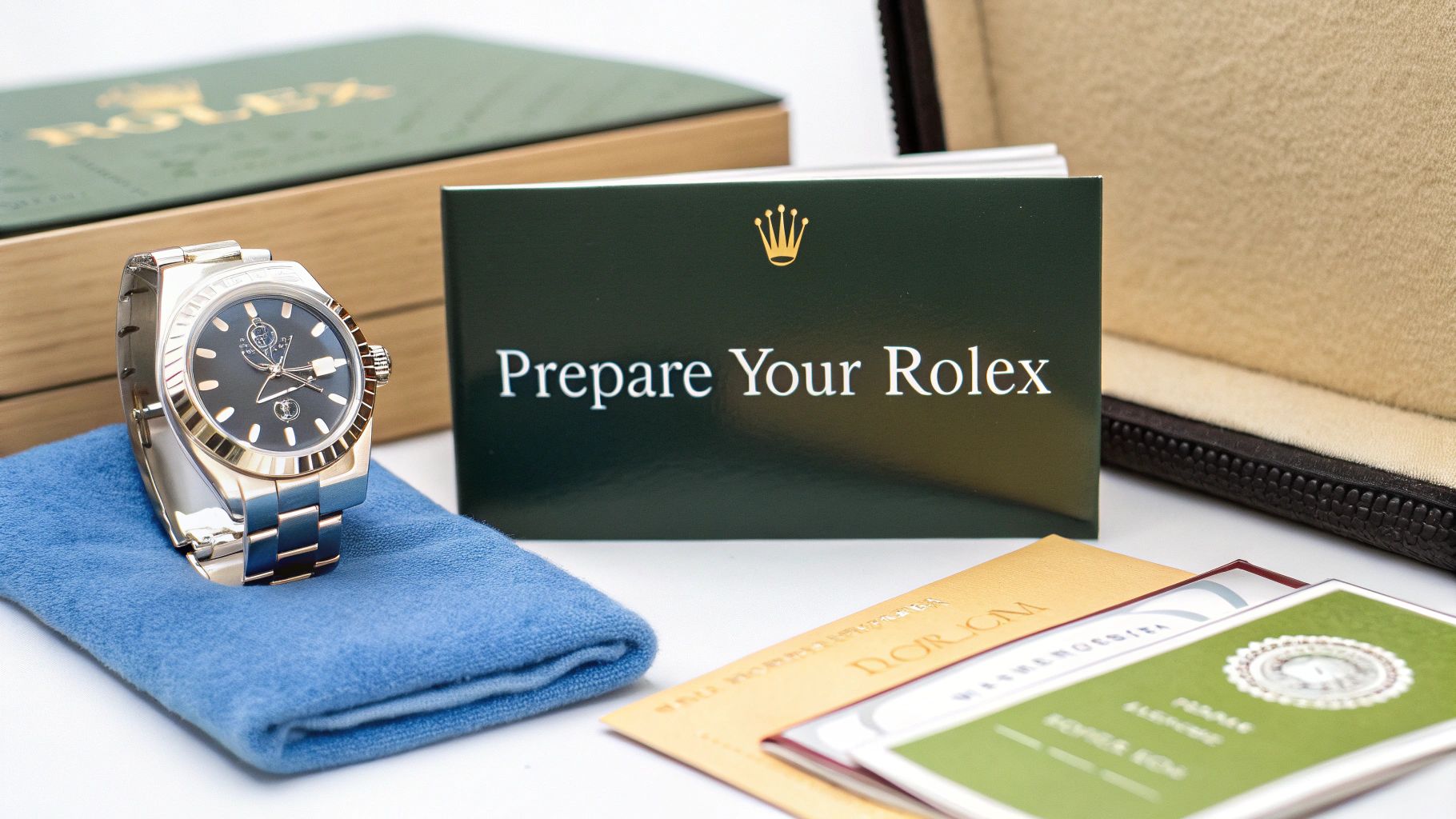
Assemble the "Full Set"
In the world of pre-owned luxury watches, you'll hear the term "full set" all the time. It simply means you have all the original materials that came with the watch when it was first sold. The more of these pieces you have, the more desirable your watch becomes to both collectors and dealers.
Think of it from the buyer's perspective: a full set signals a meticulous owner and provides an undisputed line of provenance. It's the closest they can get to the experience of buying brand new from an authorized dealer.
A complete set should ideally include:
- The Original Inner and Outer Boxes: Make sure they're the correct style for the watch's production year.
- The Warranty Card or Papers: This is the single most important document. It needs to have the watch's serial number, model number, and the original purchase date.
- Instruction Manuals and Booklets: Usually, this includes the model-specific guide and the warranty booklet.
- Hang Tags: Both the green "Superlative Chronometer" tag and the white tag with the serial and model number are highly sought after.
- Extra Bracelet Links: If you ever had the bracelet sized, including those removed links is a must for the next owner.
Having the original, dated warranty card can boost a watch's value by hundreds, sometimes even thousands, of dollars. It’s the ultimate proof of authenticity, making your watch a much safer bet for any buyer.
The Great Debate: To Service or Not to Service?
This is a question I get a lot, and there's no single right answer. While a recent official Rolex service can be a powerful selling point, it isn't always a smart investment right before you sell.
You should seriously consider a service if:
- Your watch is running poorly (losing or gaining a noticeable amount of time).
- There are obvious functional problems, like a date wheel that won't turn.
- The watch has cosmetic damage that’s more than just normal wear and tear.
However, I'd advise you to avoid a full service if the watch is running well and looks good. A standard Rolex service can be pricey, and you likely won't get that full cost back in the sale price. Sometimes, all you need is a light, professional polish to bring back its shine without over-investing.
Clean and Photograph Your Watch Like a Pro
Once the watch is running properly and you've gathered the paperwork, it's time for the final touch: presentation. A simple cleaning at home can make a huge difference in your photos.
Use a soft-bristled toothbrush with a bit of mild soap and warm water to gently clean the bracelet and case. Only do this if your watch has a screw-down crown and you're 100% sure of its water resistance. Afterward, dry it completely with a soft microfiber cloth. This is also a good time to double-check all the details and learn how to tell if your Rolex is real to ensure everything is correct.
High-quality photos are non-negotiable. They build trust and justify your price. You don't need a fancy setup; your smartphone can work wonders in natural light. Just avoid harsh flashes that create ugly glare.
Make sure your photo set includes:
- A clear, straight-on shot of the dial.
- A side profile showing the crown.
- Close-ups of the bracelet and clasp.
- A shot of the case back.
- Honest photos of any significant scratches or dings—transparency is key!
- A "group shot" of the watch with the full set: box, papers, tags, and all.
These photos prove your watch's condition and completeness, giving potential buyers the confidence they need to make a serious offer.
Determining the True Market Value of Your Rolex
Let's get one thing straight: valuing a Rolex isn't about finding some single, "correct" price. It's about figuring out what a serious, knowledgeable buyer is willing to pay for it today. That value is always in flux, influenced by your specific watch and the wider market forces that make Rolex a world of its own.
Nailing this valuation is the most critical part of the entire selling process.
Unlike a car that predictably loses value the moment you drive it off the lot, a Rolex is a different beast entirely. The foundation of its price is built on the reference number, its condition, and whether you have the original box and papers. But the real magic—and what often drives the price up—comes from Rolex's own moves in the market.
How Rolex’s Strategy Influences Your Sale Price
Rolex plays the long game, and their careful control over supply and pricing directly benefits anyone holding one of their watches. The brand’s strategy of intentional scarcity, paired with steady retail price hikes, creates a rising tide that lifts the value of pre-owned pieces. It’s a huge reason why selling a Rolex can be so profitable.
We've seen this play out in real-time. In 2024, Rolex actually trimmed its production to 1.18 million watches, down from 1.24 million. Yet, their revenue climbed to an astonishing CHF 10.58 billion. How? By strategically increasing prices, which saw the average cost of a new Rolex jump by over CHF 1,640 in just three years. You can read a fascinating deep dive into Rolex's market domination on Revolutionwatch.com to see how they pull this off.
What this means for you is simple: for many of the most sought-after models, the pre-owned market isn't just an option for buyers; it's the only option. This built-in demand is the engine that keeps resale values strong and protects your watch from depreciating like other luxury goods.
The Key Factors That Define Your Watch’s Value
To land on a realistic price, you need to look at your watch through the eyes of a seasoned buyer. Every single detail matters.
Here are the core elements that truly dictate what your Rolex is worth:
- Model and Reference Number: A "Submariner" is never just a Submariner. The reference number (like 16610 versus 126610) is the blueprint—it tells a buyer the exact materials, movement, and production era, which is the starting point for its entire value.
- Condition: This goes far beyond just looking for scratches. A collector will inspect the sharpness of the case lugs, how much "stretch" is in the bracelet, and the originality of every part. An unpolished watch that shows honest wear is often worth more than one that’s been polished down over the years.
- "Box and Papers": I can't stress this enough. Having the complete set, especially the original warranty card, is a huge deal. It's the ultimate proof of authenticity and can easily add 10% to 20% to the final sale price.
- Age and Rarity: While older doesn't automatically mean more valuable, certain vintage references or models made for only a short time can be incredibly sought-after. Tiny details, like a "flat 4" bezel on an early "Kermit" Submariner, can turn an excellent watch into a true collector's prize.
- Current Market Demand: The market has its favorites. Stainless steel sports models like the Daytona, GMT-Master II, and Submariner are almost always trading for more than their original retail price because the demand is just that intense. You can get a better sense of this by checking out our guide to the price of a Rolex watch.
Online Quotes vs. Formal Appraisals
Once you’ve got a handle on your watch's specifics, you can start digging. Browsing dealer websites and checking recent auction results gives you a decent snapshot of what's happening in the market right now.
But it’s absolutely crucial to understand the difference between an instant online quote and a proper, formal appraisal.
An online estimator might give you a quick ballpark figure, but it’s blind to the nuances of your watch. It can’t see the subtle patina on the dial or feel the stretch in the bracelet. A formal appraisal from a trusted watch expert, on the other hand, is a hands-on inspection. It’s the only way to get a truly accurate valuation based on your watch's unique condition and the live market, ensuring you don't accidentally leave thousands on the table.
Choosing the Right Place to Sell Your Watch
You’ve done the hard work of getting your watch prepared and valued. Now comes the biggest decision of all: where do you actually sell it? The path you choose here will have a huge impact on your final payout, how quickly you get your money, and how much risk you’re exposed to.
There’s a trade-off with every option. So, you need to ask yourself what you truly value most. Are you laser-focused on getting the absolute top dollar, even if it means more hassle and potential headaches? Or is your priority a fast, safe, and clean transaction for a fair price?
For an asset as valuable as a Rolex, there isn’t a single “right” answer, but one route consistently offers the best balance for most sellers.
Comparing Your Sales Options
Selling a Rolex isn't like offloading an old laptop on Facebook Marketplace. The stakes are much higher, the buyers are more sophisticated, and the potential for things to go wrong is very real. Let's walk through the main avenues you can take.
You've got a few realistic choices:
- Specialized Watch Dealer: These are the pros who buy, sell, and trade luxury watches for a living. They know the market inside and out and can typically offer you cash on the spot.
- Consignment: You hand your watch over to a shop that sells it on your behalf. You still own the watch until it sells, and the shop takes a cut of the final price.
- Auction House: This is usually reserved for the truly rare, vintage, or historically significant pieces. It can bring a high price but comes with hefty fees and a long, drawn-out process.
- Online Marketplaces: Think platforms like eBay or Chrono24. You get access to a massive audience, but you’re on your own for everything—vetting buyers, managing listings, and handling shipping.
- Private Sale: Selling directly to another person, whether it's a friend or someone from a watch forum. It offers the potential for the highest price but also carries the most risk by far.
Before you even pick a channel, simple things like having the original box and papers can significantly boost your starting position.
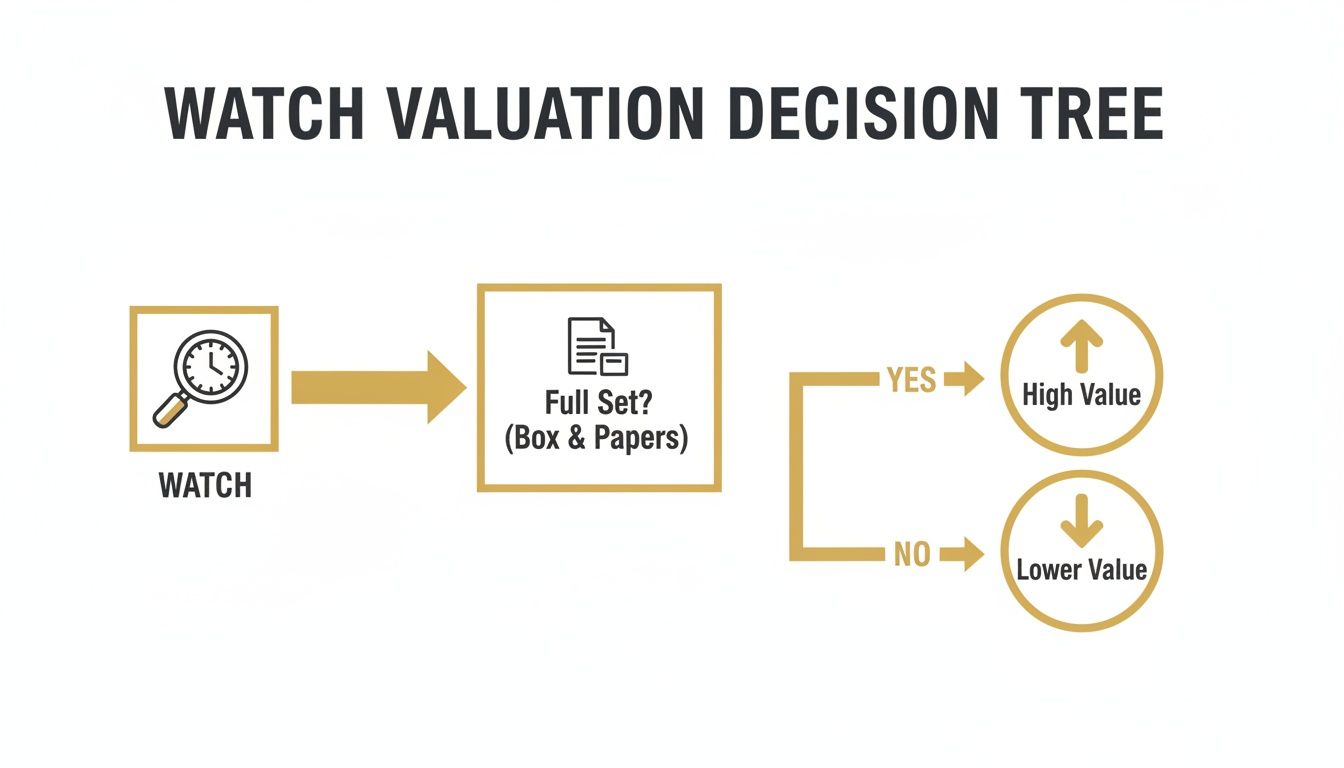
As you can see, a "full set" gives you a much stronger hand to play, no matter which table you decide to sit at.
Here’s a look at how these different sales channels stack up against each other.
Comparing Rolex Sales Channels
| Sales Channel | Potential Price | Sale Speed | Security Level | Effort Required |
|---|---|---|---|---|
| Specialized Dealer | Good to Excellent | Very Fast (often same-day) | Very High | Very Low |
| Consignment | Excellent | Slow (weeks to months) | High | Low |
| Auction House | Can be Highest | Very Slow (months) | Very High | Medium |
| Online Marketplace | Good to Excellent | Variable (days to months) | Medium | Very High |
| Private Sale | Potentially Highest | Variable (days to months) | Very Low | Very High |
This table makes it clear: while some channels might dangle a slightly higher potential price, that often comes at the cost of speed, security, and a whole lot of personal effort.
The Case for Selling to a Trusted Dealer
For the vast majority of people, selling to a reputable, specialized watch dealer is the smartest move. It offers the best mix of a strong price, blazing-fast payment, and ironclad security. The pre-owned Rolex market is an absolute giant, accounting for a staggering 34.2 percent of the entire luxury watch secondary market. This isn't just a niche hobby; it's a massive, liquid market. You can dive deeper into Rolex's secondary market strength on Chrono24.com.
What does that mean for you? It means established dealers are always looking for quality inventory and have the cash to make competitive, immediate offers.
A dealer’s entire business hinges on their reputation. They thrive on volume and repeat clients, so they can't afford to burn sellers with lowball offers or shady practices. It’s a setup where both sides have to win.
Going with a trusted dealer instantly solves the biggest problems and anxieties that come with other methods. You sidestep the long wait of consignment, the uncertainty of auctions, and the very real dangers of a private sale.
Why Private Sales Carry Major Risks
The idea of a private sale is alluring. You get to cut out the middleman and pocket 100% of the cash, right? In a perfect world, yes. But in reality, this path is littered with traps that can turn a great deal into a costly lesson.
Just think about these real-world scenarios:
- Payment Fraud: Are you an expert at spotting counterfeit bills? What about a wire transfer that looks legit but gets clawed back by the bank a week later? Scammers are sophisticated, and a Rolex is a prime target.
- Personal Safety: Meeting a complete stranger to exchange an item worth more than most cars is a recipe for disaster. Robberies and scams targeting sellers of luxury goods are unfortunately common.
- Time Wasters and Haggling: Get ready for an inbox full of lowballers, endless questions from people who aren't serious, and "buyers" who ghost you at the last minute.
- Logistical Nightmares: You're on the hook for everything. Verifying the buyer, figuring out fully insured shipping (which is complex and expensive for high-value watches), and handling any complaints after the fact.
Unless you're a seasoned seller with a rock-solid network, the potential for a slightly higher price almost never justifies the huge risks. When you're ready for a secure, professional, and straightforward experience, you can learn more about how to sell your watch through a trusted process with experts who put your safety first. A dealer handles all the details, gives you a guaranteed offer, and lets you walk away with cash in hand and zero worries.
Getting the Deal Done: Secure Payment and Shipping
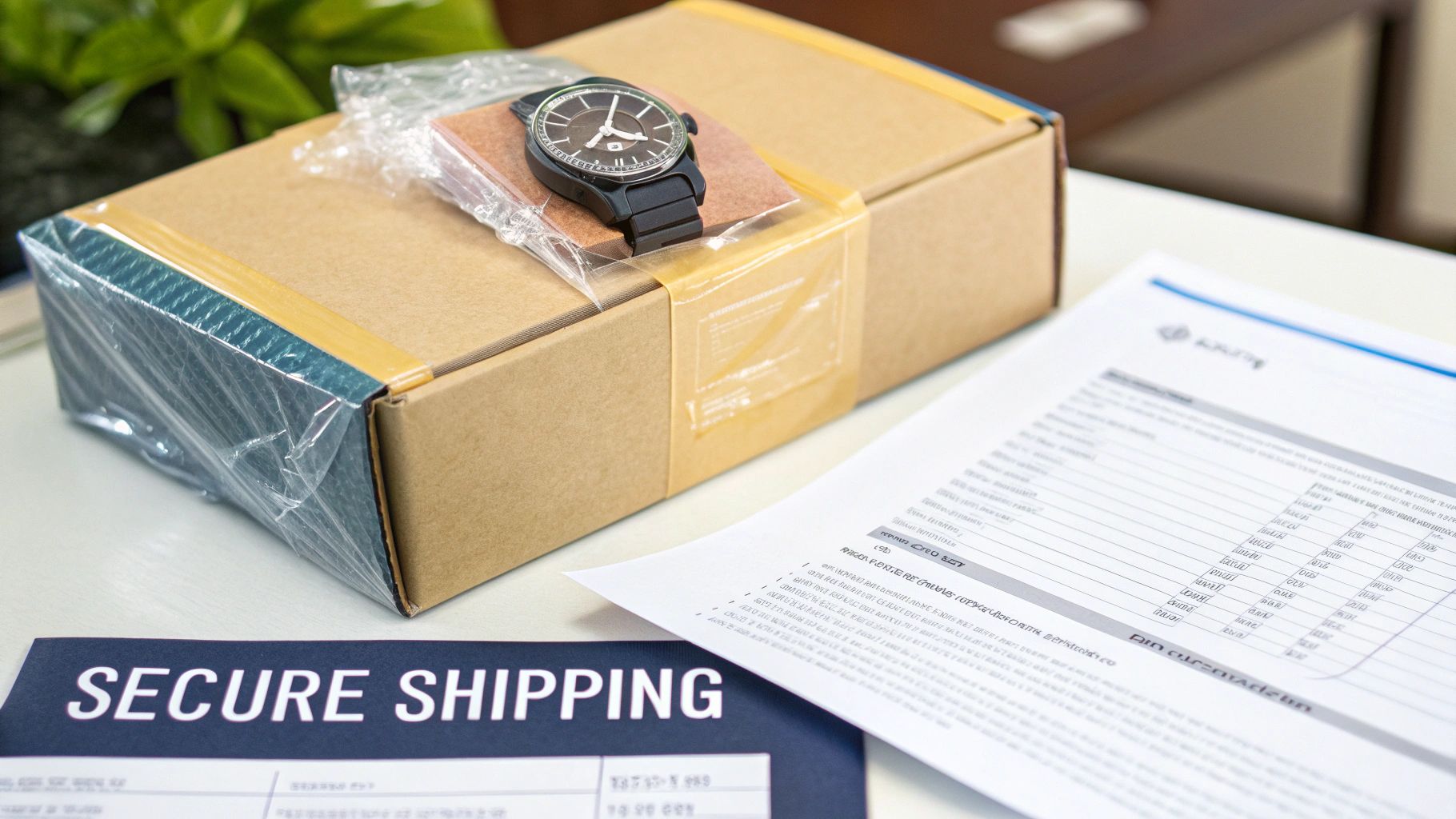
You’ve done the hard work, and now you’re at the finish line. The final steps—negotiation, payment, and shipping—are where you need to be most vigilant. A great offer means nothing until the money is securely in your account and the watch is safely in the new owner's hands. This is where meticulous attention to detail protects your investment.
Think of negotiation as a conversation, not a battle. You've already done your homework on the watch's value, so you should walk into this discussion with confidence. Know your absolute bottom-line price and be ready to explain why your asking price is fair, pointing to its condition, the complete set of documents, and current market trends.
A serious buyer will respect a seller who knows their stuff. If they try to lowball you over a minor swirl on the clasp that you already disclosed, you can stand firm. Simply explain that the price already reflects the watch's honest condition.
Securing Your Payment
This is the most critical part of the entire process. For a high-value item like a Rolex, payment is not the place to take chances. Scams are sophisticated, and some common payment methods just aren't safe enough. Personal checks, cashier’s checks, and even many peer-to-peer apps can be reversed or turn out to be fraudulent.
To protect yourself, insist on one of these methods:
- Bank Wire Transfer: This is the gold standard for a reason. Once a wire transfer hits your account and clears, it’s final. The funds can't be clawed back, which is exactly the security you need for a remote transaction.
- In-Person Cash Deal: If you're selling locally, there's nothing wrong with cash. Just make sure the exchange happens somewhere safe, like your bank's lobby. They can verify the bills right there, giving you immediate peace of mind.
- Established Dealer Payment: A reputable dealer will have a professional payment system. They'll typically offer a secure wire transfer or a company check you can trust.
My Golden Rule: Never, ever ship your watch until the funds are 100% cleared and available in your account. Don't trust a screenshot or a "payment sent" email from the buyer. Log in to your own bank account and see the money there for yourself.
A classic scam involves a fake payment that looks real for a few days before it bounces—long after you've shipped the watch. Patience here is your best defense. For more on what buyers are looking for and how to anticipate their concerns, check out our guide on how to buy a used Rolex.
Shipping a Rolex with Confidence
Mailing a Rolex isn't like sending a birthday card. It's a high-value item that requires a specific shipping protocol to protect it from damage, theft, or loss. Getting this wrong can turn a dream sale into a nightmare.
The single most important element is fully declared-value insurance. This is not the basic, limited liability that carriers include. You have to explicitly declare the full sale price of the watch and buy insurance to cover that entire amount. It costs more, but shipping without it is a risk you can't afford to take.
Here’s my personal checklist for shipping a luxury watch:
- Go Incognito: Use a plain, sturdy cardboard box. Never use a box with "Rolex" or any other luxury branding on it—that’s just asking for trouble.
- Immobilize the Watch: Wrap the Rolex box in generous layers of bubble wrap. Pack the shipping box tightly with packing material so nothing can shift or rattle during transit.
- Use a Trusted Carrier: Stick with services like FedEx or UPS that have proven systems for handling valuable items. And always, always require a signature for delivery.
- Get a Physical Receipt: Don't use a drop box. Go to a main shipping hub, hand the package directly to an employee, and get a printed receipt showing it has been scanned into their system.
Following these final steps carefully ensures all your effort pays off. You get your money safely, the watch arrives securely, and you can close the chapter on your Rolex ownership without any lingering worries.
Common Questions About Selling a Rolex
Even with a solid game plan, it's completely normal to have a few lingering questions when selling something as valuable as a Rolex. Let's be honest, it can be a little nerve-wracking. To make sure you feel confident and ready, I've rounded up the most common concerns I hear from sellers.
Think of this as our final chat before you take the next step. Going over these points will help ensure there are no surprises down the road.
How Can I Be Sure I Am Getting a Fair Price for My Watch?
This is the big one, isn't it? Every seller's number one concern is getting a fair price, and for good reason. The secret here isn't just chasing the highest number you see online; it's about understanding the true market value of your specific watch, in its exact condition, right now.
A fair, professional offer will always be based on a few key things:
- Completeness: Do you have the original box, warranty card, and booklets? A "full set" always brings a premium.
- Condition: The price has to reflect reality. This means accounting for scratches, how much stretch the bracelet has, and whether it's been polished before.
- Provenance: Is the watch's history clear and backed up by the original paperwork?
- Market Dynamics: The offer should line up with what similar models are actually trading for between professionals, not just what someone is asking for on a public forum.
The best way to gut-check an offer is to get a quote from a trusted, professional dealer. They live and breathe this data every day. Their entire business is built on making competitive, transparent offers to bring in good watches.
How Much Do the Original Box and Papers Really Matter?
They matter a ton. In the world of pre-owned Rolexes, having the original box and especially the warranty card (the "papers") can boost your watch's value by 10% to 20%, sometimes even more. This isn't just about having the accessories; it’s about what they represent.
To a serious collector or buyer, the original papers are the gold standard of authenticity and provenance. They instantly erase doubt, making your watch a much safer and more desirable purchase. That's why they'll pay more for it.
You can absolutely sell a Rolex without its papers, but you have to be realistic and expect a lower price. Any buyer will factor in that missing piece of the puzzle, as it affects the watch's desirability for the next person who owns it. If you have them, that little warranty card is your most powerful negotiating asset.
Is It Safe to Sell My Rolex Online?
Selling your Rolex online can be incredibly safe, but only if you go through a secure, established channel. The real danger comes from trying to handle a private sale yourself on an open marketplace or a forum where you don't know who you're dealing with.
Here’s a quick breakdown of the risk levels:
| Sales Channel | Scams & Fraud Risk | Payment Security | Personal Safety Risk |
|---|---|---|---|
| Private Sale (Forums, etc.) | Very High | Low | High |
| Open Marketplace (eBay, etc.) | Moderate to High | Moderate | Low |
| Trusted Dealer (Online) | Very Low | Very High | Very Low |
A reputable dealer has a bulletproof, insured process for everything. They handle the insured shipping label for you to send the watch, the appraisal, and the final payment via a secure bank wire. This completely sidesteps the risks of fake payments, shipping disasters, or the very real personal safety concerns of meeting a stranger to exchange a five-figure item. For a deeper dive into frequent queries, you can explore our full list of frequently asked questions.
What If My Watch Needs Servicing or Repairs?
If you know your watch has issues—it's not keeping time well or has some dings—just be upfront about it. Whatever you do, do not pay for an expensive service right before you sell it.
Professional buyers have their own watchmakers and can get that work done for a fraction of what you'd pay at retail. They will simply evaluate the watch, estimate the cost of the service on their end, and factor that into the offer. It's a completely standard part of the process. Trying to hide an issue or sinking money into a service yourself is almost a guaranteed way to lose money on the deal. Honesty is your best bet for a smooth, fast sale.
At Perpetual Time, we've built our reputation on providing a secure, transparent, and competitive process for selling your luxury timepiece. Our expert team offers fair, data-driven valuations and immediate payment, eliminating the risks and hassles of a private sale. If you're ready to sell your watch with confidence, start the process with us today at https://perpetualtime.com.


