
Cart
0
When you first pick up a Rolex, your hands and eyes can tell you almost everything you need to know. The secret to spotting a fake often lies in a physical inspection, long before you even think about opening the case back. It’s all about scrutinizing the watch's core components for that signature Rolex perfection and verifying its vital statistics.
A genuine Rolex has a certain heft, a tangible quality that fakes just can't match.
Your Essential Rolex Authentication Checklist
Before you get into the nitty-gritty of movement inspection or pressure testing, you need a solid game plan for your initial once-over. This is your first line of defense, designed to help you weed out the obvious fakes and build a foundational assessment.
Think of it like evaluating a classic car; you wouldn't buy one without an ultimate inspection checklist to guide you through the mechanics and bodywork. The same systematic approach is crucial for verifying a high-value timepiece.
The First Four Things I Always Check
When I'm handed a watch, my initial inspection zeros in on four key areas. These are the details where counterfeiters consistently cut corners, making them the easiest places to spot a forgery.
- Serial and Reference Numbers: On an authentic Rolex, the engravings are diamond-etched with incredible precision. They are deep, sharp, and catch the light beautifully. On older models, you’ll find them between the lugs. On modern pieces (post-2007), they're engraved on the inner rehaut ring. Fakes often have shallow, acid-etched numbers that look sandy or poorly defined.
- Dial and Case Finishing: Look for absolute perfection. The text on the dial should be crisp and slightly raised, with no fuzzy edges. The hour markers and hands should be flawlessly applied and finished. The case itself will have razor-sharp lines where brushed and polished surfaces meet—something that requires a level of skill most counterfeit operations can't replicate.
- The Weight and Feel: This is a big one. A genuine Rolex feels solid and dense in your hand. This is because Rolex uses its proprietary 904L steel, which is heavier and more corrosion-resistant than the cheaper 316L steel used in almost all fakes. If the watch feels surprisingly light or flimsy, it's a major red flag.
- Bracelet and Clasp: Give the bracelet a gentle shake. It should feel tight, with minimal stretching or rattling between the links. The clasp is another giveaway; a real Rolex clasp snaps shut with a secure and satisfying "click." The coronet and other engravings on the clasp should be just as sharp and detailed as those on the case.
A genuine Rolex is an exercise in perfectionism. From the exact 2.5x magnification of the Cyclops lens to the silent, smooth glide of the bezel, every detail is intentional. If something looks or feels slightly "off," it probably is.
This quick-reference table breaks down the most common tells for the key areas of inspection.
Rolex Authentication At a Glance Key Indicators
| Area of Inspection | Genuine Rolex (What to Expect) | Common Counterfeit (Red Flags) |
|---|---|---|
| Engravings | Deep, crisp, laser-precise lettering on rehaut and between lugs. | Shallow, acid-etched, or "sandy" looking numbers and letters. |
| Weight | Substantial, dense feel due to 904L steel or precious metals. | Noticeably light or flimsy, often made from cheaper 316L steel. |
| Dial Details | Flawless, sharp text; perfectly set indices; clean lume application. | Blurry or smudged text; crooked markers; sloppy lume. |
| Cyclops Lens | Exact 2.5x magnification; date "snaps" into the entire window. | Low magnification (1.5x); date appears small or off-center. |
| Bracelet/Clasp | Solid, tight links; secure clasp with a precise click and sharp engravings. | Rattly, loose links; flimsy clasp; poorly defined engravings. |
This table serves as a great mental checklist to run through as you're handling a potential purchase. These are the high-level indicators that can give you a "yes" or "no" feeling almost instantly.
The flowchart below gives you a simple decision-making path for these initial checks.

By walking through these fundamental checks—serial numbers, weight, and dial inspection—you build a strong case for or against a watch’s authenticity. Mastering this first look is your most powerful tool. It allows you to quickly dismiss the bad fakes and decide which watches are worth a deeper, more technical dive.
Decoding Serial Numbers And Engravings
Every Rolex watch has a unique fingerprint: its serial number. Think of it as the watch's birth certificate and social security number all rolled into one. It’s the very first thing I check, as it’s a gateway to understanding the watch's entire history. Knowing where to look and what you’re looking at is a non-negotiable skill for any serious buyer.
On older, what makes a vintage Rolex special, generally from before the mid-2000s, this means you'll have to pop the bracelet off. Tucked between the lugs at the 6 o'clock position, you'll find the serial number. The model's reference number is in the same spot, but at the 12 o'clock side.
Rolex started changing things up around 2005. They began engraving the serial number on the rehaut—that's the inner metal flange between the dial and the crystal. By 2008, this became the only place you'd find it on a new watch, making it much easier to spot without needing to take anything apart.
The Shift To Random Serial Numbers
The serial number itself tells a story. From the very beginning up until mid-2010, Rolex used a sequential system. This often included a letter prefix, which allows us to pinpoint a watch's production year pretty accurately.
- For instance, an 'R' series serial number tells you the watch was made around 1987.
- A 'Z' series number points to a production window of 2006-2007.
The problem was, this system was too predictable. Counterfeiters got frighteningly good at guessing and faking valid serial number ranges for their knock-offs. So, in mid-2010, Rolex threw them a curveball and switched to a completely randomized alphanumeric system. These new eight-character serials are a jumbled mix of letters and numbers, making them impossible to date without access to Rolex's private database.
Here's a huge red flag I see all the time: a seller lists a watch as being from the 1990s, but it has a random eight-digit serial number. That's not a mistake; it's an immediate, undeniable tell that something is very wrong.
Scrutinizing The Quality Of The Engraving
Now, let's get into the details, because this is where most fakes completely fall apart. A genuine Rolex serial number isn't just stamped on; it's precision-cut with a diamond-tipped tool. The result is an engraving with incredibly fine, crisp, and clean lines.
Get a good jeweler's loupe and look closely. A real engraving sparkles as it catches the light, with sharp, perfect edges that give it an almost three-dimensional feel. You can see the quality.
In contrast, fakes often betray themselves with shoddy work:
- Shallow Depth: The engraving looks faint, almost like a light sketch, lacking the deep, confident cut of the real thing.
- "Sandy" Texture: Many counterfeiters use acid etching. Instead of clean lines, this leaves behind a grainy, pitted, or "sandy" look inside the numbers and letters.
- Wrong Font: The specific Rolex font is proprietary and notoriously hard to copy. Fakers often get the spacing or the shape of the characters just slightly wrong.
This level of detail is absolutely critical. A 2023 study found an estimated 23.3 million counterfeit watches circulating in the U.S. alone. Rolex is the number one target, making up at least half of all fakes. As ECI Jewelers' post on the topic shows, the scale of the problem is staggering, which is why you have to be so careful.
Reference Numbers And Cross-Verification
While the serial number is unique to one watch, the reference number identifies the specific model. On older watches, you'll find it between the lugs at 12 o'clock (it's also on the warranty card and hang tags). This number tells you everything from the model family and bezel type to the case material. A reference 16610, for example, is the code for a classic stainless steel Submariner Date.
Cross-referencing is your final check here. The reference number on the watch must match the model it claims to be. A Submariner should have a Submariner reference, not a Datejust one. For a vintage piece, you also need to ensure the dial, hands, and bezel are all correct for that specific reference and its production era. This confirms the watch isn't just authentic, but also original—a crucial distinction in the world of collecting.
Examining The Dial, Bezel, And Cyclops Lens
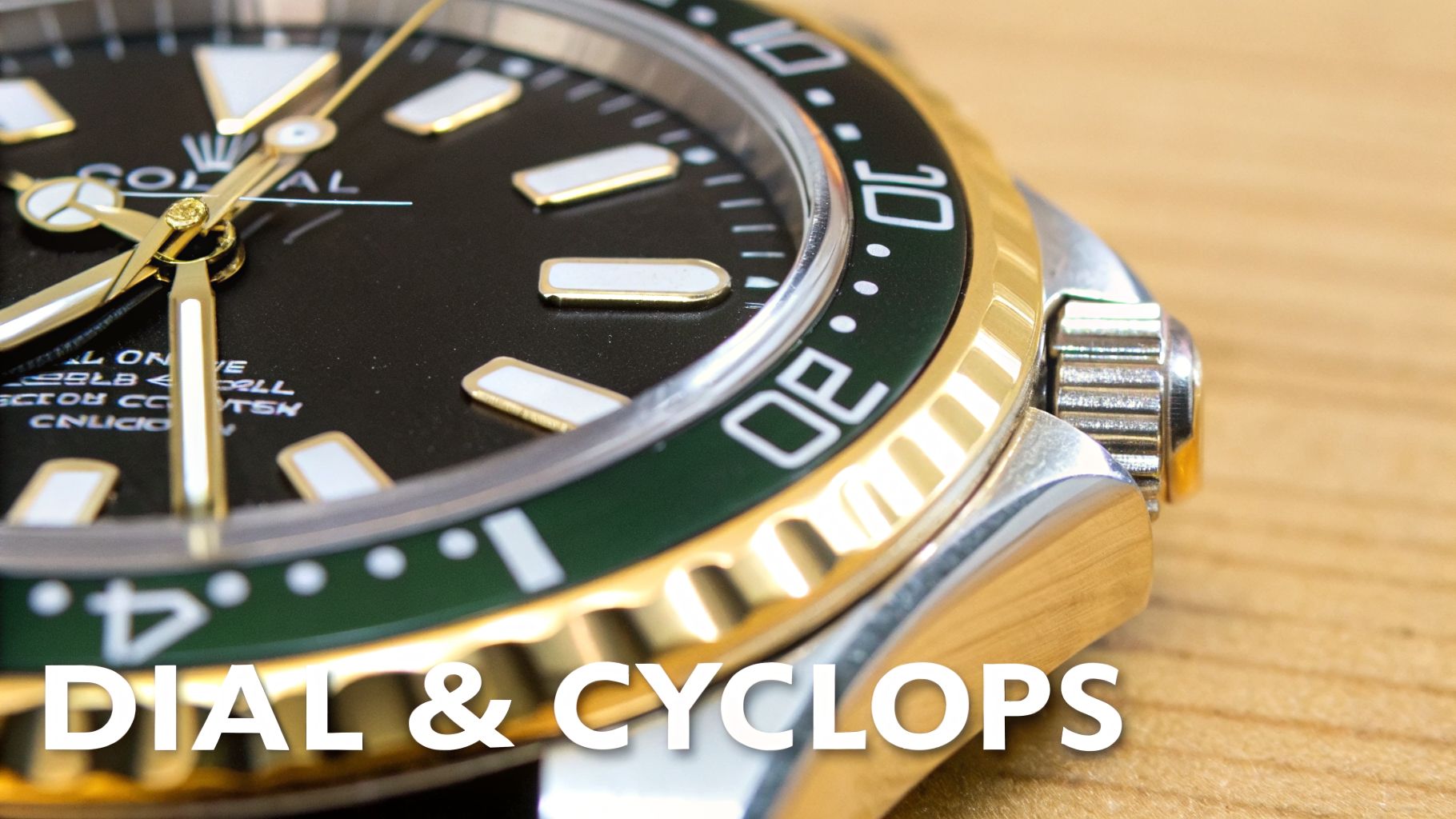
Once you've handled the basics, it’s time to get up close and personal with the face of the watch. The dial, bezel, and crystal are where Rolex’s obsession with perfection truly shines, and it’s also where most counterfeiters cut corners. Get your loupe ready—this is where the fakes give themselves away.
Start by zooming in on the dial text. On a genuine Rolex, every single letter is flawless. The printing is crisp with razor-sharp edges, creating a slightly raised effect that you can almost feel. You should find absolutely no smudging, bleeding, or fuzzy lines, even under serious magnification.
Pay close attention to the spacing. Rolex uses a proprietary font and kerning (the spacing between characters) that forgers find almost impossible to get right. On fakes, you'll often see the letters in "OYSTER PERPETUAL" or "SUBMARINER" looking cramped or just slightly out of line. It's a subtle clue, but a dead giveaway once you know what to look for.
Inspecting The Markers And Coronet
Now, shift your focus to the applied elements on the dial—the hour markers and the famous Rolex coronet at the 12 o'clock position. On a real Rolex, these are almost always crafted from precious metals like 18k white gold, even on stainless steel models. This isn't just for looks; it prevents any possibility of tarnishing over time.
These markers are set with surgical precision. They must be perfectly straight, evenly spaced, and finished without a single flaw. A loupe will reveal sharp, clean angles and beautifully polished surfaces. Replicas, on the other hand, often have markers that are poorly glued on, appearing crooked, dull, or with rough, unfinished edges.
The Rolex coronet itself is a major tell. A real crown has five distinct points with tiny, perfectly round spheres at the tips. The entire emblem is well-defined with a clean, embossed look. Fakes tend to have crowns that look flat and lifeless, with pointy or misshapen tips.
The Unmistakable Cyclops Lens
The Cyclops lens over the date is one of the most poorly replicated features, and luckily, one of the easiest to spot. Rolex designed its lens to magnify the date by a very specific power: exactly 2.5x. This makes the date literally "pop," filling the entire window for maximum legibility.
Counterfeit watches almost never achieve this. Their magnification is usually weak, often around 1.5x, which makes the date look small, off-center, and a bit pathetic. If you glance at the date and it doesn’t jump out at you, your alarm bells should be ringing.
A genuine Cyclops has a very distinct, raised bump on the crystal. If you run your finger over it, it should feel prominent. Fakes often feel too flush. You'll also find a tiny, almost invisible anti-reflective coating applied just under the lens on a real one.
Here’s another quick check: watch the date change at midnight. On most modern Rolex movements, the date snaps over to the next day instantly. Cheaper fake movements often have a slow, dragging date change that can take an hour or more to complete.
Evaluating The Bezel's Function And Finish
A Rolex bezel isn't just for decoration; it’s a functional piece of high-precision engineering. The specifics will vary by model, but the standard of quality is universal.
For a Submariner or GMT-Master II, the rotating bezel is a mechanical masterpiece. Here’s what you should check:
- Unidirectional Action (Submariner): A Submariner bezel is a dive-safety tool, so it must only turn counter-clockwise. If it spins both ways, it’s a fake. No exceptions.
- Precise Clicks: A modern genuine bezel makes 120 sharp, satisfying clicks in a full 360-degree rotation. The sound is clean and mechanical, never loose or gritty. Fakes often have fewer clicks (maybe 60 or 90) or feel mushy.
- Ceramic Insert: On modern Cerachrom bezels, the numbers are engraved into the ceramic and then filled with a layer of platinum or gold. They should look crisp and slightly recessed, not simply printed on the surface.
If you’re looking at a Datejust or Day-Date with a fluted bezel, the quality of the finishing is key. The fluting on a real Rolex will be incredibly sharp and precise, creating a brilliant starburst effect as it catches the light. The peaks and valleys are perfectly uniform. Fakes typically have soft, rounded fluting that looks dull and feels like it was cast from a cheap mold rather than expertly cut.
The Inimitable Feel Of A Genuine Rolex
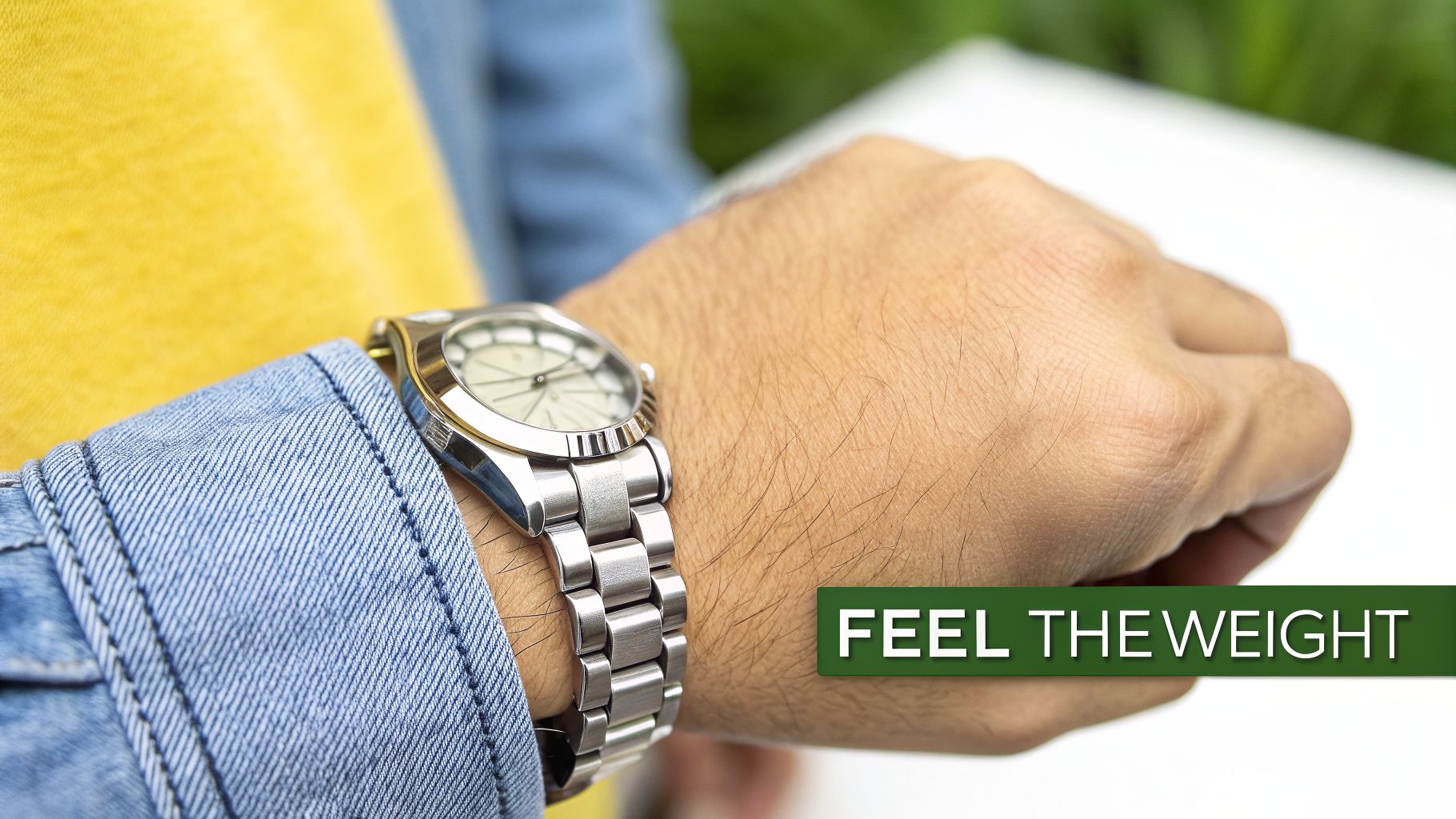
After you’ve handled enough watches, you start to develop a sixth sense for the real deal. It’s a feeling that goes beyond what you can see. The moment you pick up a genuine Rolex, there’s a substantial, unmistakable presence that even the best forgeries can’t quite get right. Trust that instinct. If a watch feels anything less than exceptional, it probably is.
This feeling starts with the sheer weight and density of the materials. Rolex is one of the very few watchmakers that forges its own steel, a proprietary alloy called 904L Oystersteel. It’s not just more corrosion-resistant than the standard 316L steel used in nearly every fake; it’s noticeably heavier. A real Rolex feels solid, balanced, and significant on your wrist.
So, if you pick up a supposed steel Submariner and it feels surprisingly light or flimsy, that’s a massive red flag. You're almost certainly holding a counterfeit made with cheaper, less dense metal.
Assessing The Bracelet And Clasp
Now, let's get our hands on the bracelet. This is where Rolex’s obsessive engineering really shines. A genuine Oyster or Jubilee bracelet feels like a single, seamless unit. The links are machined with such tight tolerances that the entire construction feels both flexible and incredibly solid at the same time.
Give the bracelet a little shake. A real Rolex bracelet, especially on a modern reference, will have very little "rattle" or stretch. Fakes, on the other hand, often sound and feel jangly, loose, and cheap. You can see noticeable gaps and play between the links—they just don't have the integrity.
The clasp is one of the most revealing components. It’s a high-touch area, and it's where counterfeiters’ cost-cutting becomes glaringly obvious. A genuine Rolex clasp closes with a secure, satisfying click that just screams confidence.
When you snap the safety latch on a real Rolex Oysterlock clasp, you'll hear a crisp, metallic click. There’s zero mushiness or hesitation. It’s the sound of precision engineering that is incredibly difficult and expensive to replicate.
Once it's closed, run your fingers over the clasp. The edges should feel perfectly smooth and finished, with no rough or sharp spots. And look at the engravings, like the Rolex coronet—they should be deep, crisp, and beautifully defined, not just shallowly etched or stamped on.
Testing The Clasp’s Functionality
Many modern Rolex sport models have brilliant adjustment systems that are a counterfeiter's worst nightmare. Putting these mechanisms through their paces is a fantastic real-world authenticity test. For anyone entering the secondary market, understanding the small details is key, and getting familiar with the general principles of buying used luxury watches can provide crucial context for these hands-on evaluations.
Pay special attention to these two common systems:
- The Glidelock System: You'll find this on professional models like the Submariner and Sea-Dweller. It lets you make fine adjustments without any tools. Just lift the inner panel of the clasp, slide the bracelet in 2mm increments, and snap it back down. The action should feel buttery smooth and lock securely.
- The Easylink System: This system is common on models like the Datejust and GMT-Master II, giving you a quick 5mm extension. You simply "unfold" a hidden link from inside the clasp. The mechanism should operate effortlessly with a gentle pull and lock back into place with confidence.
Go ahead and test these features. A fake Glidelock will often feel gritty, get stuck, or have a clumsy release. A counterfeit Easylink might not lock properly or feel flimsy and insecure. This kind of functional testing is powerful because it’s not just about how the watch looks, but how it works—and that’s where true quality always reveals itself.
Verifying The Heartbeat: The Rolex Movement
After you've scrutinized every detail on the outside of a watch, it’s time to look at its heart and soul: the movement. For an experienced authenticator, opening the case back is the final word. It’s like looking at the watch’s mechanical DNA, and it's where even the most convincing fakes fall apart.
A word of caution, though: this is not a do-it-yourself job. Rolex Oyster cases are sealed tight to guarantee water resistance, and you need specialized tools to open them without causing serious, permanent damage. Please, leave this step to a certified watchmaker.
What A Genuine Rolex Movement Looks Like
The moment a professional opens that case back, any lingering doubts usually vanish. A genuine Rolex caliber is a masterpiece of industrial engineering, finished to an incredible standard. Every surface, even the parts an owner will never see, is meticulously decorated.
This is the exact point where even high-end replicas, sometimes called "super-clones," can't keep up the act. They might try to copy the overall design, but they simply can't replicate the finesse.
Here’s what an expert is trained to spot:
- Impeccable Finishing: We look for the beautiful circular graining (perlage) on the plates and perfectly beveled edges. Fakes often have rough machine marks, unfinished surfaces, and sometimes even specks of dust trapped inside.
- The Iconic Red Reversing Wheels: Many of Rolex’s workhorse automatic movements, like the famous Caliber 3135, have distinct, anodized red gears in the winding system. On fakes, these wheels are often painted, made of cheap plastic, or just the wrong shade of red.
- Crisp Engravings and Jewel Settings: All the engravings on a real Rolex rotor and its bridges are sharp, deep, and immaculate. The synthetic rubies (the jewels) are set perfectly. On a counterfeit, you’ll see sloppy engravings and cloudy jewels that look like they were just dropped in place. To see what true craftsmanship looks like, you can learn more about the legendary Rolex 3135 movement.
The Telltale Sweep of the Seconds Hand
Even if you can't open the watch, you can still get clues about the quality of the movement inside. The most famous tell is the sweep of the seconds hand.
A modern Rolex movement beats at 28,800 vibrations per hour (vph). That translates to 8 ticks per second, creating that iconic, fluid glide around the dial. Many cheaper fakes use movements with a lower beat rate, which results in a noticeably stuttered or choppy motion.
A genuine Rolex movement isn't just made to look good—it's built for world-class performance and a lifetime of reliability. This internal quality is the bedrock of the brand's entire reputation.
The Importance Of Pressure Testing
Once the movement inspection is complete, a professional will always reseal the watch and perform a pressure test. This is an absolutely essential part of any proper authentication or service. Using specialized equipment, the test confirms that the case, crown, and crystal seals are all sound and meet Rolex’s strict water-resistance standards.
A watch that fails a pressure test has a serious problem. It could have a bad gasket or an improperly tightened case back, leaving it vulnerable to moisture, dust, or catastrophic water damage. This test doesn't just verify the integrity of a genuine Oyster case; it proves the watch is ready to perform as intended, protecting your investment for years to come.
What's The Big Deal With Box and Papers?
In the watch world, you'll hear the term "full set" thrown around a lot. It's considered the gold standard and means the watch comes with everything it had when it left the authorized dealer: the original box, warranty card or papers, manuals, and maybe even the little hang tags. For any buyer, this is a huge plus, offering a clear history—or provenance—and an immediate sense of confidence.
But let's be realistic. Over the decades, life happens. People move, boxes get tossed, and paperwork gets lost. It’s incredibly common, and it certainly doesn't mean a watch is a fake. What it does mean is that we have to put the physical watch itself under an even more powerful microscope, making all the hands-on checks we've discussed even more critical.
How to Spot Fake Rolex Paperwork
If a watch does come with papers, you have to vet them just as hard as the watch. Fakers are getting scarily good at creating bogus documentation to go along with their bogus watches. A genuine modern Rolex warranty card, for example, is a little piece of high-tech security.
Here's what I look for on modern cards:
- Feel and Finish: A real card is sturdy plastic, not flimsy cardboard. Run your finger over the background—it should have a distinct, fine, almost sand-like texture that counterfeiters struggle to get right.
- Raised Details: The serial and reference numbers are embossed, meaning they are raised and have a tactile feel. They shouldn't just be printed flat on the surface.
- Hidden Tech: On cards from 2020 onward, Rolex embedded an NFC chip you can scan with a smartphone, which links to their site. These newer cards also hide patterns that only show up under a UV light.
If the font looks blurry, the card feels cheap, or those security features are missing, you’re almost certainly looking at fake papers. And if the papers are fake, you can bet the watch is, too.
Does a "Full Set" Actually Add Value?
Absolutely. Having a complete, verified set of box and papers has a major impact on a Rolex's market value. A watch with its full provenance can easily fetch a 15-25% price premium over a "naked" watch (one with no accessories). For a serious collector, that premium is well worth it for the peace of mind and historical record.
The stakes are high. The market for fakes is alarmingly huge, especially in the US, where watches make up 19% of all counterfeit goods purchased by the 24% of consumers who admit to being scammed. If you want to go down that rabbit hole, you can read the full study on the US counterfeit watch market.
A lack of papers isn’t a dealbreaker, but it is a demand for greater scrutiny. It means you must be unequivocally confident in the seller's expertise and transparency.
Is It Safe to Buy a Watch Without Papers?
Buying a naked watch can be a fantastic way to get into a grail watch at a more accessible price. But it all comes down to one thing: absolute trust in the person or company authenticating it.
Here at Perpetual Time, every single watch that comes through our door—with or without papers—gets the same exhaustive, multi-point inspection. We're checking serial numbers against our databases, opening the case back to verify the movement, and confirming every last detail against factory specs. It's the only way to operate.
This is where a seller's transparency is everything. When papers are missing, you have every right to ask for more. You should expect crystal-clear photos, detailed notes on the watch’s condition, and a business that stands behind the watch's authenticity with an ironclad guarantee. For more on this, our guide on how to buy a used Rolex is packed with essential tips for a safe purchase.
In the end, while provenance is a powerful story, the real truth is always found inside the watch itself.
Common Rolex Authentication Questions
When you're diving into the world of pre-owned Rolexes, a few questions always seem to pop up. Let's tackle some of the most common ones we hear from buyers and collectors to give you some real-world, practical advice for your search.
Can I Authenticate A Rolex By Serial Number Online?
This is a big one, and the short answer is a hard no. While you can use online databases to get a rough production date for a pre-2010 Rolex, this does not confirm authenticity. Think about it: copying a legitimate serial number and engraving it onto a fake is one of the easiest things for a counterfeiter to do.
True authentication goes way beyond a string of digits. It's about the microscopic details—the crispness of the engraving, the finish on the case, the printing on the dial, and of course, the movement ticking inside. A serial number is just one piece of the puzzle, never the entire solution.
Is The Sweeping Second Hand A Guaranteed Sign?
A beautifully smooth, sweeping second hand is a classic Rolex trait. That distinct glide, usually at eight beats per second, is a hallmark of the high-quality mechanical movements Rolex is famous for. It’s certainly a great sign.
But it's not a foolproof guarantee. The makers of top-tier fakes, often called "super-clones," have gotten frighteningly good at mimicking this motion. On the flip side, don't forget that some authentic Rolex models, like the vintage Oysterquartz, were built with quartz movements and have a distinct one-second tick. Relying on the sweep alone is a dangerous shortcut.
Trust your instincts, especially when it comes to the tangible feel of the watch. If something feels off—whether it’s the weight, the sound of the clasp, or the action of the bezel—it’s a signal to investigate further, not to dismiss your gut feeling.
What If The Watch Feels Too Light?
Your hands can be one of your best authentication tools. A genuine Rolex has a certain heft, a solid and substantial feel that comes from using premium materials. Modern models are crafted from Rolex's own 904L steel or precious metals, which are incredibly dense. The quality of these materials is a huge factor in what drives the resale Rolex value.
If you pick up a watch and it feels surprisingly light or flimsy, that’s a massive red flag. It’s a tell-tale sign that it might be made from cheaper 316L steel, which is common in fakes, or worse, a plated base metal. If you ever have the chance, try to handle a confirmed genuine model to get a feel for the proper weight and balance. It makes a world of difference.
At Perpetual Time, we eliminate all guesswork. Every watch we offer is rigorously authenticated and guaranteed, ensuring your purchase is not just an investment in a beautiful timepiece, but an investment in confidence. Explore our collection of certified pre-owned luxury watches at PerpetualTime.com.


