
Cart
0

When you get down to it, the real difference between Audemars Piguet and Rolex comes down to a fundamental philosophy. Rolex builds iconic, rock-solid tool watches made for everyday life and instant recognition, while Audemars Piguet creates wearable art with bold designs and incredibly complex, hand-finished movements. It's a choice between functional, everyday luxury and exclusive, high-craft watchmaking.
AP vs Rolex The Definitive Comparison
Deciding between these two giants is a rite of passage for many collectors. It’s a classic matchup, pitting the most famous luxury watch brand in the world against one of the pillars of true haute horlogerie. This guide is here to break it all down, helping you figure out which industry titan fits your style, your life, and your long-term goals.
Rolex built its empire by making precision instruments that are as dependable as they are prestigious. From the bottom of the ocean to the top of Mount Everest, their watches are engineered for real-world performance and have become an undeniable symbol of success. As we cover in our guide on why Rolex remains the ultimate status symbol, the brand's power is in its unwavering consistency and mass appeal.
Audemars Piguet, on the other hand, stands for a different kind of luxury. As one of the "Holy Trinity" of Swiss watchmaking, AP has stayed in the family since it was founded in 1875, and they've never stopped pushing the limits of design and mechanical engineering. AP speaks to the enthusiast—the person who truly values the intricate, artistic details you can see through a sapphire caseback.
The heart of the AP vs Rolex debate is really a choice between two types of perfection. Rolex offers perfected industrial luxury, while Audemars Piguet delivers artisanal exclusivity. One is an icon of achievement; the other is a masterpiece of craft.
To make the right call, you need to look past the surface and understand what each brand truly stands for in the market. This comparison will take you beyond the obvious and dig into the core differences that define them.
Quick Comparison AP vs Rolex at a Glance
To kick things off, this table gives you a bird's-eye view of the core philosophies driving Audemars Piguet and Rolex. It's a great starting point for understanding the key distinctions we'll be exploring in more detail.
| Aspect | Audemars Piguet (AP) | Rolex |
|---|---|---|
| Core Identity | Horological Artistry & Avant-Garde Design | Robust Engineering & Timeless Functionality |
| Market Position | Exclusive 'Holy Trinity' Watchmaker | Dominant Mass-Luxury Market Leader |
| Best Known For | Complex movements and intricate hand-finishing | Durability, reliability, and brand recognition |
| Ideal Owner Profile | The watch connoisseur seeking haute horlogerie | The individual seeking a symbol of success and a daily wearer |
This quick summary sets the stage. AP is about pushing the boundaries of craft, while Rolex is about perfecting an icon. Now, let's dive into the specifics.
Brand Heritage: Where AP and Rolex Come From
To really get to the heart of the AP vs. Rolex question, you have to look at where they came from. These two brands sit at the pinnacle of Swiss watchmaking, but they climbed entirely different mountains to get there. Their histories aren't just trivia; they're the DNA that shapes every watch they make today.
Rolex was the brainchild of Hans Wilsdorf, a marketing visionary who, back in 1905, saw a future for the wristwatch when most considered it a flimsy piece of jewelry. He wasn't a traditional watchmaker from the Swiss valleys; he was a brilliant businessman obsessed with a simple idea: making wristwatches tough and reliable enough for daily life. He proved his point with the first-ever waterproof watch, the Oyster, in 1926. That one innovation set the course for the next century, cementing Rolex's reputation for building bulletproof tools for professionals—divers, pilots, adventurers, you name it.
Rolex: The Unquestionable King of Luxury Watches
Rolex's dominance today is a direct line from that early vision. They mastered the art of high-volume production while maintaining an insane level of quality, a feat no one else has replicated. Their name became a byword for dependability and success.
The numbers don't lie. As of 2023, Rolex commands a massive 32% retail market share, completely overshadowing every other brand. This power is just as strong on the pre-owned market, where it makes up 34.2% of all global sales. It's the most recognized, most sought-after, and most liquid watch brand on the planet. With over $11.43 billion in sales in 2024, Rolex isn't just a watchmaker; it's a global cultural icon. You can dig deeper into these figures in the latest Swiss watch brands report on chronohunter.com.
The Bottom Line: Rolex's story is one of relentless innovation and marketing genius. It's an industrial powerhouse that produces iconic, ultra-reliable watches at a scale that defies belief.
Audemars Piguet: A Bastion of High Watchmaking
Audemars Piguet, on the other hand, was born in a completely different tradition. Founded way back in 1875 by Jules Louis Audemars and Edward Auguste Piguet, AP has been family-owned since day one. That independence is crucial—it has allowed them to focus purely on the art of complex, handcrafted watchmaking without answering to shareholders.
AP is a member of the "Holy Trinity" of watchmaking, a title it shares with Patek Philippe and Vacheron Constantin. This isn't just marketing fluff; it's a recognition from collectors for brands that have consistently produced the most exquisite and complicated timepieces in history. While Rolex was focused on making watches that could survive a dive to the Mariana Trench, AP was creating grand complications and pushing the boundaries of design.
This commitment to craft and exclusivity is what defines AP's place in the market. They produce a tiny fraction of the watches Rolex does, catering to a collector who prioritizes artistry and rarity above all else. Their defining moment came in 1972 with the Royal Oak, a watch so bold and unconventional it single-handedly created the luxury sports watch category. Rolex may have perfected the genre for the masses, but AP invented it. At its core, the AP vs. Rolex debate comes down to this very tension: old-world artisanal mastery versus unstoppable industrial perfection.
Comparing Signature Models: Royal Oak vs. Submariner
To truly get to the heart of Audemars Piguet and Rolex, you have to look at their most iconic creations: the Royal Oak and the Submariner. These aren't just watches; they're the purest expressions of each brand’s entire philosophy. Putting them head-to-head is where the real differences—and the core of the AP vs. Rolex decision—come to light.
The Audemars Piguet Royal Oak, penned by the legendary Gérald Genta in 1972, was nothing short of a revolution. It completely upended the luxury watch world by launching a stainless steel sports watch that cost more than most gold dress watches of the day. Its design was bold and unapologetic, with an octagonal bezel inspired by a vintage diver's helmet, eight exposed hexagonal screws, and a bracelet that flowed seamlessly from the case.
The Rolex Submariner, introduced back in 1953, was the polar opposite. It was a tool, first and foremost. As one of the original dive watches, it was engineered for a single, critical purpose: to be a bulletproof and easy-to-read instrument for professional divers. Its form was dictated entirely by its function, resulting in a classic round case, a rotating bezel to track elapsed time, and a dial built for maximum clarity in the murkiest depths.
Design Philosophy: A Study In Contrasts
Aesthetically, the Royal Oak and Submariner are worlds apart. The Royal Oak is all about architectural complexity and exquisite finishing. Its case is a masterpiece of sharp, dynamic angles, with satin-brushed surfaces set against mirror-polished bevels that play with light beautifully. The integrated bracelet isn't an afterthought; it's a piece of jewelry in itself, composed of hundreds of meticulously hand-finished components.
The Submariner’s design, on the other hand, is a masterclass in refined utility. Its iconic Oyster case is smooth, tough, and engineered to handle crushing underwater pressure. Over the decades, Rolex has only made small, incremental changes, focusing on enhancing durability and performance rather than chasing design trends. It's a look that is instantly recognizable and respected for its timeless, purpose-built appeal.
This market overview captures the scale and influence of these two horological titans.
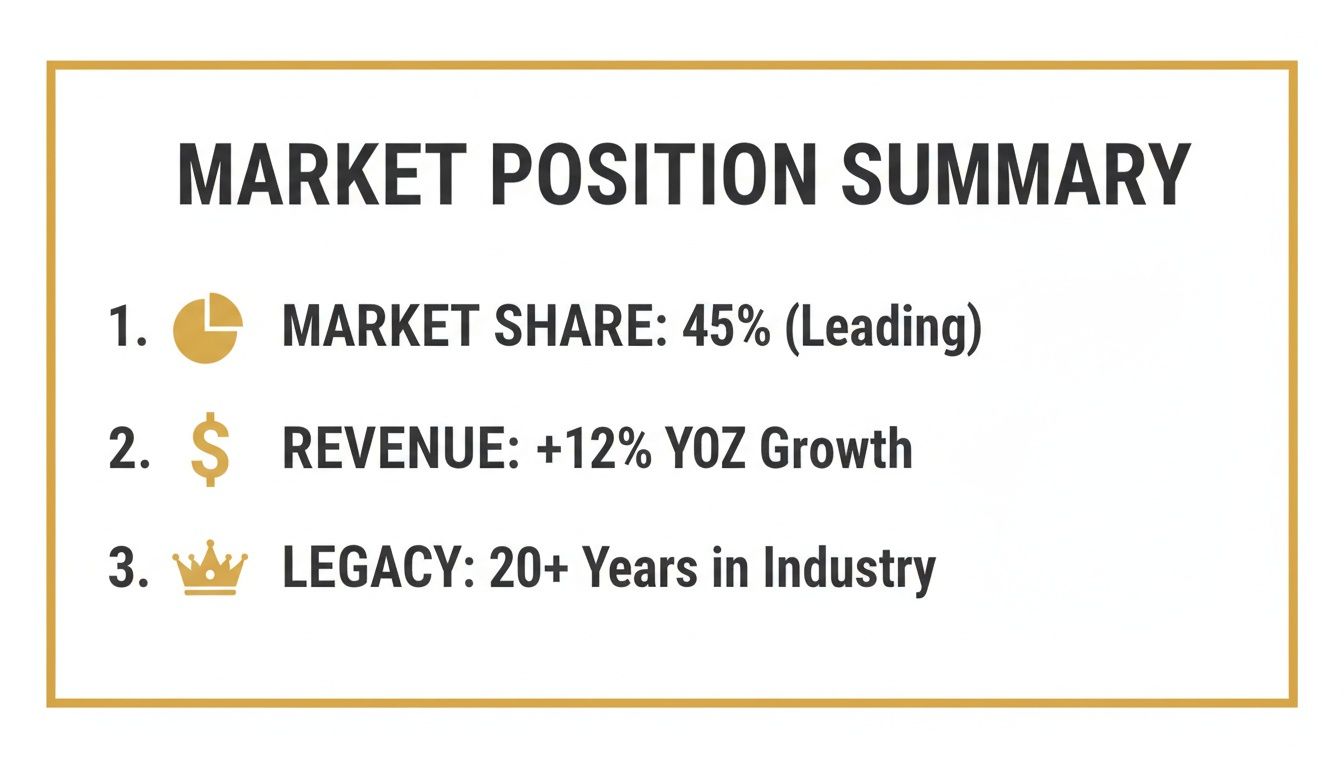
The data puts Rolex's massive market share and revenue into perspective, while also showing the incredible legacy and brand power both companies wield.
Dial Craftsmanship: Art vs. Utility
The dials tell the same story of opposing philosophies. The Royal Oak is famous for its intricate Petite Tapisserie pattern, a detailed guilloché dial created using a century-old pantograph machine that takes incredible skill to operate. This textured, grid-like pattern gives the dial a visual depth and complexity that is purely for aesthetic appreciation.
The Submariner's dial is the benchmark for legibility. Its large, lume-filled hour markers and broad hands are designed to be read in a split second, whether you're in a meeting or 300 meters below the surface. Every single element is there for a reason, from the high-contrast black dial to the powerful Chromalight display that glows a cool blue in the dark.
The Royal Oak's dial invites you to look closer and admire its artistry. The Submariner's dial gives you the information you need, instantly and without fuss. This single distinction gets to the core of the AP vs. Rolex comparison.
Movement and Technical Execution
Under the hood, the differences are just as stark. Audemars Piguet is celebrated for its stunningly finished, and often remarkably thin, in-house movements. On many Royal Oak models, a sapphire crystal caseback allows you to admire the intricate craftsmanship, from the decorated bridges to the solid gold winding rotor. The emphasis is on mechanical elegance and visual perfection.
Rolex movements, like the Calibre 3235 in the modern Submariner, are intentionally hidden behind a solid steel caseback. They aren't meant to be seen; they're built to perform flawlessly for years with minimal intervention. These are rugged, highly accurate workhorse calibers, engineered for extreme precision, shock resistance, and long-term reliability. When you consider a watch like the Rolex Submariner 41mm 126610, you're buying into that legacy of unmatched dependability.
Let's break down the key differences in a simple format.
Royal Oak vs Submariner Key Differentiators
| Feature | Audemars Piguet Royal Oak | Rolex Submariner |
|---|---|---|
| Design Language | Architectural, angular, complex finishing | Functional, robust, purpose-built tool |
| Bezel | Fixed octagonal bezel with 8 exposed screws | Unidirectional rotating 60-minute dive bezel |
| Bracelet | Integrated, tapering bracelet with fine finishing | Three-link Oyster bracelet with Glidelock clasp |
| Dial Signature | Petite Tapisserie guilloché pattern | High-contrast with large luminescent markers |
| Movement Focus | Aesthetic beauty, thinness, fine finishing | Robustness, accuracy, long-term reliability |
| Water Resistance | Typically 50 meters | 300 meters (1,000 feet) |
| Primary Appeal | Wearable art, horological craftsmanship | Timeless icon, go-anywhere durability |
Ultimately, choosing between these two icons boils down to what you prioritize in a watch. The Royal Oak is for the enthusiast who views a timepiece as wearable art, someone who values avant-garde design and visible mechanical craftsmanship.
The Submariner is for the person who wants a timeless, indestructible icon that represents a legacy of performance and is ready for absolutely anything.
Analyzing Investment Potential and Resale Value
For many of us, a luxury watch isn't just a passion piece; it's a hard asset. When you stack AP against Rolex, their performance on the secondary market tells two very different but equally compelling stories. Both are fantastic stores of value, but they appeal to completely different financial mindsets and risk appetites.
Think of Rolex as the "blue-chip stock" of the watch world. It’s remarkably stable and predictable, especially the stainless steel sports models like the Submariner and GMT-Master II. The brand's insane global demand, paired with tightly controlled production, creates a price floor that’s almost impossible to beat.
This rock-solid stability makes Rolex a perfect entry point for anyone looking to invest in watches. The models are incredibly liquid—meaning you can sell one fairly quickly without taking a major hit—which is a crucial factor for any asset. There's a real sense of security that comes with buying a Rolex.
Audemars Piguet: The High-Growth Asset
Audemars Piguet, on the other hand, is a different beast entirely. It’s more like a high-growth, high-reward asset. The cost to get in the game is significantly higher, both at retail and on the open market. But if you land the right piece, the potential for explosive appreciation, particularly with sought-after Royal Oak references, can blow Rolex out of the water.
What drives this? Pure, unadulterated scarcity. AP makes far fewer watches than Rolex, and getting your hands on a popular model from a boutique usually means a very long wait or a very deep purchase history. This chokehold on supply fuels a feeding frenzy on the secondary market, sending prices for certain models to multiples of their original sticker price.
The numbers don't lie. Certain AP models have shown an average value increase of a staggering 64.85% over a five-year period. This performance has outpaced major financial benchmarks like the DAX index and even LVMH stock. With sales hitting $2.66 billion in 2024, it's clear that an AP is a serious investment vehicle. You can dig deeper into these market share battles on vertu.com.
While Rolex brings stability and broad-market strength to the table, Audemars Piguet offers the potential for much higher returns fueled by exclusivity and rarity. Your choice really comes down to whether you want a secure, liquid asset or a more dynamic, high-appreciation investment.
Market Dynamics and Key Value Drivers
The resale value for both brands is propped up by powerful market forces. Getting a handle on these drivers is the key to making a smart buy.
What Keeps Rolex Values High?
- Brand Equity: Simply put, Rolex is the most recognized luxury watch brand on the planet. This creates a massive, constant pool of buyers.
- Production vs. Demand: Even while making close to a million watches a year, demand for key models still swamps the available supply.
- Built to Last: These watches are tough. Their robust construction means they hold up exceptionally well, making them a safe bet on the pre-owned market. Get the full scoop in our guide on the factors influencing the resale Rolex value.
What Drives Audemars Piguet's Value?
- Extreme Scarcity: With tiny production runs for coveted models like the Royal Oak "Jumbo," collectors are always fighting over the few that become available.
- Masterful Craftsmanship: The sheer level of hand-finishing and horological artistry justifies the premium price and attracts serious connoisseurs willing to pay for it.
- Unmatched Prestige: As a member of watchmaking’s "Holy Trinity," AP carries a level of prestige that resonates with the very top of the market.
Ultimately, your investment strategy should mirror your personal goals. If you're looking for a dependable store of value with high liquidity and a proven track record, a stainless steel Rolex sports model is a no-brainer. But if you have a higher tolerance for risk and are chasing greater potential capital gains through rarity, a sought-after Audemars Piguet Royal Oak might just be the smarter financial move.
Navigating The Ownership Experience

The thrill of buying a new watch is one thing, but living with it day-in and day-out is where the real differences between Audemars Piguet and Rolex come to light. This is about more than just brand prestige; it’s about how the watch fits into your actual life, from its durability on your wrist to the cost of keeping it running perfectly.
Rolex has earned its crown by building some of the most reliable and robust timepieces on the planet. A Submariner or Explorer isn't just a watch; it's a tool engineered to be worn everywhere and do everything. You simply don't have to worry about them. Their tough Oystersteel cases and bracelets are made to take the knocks of an active life and keep on ticking.
Audemars Piguet, on the other hand, requires a bit more care. The Royal Oak is a masterpiece of finishing, with its razor-sharp angles and interplay of brushed and polished surfaces. It’s absolutely stunning, but that level of artistry means it's also more vulnerable to the realities of daily life. Every desk corner and door frame suddenly becomes a potential hazard.
Durability And Daily Wear
The real story of wearability is told in the finishing. A scratch on the brushed bracelet of a Rolex Submariner often just blends in, adding to the watch's story and character over time. But a similar mark on a Royal Oak's meticulously finished bezel can feel like a glaring flaw, disrupting its clean, architectural beauty.
Ultimately, choosing a daily wearer is a lifestyle decision. If you want a watch you can set, forget, and wear without a second thought, Rolex is the undisputed champion. If you derive joy from appreciating fine craftsmanship and are naturally mindful of what's on your wrist, the Royal Oak is an incredibly rewarding companion.
This practical difference is baked into their very construction. Rolex models are famous for their tank-like build and high water resistance, making them as suitable for yard work as they are for a board meeting. An AP is a solidly built watch, no question, but it’s far more at home in the office than it is at the beach. Spotting the signs of this robust construction is crucial when buying pre-owned, and our guide on how to tell if your Rolex is real can help you learn what to look for.
Servicing Costs And Accessibility
Like any high-performance machine, these watches need regular maintenance to stay in top condition. Both brands generally recommend a service every 5-10 years, though this can vary based on how you use the watch.
This is where Rolex pulls ahead in terms of convenience. Its massive global network of service centers makes finding a certified technician easy. A routine service for a common steel model will typically run between $800 and $1,200, and you can usually expect your watch back in a few weeks to a couple of months.
Getting an Audemars Piguet serviced is a different ballgame—more exclusive and definitely more expensive. The sheer complexity of the movements and the skill needed to correctly refinish the intricate cases mean servicing is best left to AP's own workshops. A standard service on a Royal Oak starts around $1,500 and can go up quickly from there, especially for complicated models. Be prepared for longer wait times, too, often stretching for several months. This is a crucial, real-world cost that has to be factored into the price of ownership.
Acquiring Your Timepiece: The Pre-Owned Advantage
Let's be realistic. For the most coveted Audemars Piguet and Rolex models, walking into an authorized dealer and buying one on the spot is pretty much a fantasy. Unless you have a long and storied purchase history, you'll likely face an indefinite wait.
This is why the pre-owned market has become the main way most enthusiasts actually get their hands on a grail watch. But diving in without a guide is a risky proposition.
Private sellers and open marketplaces can be a minefield. You're not just dodging outright fakes; you're also trying to avoid watches with undisclosed service needs, shoddy aftermarket parts, or hidden mechanical problems that can turn a dream purchase into a nightmare. Authenticating these complex timepieces is a job for a seasoned pro.
Why Work With a Certified Dealer?
This is where a trusted specialist like Perpetual Time changes the game entirely. We don't just connect buyers and sellers—we own every single watch we list. This isn't a minor detail; it means we have skin in the game and are fully accountable for the quality and authenticity of our inventory.
Think of a certified dealer as your personal firewall against risk. We put our expertise on the line to meticulously vet every single watch for authenticity, mechanical health, and provenance before it ever gets near a customer.
Our verification process is exhaustive and goes far deeper than a quick look under a loupe. It's a comprehensive, multi-point inspection of the watch's DNA.
Key Verification Steps:
- Serial and Reference Check: We meticulously cross-reference serial numbers with manufacturing records to confirm the watch’s age, model, and configuration are all correct.
- Movement Inspection: Our in-house watchmakers conduct a deep examination of the caliber, ensuring it's 100% authentic, running to spec, and free of any non-genuine components.
- Case and Bracelet Analysis: We scrutinize every detail of the case, dial, and bracelet to verify originality. We're looking for factory-correct finishing and flagging any signs of improper polishing or alterations.
This rigorous process means no unpleasant surprises. The watch you see online is exactly the watch you'll get. If you want to learn more about the specifics, our guide on buying used luxury watches is a great resource.
By backing every watch with a warranty and a promise of complete transparency, we provide the peace of mind you need when making such a significant investment. This is what makes the pre-owned market the smartest, safest, and most practical path to finally owning that perfect Audemars Piguet or Rolex.
Answering Your Final Questions: AP vs. Rolex
Even after breaking it all down, a few key questions always seem to pop up when it's time to make that final decision. Let's tackle the most common ones head-on so you can choose with total clarity.
Which Brand Holds Its Value Better, AP or Rolex?
Both of these brands are absolute titans on the secondary market, but they play the investment game very differently. Rolex, especially its steel sports models, offers incredible stability and liquidity. Think of it as the blue-chip stock of the watch world—demand is constant, predictable, and your value is exceptionally well-protected.
Audemars Piguet is a different beast entirely. In-demand Royal Oak models can deliver much higher percentage gains, acting more like a high-growth asset. The flip side? That market can be more volatile. So, if you're after stable, reliable value retention, Rolex is the undisputed king. If you're chasing higher potential appreciation (and have the higher entry price), AP is a top contender.
Is Audemars Piguet More Prestigious Than Rolex?
This really depends on how you define "prestige." In the exclusive circles of haute horlogerie—the high art of watchmaking—Audemars Piguet is widely considered more prestigious. It's part of the "Holy Trinity" of watchmaking, alongside Patek Philippe and Vacheron Constantin, a title earned through centuries of crafting complex movements and exquisite hand-finishing.
Rolex, on the other hand, holds a different, but equally powerful, kind of prestige. It's the universally recognized symbol of success and achievement. Its prestige comes from being an icon, from its bulletproof reputation, and from being known and desired across the globe.
Ultimately, AP’s prestige is about artistry and exclusivity. Rolex’s is about cultural dominance and accomplishment.
Can I Wear An Audemars Piguet Royal Oak Every Day?
Absolutely, but you'll need to be more careful with it than you would a Rolex. The Royal Oak's iconic design is a symphony of sharp angles, brushed surfaces, and polished chamfers. While stunning, this intricate finishing is more prone to showing the dings and scratches of daily life.
A Rolex Submariner or GMT-Master II is built from the ground up to be a tool. Its case and bracelet are engineered to take a beating and keep on ticking. If your priority is a tough, "go anywhere, do anything" watch that you never have to worry about, a Rolex is simply the more practical choice for a true daily driver.
At Perpetual Time, we know that choosing the right watch is a personal journey. Our collection of certified pre-owned Audemars Piguet and Rolex timepieces is inspected, authenticated, and backed by our in-house experts, giving you complete peace of mind with your investment. Explore our curated selection and find your perfect watch today.


