
Cart
0

The real difference boils down to one simple question: do you want a daily ritual or everyday convenience? A manual watch needs you to wind the crown each day, creating a tangible, personal connection to your timepiece. An automatic watch, on the other hand, winds itself using the simple motion of your wrist, offering a "set it and forget it" ease. It's a choice between tactile tradition and modern practicality.
Understanding the Heart of Your Timepiece
At the core of every great watch is its movement—the intricate mechanical engine that drives the hands. When you enter the world of fine watchmaking, you’re leaving behind the battery-powered quartz technology that you see everywhere else. And it’s a surprisingly niche world; quartz watches actually make up a staggering 71% of all units sold, leaving traditional mechanical movements with just 29%. You can dig deeper into these watch market share insights on WatchCrunch.com.
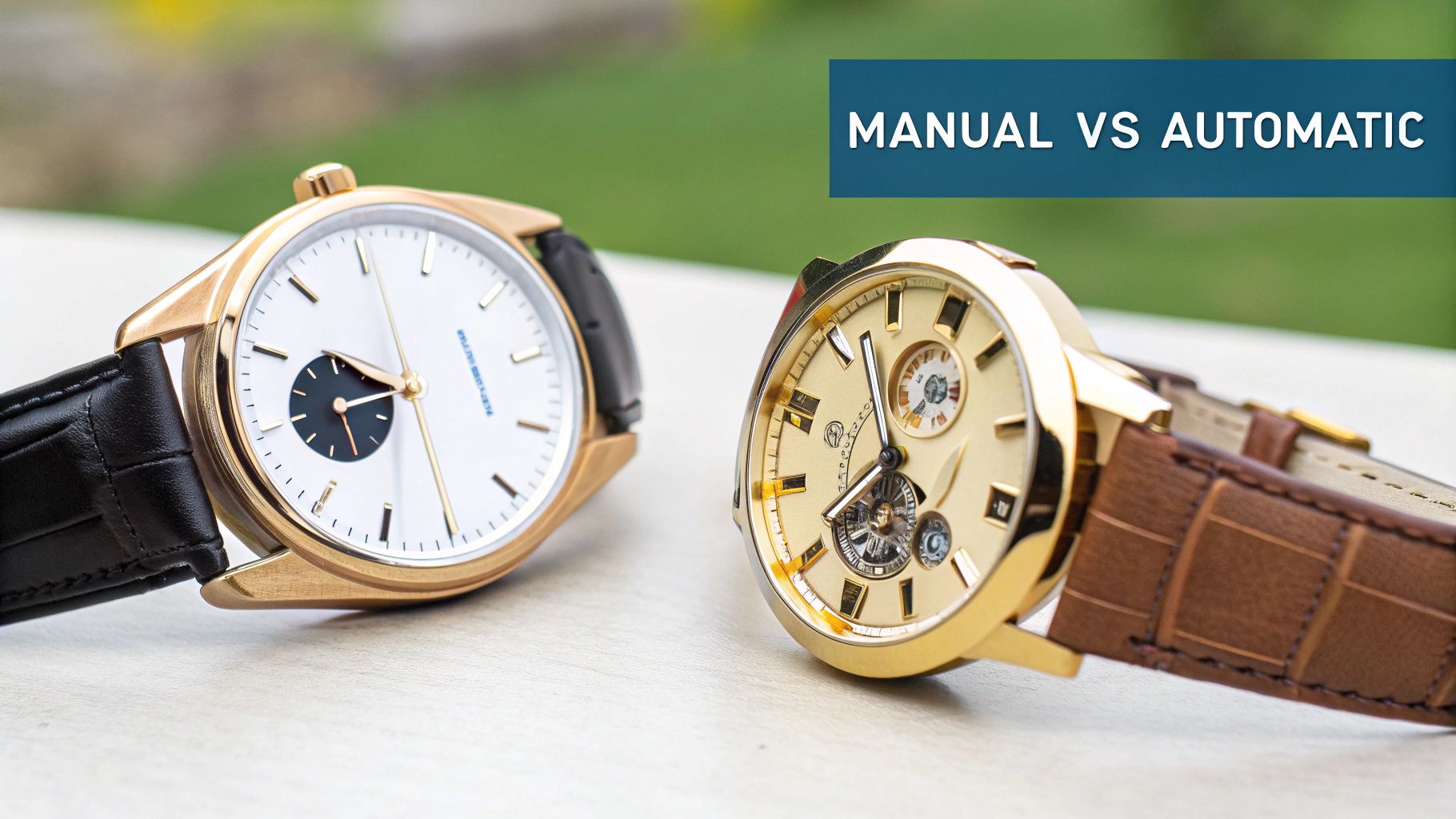
Choosing between a manual and an automatic movement is one of the first, most defining decisions you'll make as a collector. It shapes everything from your daily routine to long-term service needs. This isn't just about the mechanics inside the case; it's about the kind of relationship you want to have with your watch.
The Daily Interaction
A manual, or hand-wound, watch invites a daily ritual. Winding the crown becomes a quiet moment of connection—you can literally feel the gears engaging as you power the mainspring. This is the classic, purist's choice, celebrated for its elegant simplicity and deep historical roots. For many horology lovers, this daily interaction is the whole point.
An automatic, or self-winding, watch is built for the pace of modern life. It houses a weighted rotor that spins with your natural movements, constantly winding the mainspring. As long as you wear it consistently, it just keeps running. No fuss, no daily winding required, making it the perfect companion for someone who just wants their watch to work.
At a Glance Manual vs Automatic Watch Fundamentals
To quickly frame the decision, let's break down the core experiential and functional differences between these two celebrated movement types. This table provides a clear, at-a-glance reference to help you understand the fundamental trade-offs you're making.
| Characteristic | Manual (Hand-Wound) | Automatic (Self-Winding) |
|---|---|---|
| Power Source | Daily winding of the crown by hand | Kinetic energy from the wearer's wrist motion |
| Daily Ritual | Required; must be wound every 1-2 days | Not required if worn regularly |
| Movement Profile | Generally thinner and lighter due to fewer parts | Typically thicker and heavier to house the rotor |
| Caseback View | Often provides an unobstructed, beautiful view of the caliber | The rotor may partially obscure the movement's view |
| Collector Appeal | Prized by purists for tradition and interaction | Valued for convenience and engineering innovation |
Ultimately, this table highlights the primary fork in the road: one path leads to a more engaged, traditional ownership experience, while the other offers practical, sophisticated engineering designed for an active lifestyle.
A Look Under the Hood: What Makes Them Tick
Every mechanical watch is a tiny, living machine, a miniature world of gears and springs working in harmony right on your wrist. But the way a manual and an automatic watch keep time comes from two completely different design philosophies. Understanding what's going on inside helps you appreciate the specific kind of craftsmanship you're buying into.
A manual-wind watch is mechanical power in its most direct form. The energy starts with you. When you turn the crown, you're directly winding the mainspring—a tightly coiled strip of metal that acts as the watch's fuel tank.
There's a certain satisfaction to it. You can feel the slight resistance of the gears meshing, a direct physical connection to the heart of your timepiece. This beautiful simplicity is a huge part of its appeal.
The Purity of the Manual Caliber
Since a manual movement doesn't need a self-winding system, it has far fewer parts. This lean approach isn't just about simplicity; it opens up some real design advantages that collectors and enthusiasts love.
For one, manual movements can be made incredibly thin. This allows watchmakers to create slimmer, more elegant cases that slip easily under a dress cuff, which is why they're a classic choice for formal watches.
Without a winding rotor in the way, a manual movement offers a full, unobstructed view of the caliber's architecture through a display caseback. It's like looking into the open engine bay of a classic sports car, where every polished bridge, jewel, and gear is right there for you to admire.
Take a classic like the Patek Philippe Calatrava. Its famously slender profile is only possible because of its refined manual-wind caliber. Patek leverages that open space to show off its legendary finishing skills, with details like Côtes de Genève (Geneva stripes) and perlage (circular graining) turning the movement into a true work of art.
The Ingenuity of the Automatic Winding System
If a manual watch is all about elegant simplicity, an automatic is a masterpiece of complex convenience. Its key component is the rotor, a weighted, semi-circular piece of metal that swings freely as you move your arm.
The genius of the system is that it captures the energy from your everyday movements. As you walk or gesture, the rotor spins, and that kinetic energy is transferred through a gear train to continuously wind the mainspring. The watch essentially powers itself, no daily winding required.
The real cleverness, though, is in the reversing gears. Early automatic systems were pretty inefficient, only winding the mainspring when the rotor spun in one direction. Modern movements, like the ones Rolex has perfected, use sophisticated reversing gears that allow the rotor to wind the spring no matter which way it spins, making them far more efficient.
This constant trickle of power also keeps the mainspring at a more consistent level of tension, which can lead to more stable and accurate timekeeping over its entire power reserve. The engineering inside a Rolex Perpetual movement, for instance, is built for a life of robust, non-stop performance, capturing every flick of the wrist to keep the watch running reliably.
So, when you compare a manual vs automatic watch, you're really looking at two different expressions of mechanical art. The manual offers a pure, unfiltered connection to traditional watchmaking, celebrating slim design and tactile interaction. The automatic, on the other hand, showcases brilliant engineering built for practical, everyday life—a testament to how watchmaking evolved to meet the demands of the modern wearer. Your choice really comes down to whether you prefer mechanical purity or sophisticated automation.
Comparing the Realities of Daily Ownership
Beyond the technical specs and beautiful mechanics, the real-world difference between a manual and automatic watch comes down to your daily life. The way you live, work, and interact with your timepiece will ultimately decide which movement feels less like a feature and more like a part of you. This is a practical choice, one that balances power reserve, accuracy, and even the view through the caseback.
The conversation really begins with the power reserve—how long a fully wound watch will keep ticking before it stops. Most mechanical watches, whether manual or automatic, offer a reserve of somewhere between 40 to 80 hours. The crucial difference, though, is how you keep that power topped up.
Managing Your Watch’s Power Reserve
With a manual watch, you get predictable consistency. Give it a full wind in the morning, and you know it will run for its entire stated reserve, no matter what your day looks like. For someone with a quieter lifestyle or a collector who rotates through several watches, this reliability is a huge plus.
An automatic, on the other hand, is powered by your life. A busy day spent walking around keeps the mainspring nice and tight. But if you're stuck at a desk all day, you might not be generating enough kinetic energy to maintain a full charge. This can cause the watch to stop overnight or run low, which can subtly impact its timekeeping.
For someone who wears the same watch every day and stays reasonably active, an automatic is pure set-it-and-forget-it convenience. But for a collector who loves switching things up, a manual is often far simpler to manage—just wind it and you're good to go. No need for a watch winder or a "warm-up" day of wear.
This image highlights the key physical differences that stem from their internal designs.
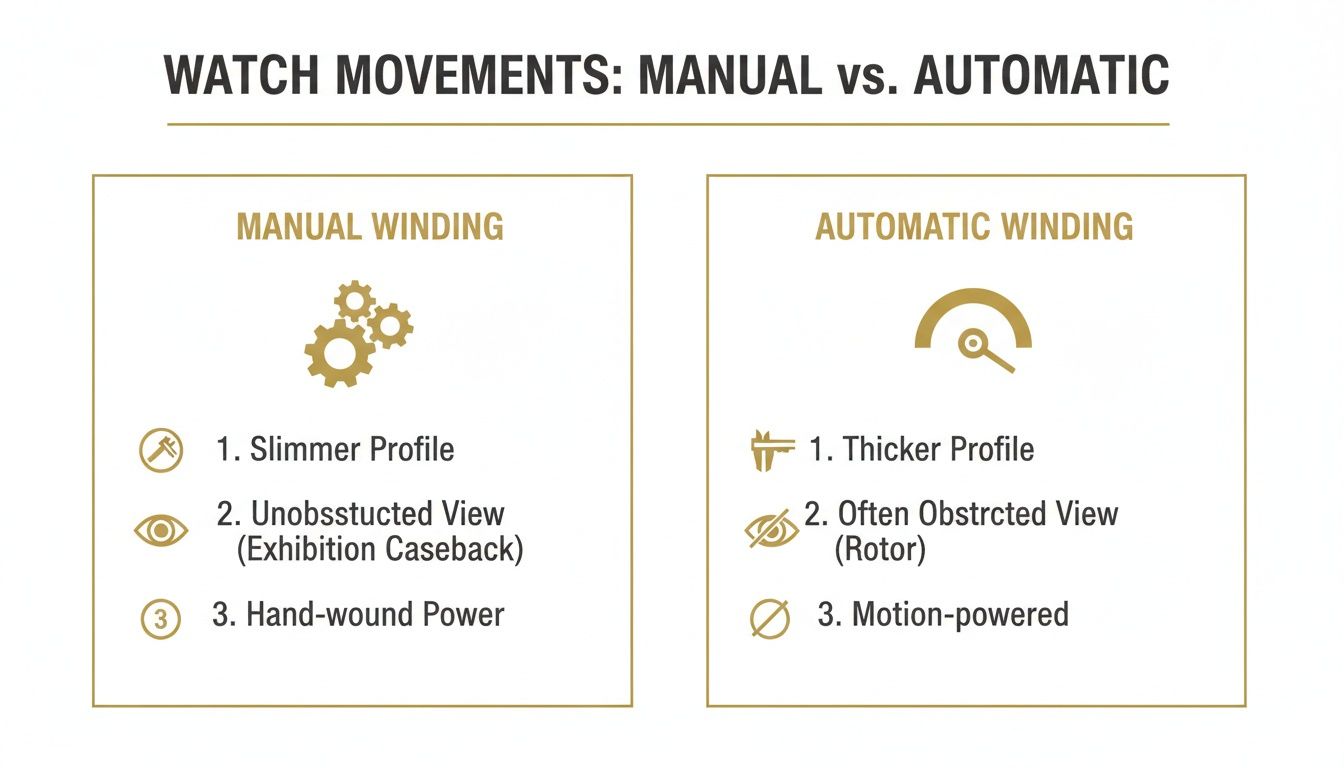
As you can see, leaving out the rotor allows manual watches to be slimmer with a wide-open view of the movement. Automatics trade that slender profile for the convenience of self-winding.
The Nuances of Timekeeping Accuracy
When people debate manual vs. automatic, accuracy is often misunderstood. Neither movement type is inherently more precise than the other. A chronometer-certified manual caliber from Omega will be just as accurate as a chronometer-certified automatic from Rolex. The real differentiator is how consistently power is delivered to the escapement.
Because an automatic watch is constantly being wound by your wrist, it keeps the mainspring in a near-perfect state of tension. This consistent torque can lead to more stable and predictable timekeeping day after day. A manual watch, by contrast, delivers its strongest push right after being wound and gradually weakens as it unwinds, which can introduce tiny rate variations. For most of us, this difference is practically unnoticeable, but it's a detail that true horology nerds love to discuss.
Durability and Long-Term Servicing
Durability is another one of those areas where context is everything. On paper, manual movements have fewer parts—no rotor, no winding gears—which means fewer things can break. That elegant simplicity makes them theoretically more robust.
In the real world, however, automatic movements are often built into watches designed to take a beating. Think of dive watches and field watches. Their tough-as-nails cases are engineered to shield the more complex mechanism inside from shocks, water, and whatever else you throw at it. So, in practice, an automatic sports watch is often far more durable than a delicate, manual-wind dress watch.
When it comes to maintenance, both types need a proper service every 5-8 years to keep them running smoothly. While an automatic has more components to inspect, the service cost and interval are generally quite similar for quality timepieces. You can learn more about what goes into a professional watch service and see why it’s so critical for preserving both kinds of movements.
The table below breaks down these practical ownership differences, helping you see which style better aligns with your lifestyle and expectations.
Ownership Experience Breakdown: Manual vs. Automatic
| Ownership Aspect | Manual Watch | Automatic Watch |
|---|---|---|
| Daily Interaction | Requires a daily ritual of winding the crown. Creates a tactile connection. | "Set and forget" as long as it's worn regularly. Interaction is minimal. |
| Power Reserve | Predictable and reliable. A full wind guarantees the stated reserve. | Variable. Depends on the wearer's daily activity levels to stay wound. |
| For Collectors | Ideal for rotation. Easy to pick up, wind, set, and wear without a winder. | Can be inconvenient to rotate without a watch winder; may need winding and setting. |
| Case Profile | Generally slimmer and lighter due to the absence of a rotor assembly. | Typically thicker and heavier to accommodate the self-winding mechanism. |
| Aesthetics | Offers an unobstructed view of the movement through an exhibition caseback. | The spinning rotor is part of the visual appeal, a dynamic mechanical display. |
Ultimately, this comparison isn't about which is "better," but about which is better for you. It's a choice between a daily hands-on ritual and effortless convenience.
The Collector’s View: Aesthetics and Appeal
Finally, there's the sheer visual and emotional experience, which for many is the deciding factor. An exhibition caseback on a manual-wind watch provides a stunning, uninterrupted panorama of the movement. You get to admire the intricate bridges, the hypnotic spinning of the balance wheel, and the beautiful, hand-applied finishes like Côtes de Genève without a rotor in the way.
An automatic offers a different kind of mechanical theater. There's a unique pleasure in watching the decorated rotor spin with a flick of the wrist—a constant, visible reminder of the watch's clever, self-sustaining design. This practical, modern appeal is a big reason why automatic watches have pulled ahead, now making up over 60% of the entire mechanical market. It's a segment that continues to grow, fueled by innovations that fit perfectly with today's lifestyles.
Which Movement Fits Your Collector Profile
Deciding between a manual and an automatic watch goes far beyond the technical specs. It’s really a reflection of your lifestyle, your daily habits, and what you truly value in a timepiece.
To help you land on the right one, I’ve broken down the choice based on four common profiles I see all the time. Find the one that sounds most like you, and you'll have a much clearer idea of where to start. This isn’t about a generic pros-and-cons list; it's about matching the right movement to the right owner.
For The Daily Wearer
You’re busy. You need a reliable, no-fuss companion for a demanding professional life. The last thing you want to think about in the morning is your watch—you just need it to be accurate, tough, and ready to go. You probably wear the same watch most days and prioritize performance over everything else.
Recommendation: Automatic Movement
For you, an automatic watch is the clear winner. Its self-winding mechanism is literally designed for the rhythm of an active life, keeping the mainspring topped up as you move through your day. This grab-and-go convenience is unbeatable.
Top-tier automatics are almost always housed in robust cases built for real-world resilience, from classic dive watches to versatile sport models. The market reflects this, too. Men's automatic watches dominate the mechanical space, known for their bolder designs and reputation as dependable, investment-grade workhorses. For more on this, check out the mechanical watch market report on GrandViewResearch.com.
For The Horological Purist
You're captivated by the history and artistry of watchmaking. For you, a mechanical watch isn't just for telling time; it’s a tangible link to a centuries-old craft. You genuinely appreciate the ritual, the pure engineering, and the unfiltered view of a beautifully finished caliber.
Recommendation: Manual Movement
A classic hand-wound watch will speak directly to your soul. That daily ritual of winding the crown becomes a cherished interaction—a quiet moment that connects you to the very heartbeat of your timepiece.
For the purist, the absence of a rotor is a feature, not a drawback. It allows for a slimmer, more elegant case profile and provides a breathtaking, unobstructed view of the movement's intricate architecture through a sapphire caseback. This is mechanical art in its purest form.
For The Rotational Collector
You've got a growing collection and love swapping watches to match an outfit, your mood, or the occasion. You might wear a different piece every other day, so you need something you can grab from the watch box and get running without a lot of hassle.
Recommendation: Manual Movement (with a caveat)
For someone who rotates watches frequently, a manual offers incredible simplicity. When a manual watch stops, you just wind it, set the time, and you’re good to go. There’s no shaking it to get the rotor moving or wondering how much power is left in the tank.
The one exception? An automatic watch kept on a watch winder. That offers the ultimate convenience, keeping your whole collection ready at a moment’s notice. So the choice here comes down to whether you prefer the quick, hands-on ritual of winding or the automated readiness a winder provides. If you're looking to grow your stable, our guide on how to build a watch collection has some great tips.
For The First-Time Investor
You're ready to make your first serious watch purchase. You see it as both a personal luxury and a potential asset. You want a watch with broad appeal, strong brand recognition, and a movement that’s easy to live with as you get your feet wet in the world of horology.
Recommendation: Automatic Movement
An automatic watch is the ideal entry point. Its simple, self-powering nature removes any intimidation, while its massive popularity ensures strong market demand and liquidity should you ever decide to sell. There's a reason iconic automatic models from the big brands are considered blue-chip assets—they are proven, desirable, and understood by collectors everywhere.
How Movement Choice Impacts Long-Term Value
For a serious collector, a watch is more than just a tool for telling time—it’s a tangible asset. When you’re weighing a manual vs automatic watch, you have to consider how that choice might play into the timepiece's financial future and investment potential. While a lot of things affect a watch's value, the movement is a huge part of its story.
As a general rule, the pre-owned market consistently shows that iconic automatic models from giants like Rolex and Audemars Piguet tend to hold their value incredibly well, and often appreciate. Their workhorse, self-winding movements are at the heart of watches that have become global symbols of achievement and style.
The sheer demand for models like the Rolex Submariner or Audemars Piguet Royal Oak creates a very liquid market, meaning they are always easy to sell. Their value is a potent mix of brand power, unmistakable design, and the simple, everyday convenience that an automatic movement offers.
The Allure of Rarity in Manual Watches
While automatics are often the safer, more predictable investment, the world of manual-wind watches is where you can find truly exceptional returns. This is especially true for rare, historically important pieces from the most respected watchmakers. I'm talking about vintage chronographs from Jaeger-LeCoultre or the early A. Lange & Söhne models that marked their grand return to watchmaking.
These manual-wind timepieces were often made in much smaller numbers, and their movements are celebrated as works of art. A collector who manages to find a rare Patek Philippe Calatrava with a unique dial or a Vacheron Constantin Historiques with a flawlessly finished manual caliber isn't just buying a watch; they're acquiring a piece of horological history.
The investment ceiling for a rare, historically significant manual-wind watch is often far higher than that of its mass-produced automatic counterpart. Its value is tied to scarcity and connoisseurship, attracting a very specific type of buyer willing to pay a premium for mechanical purity and provenance.
Market Liquidity and Overall Value
It’s also critical to think about market liquidity—how easily you can buy or sell an asset. This is where popular automatic sports watches usually win, thanks to brand recognition and the sheer number of them out there. Let's be honest, there is always a buyer for a steel Rolex.
But at the end of the day, the biggest driver of long-term value is never just the movement. It’s a complex equation where several key factors have to line up perfectly:
- Brand Prestige: A name that commands respect is non-negotiable.
- Rarity and Scarcity: Limited runs or discontinued models are a natural recipe for high demand.
- Condition: A watch in pristine, original condition will always fetch a premium.
- Provenance: Having the original box, papers, and service records adds immense value.
The movement is just one piece of this puzzle. An automatic might offer a wider, more liquid market, making it a reliable store of value. You can see some of the top performers in our guide on luxury watches that hold their value. In contrast, a special manual-wind watch from a top-tier brand offers the potential for much greater appreciation—as long as you find the right piece and, eventually, the right buyer.
Your Pre-Owned Watch Inspection Checklist
Buying a pre-owned watch is an incredible way to get your hands on a piece with some real history and character. But whether you're eyeing a manual or an automatic, a thorough hands-on inspection is absolutely non-negotiable. This checklist will walk you through what I look for, helping you buy with total confidence.

The first thing I always do is interact with the movement itself. You can learn a surprising amount about a watch's internal health just from the way it feels and sounds, long before you even check its timekeeping.
Movement-Specific Checks
With a manual watch, the winding is your best diagnostic tool. Give the crown a gentle turn. You want to feel a smooth, consistent, and clean resistance. Any grittiness, jumping, or looseness is a sign of trouble, hinting at worn gears or a desperate need for a service.
For an automatic watch, it's all about listening. Hold the watch up to your ear and give it a slight shake. You should hear the quiet, fluid whir of the rotor spinning. If you hear a loud rattle or a grinding noise, that's a major red flag—it often means the rotor is loose or its bearings are shot.
A healthy movement, manual or automatic, should feel and sound like a finely tuned machine. Any harshness or weird noise during winding or movement is a clear warning that the watch needs a professional look, and that should heavily influence your offer.
Universal Inspection Points
Once you've gotten a feel for the movement, it's time to zoom out and assess the watch's overall condition and authenticity. These points are vital for any timepiece and have a huge impact on its value and how much you'll enjoy it down the road.
- Dial and Hands Authenticity: Get a loupe and examine the text on the dial. The printing should be perfectly crisp and uniform, with zero smudging. The hands need to be the correct shape and length for that specific reference model and show no signs of corrosion. The techniques for spotting fakes, like those used to learn how to tell if your Rolex is real, are helpful across many brands.
- Case and Lug Condition: Keep an eye out for over-polishing. The edges of the case and lugs should be sharp and well-defined. If they look soft, rounded, or uneven, the watch has probably lost a lot of its original metal from aggressive polishing, which seriously hurts its value.
- Bracelet Integrity: Check the bracelet for sag or stretch, a common issue on older bracelets like a vintage Rolex Jubilee. The links should feel solid, and the clasp needs to lock securely. A worn-out bracelet can be a very expensive fix.
- Box and Papers: Having the original box, warranty card, and manuals is a massive plus for value and peace of mind. While a fantastic watch is still a fantastic watch without them, having the "full set" is the gold standard for proving a timepiece's history and authenticity.
Common Questions About Watch Movements
Even after you've got the basics down, a few key questions always pop up when you're on the brink of buying a great watch. Let's tackle the ones I hear most often from collectors trying to decide between manual and automatic.
Can You Manually Wind an Automatic Watch?
Absolutely. Almost any modern automatic watch lets you wind it by hand using the crown. This is a fantastic feature, especially if the watch has been sitting in a drawer and has completely wound down.
Think of it as a "kick-start." A few dozen turns will get it going with a solid power reserve. Once it's on your wrist, your everyday movements take over to keep it topped up. You shouldn't need to wind it by hand every day if you're wearing it regularly.
Which Watch Movement Is More Accurate?
This is a classic question, but the answer is neither. One isn't inherently more accurate than the other. A watch's ability to keep precise time comes down to the quality of its engineering, how skillfully it was assembled, and how well a watchmaker has regulated it.
A chronometer-certified manual Patek Philippe will be just as precise as a chronometer-certified automatic Rolex. The real X-factor is the caliber's design and its state of tune, not how you get power into the mainspring. When it comes to manual vs automatic watch accuracy, it’s a dead heat.
The biggest factor in day-to-day accuracy is how consistently the mainspring delivers power. Because an automatic watch is constantly being wound by your wrist's motion, it tends to keep the mainspring in a more stable, optimal state of tension. This can lead to slightly more consistent timekeeping from one day to the next.
How Often Do They Need to Be Serviced?
Both manual and automatic movements are complex little engines that need a tune-up to stay in peak condition. The industry standard service interval for both is generally every 5 to 8 years, but always check the specific manufacturer's recommendation.
A full service is quite involved: the watchmaker completely disassembles the movement, ultrasonically cleans every part, lubricates all the friction points, and re-regulates it for accuracy. A manual movement has fewer parts since it lacks a rotor assembly, but for high-end watches, the service cost and frequency are pretty much the same. If you've got more questions, our comprehensive watch FAQs page has you covered.
At Perpetual Time, we believe an informed collector is a confident one. Explore our curated collection of certified pre-owned timepieces and find the perfect watch that speaks to your style and passion at https://perpetualtime.com.


