
Cart
0
At its core, a hand-wound mechanical watch is a tiny, intricate engine that runs on a little bit of your energy each day. There are no batteries, no circuits—just pure mechanics. It’s a lot like a classic wind-up toy; you turn the crown to tighten a spring, and that stored energy powers a beautifully complex dance of gears and levers.
The Timeless Engine on Your Wrist
In a world filled with smart devices buzzing on our wrists, the appeal of a simple, hand-wound mechanical watch feels more potent than ever. It's a conscious choice to connect with timekeeping in its most traditional, tangible form. Unlike a quartz watch running silently on a battery or an automatic watch that winds itself with the motion of your arm, a manual watch relies on a daily, hands-on ritual.
That simple act of turning the crown is what makes it so special. It creates a direct connection to the centuries-old craft of watchmaking. It’s a small, deliberate moment that elevates the watch from a mere accessory to a true personal companion. You’re not just wearing a watch; you’re an active participant in keeping it alive.
The Heart of Mechanical Artistry
So, how does it all work without a drop of electricity? The magic comes down to a few key components working in perfect unison:
- The Mainspring: When you wind the crown, you're coiling this powerful little spring, which stores all the potential energy the watch needs to run.
- The Gear Train: As the mainspring slowly and steadily unwinds, it releases its energy, turning a series of finely-tuned, interconnected gears.
- The Escapement: This is the ingenious part. It acts like a gatekeeper, releasing the mainspring's energy in precise, controlled bursts that create the classic "tick-tock" sound.
This purely mechanical system is a marvel of precision engineering. For many, the charm of a hand-wound watch lies in this character and the personal connection it creates. Some collectors even take it a step further, seeking out personalised watches and jewellery to make their timepiece a truly one-of-a-kind treasure.
A hand-wound watch is more than an instrument for telling time; it's a daily reminder of the beauty in old-world craftsmanship and deliberate action. It asks for a moment of your attention, and in return, it gives you a tangible link to horological history.
It's this direct relationship that truly sets a manual-wind movement apart, paving the way for a much deeper appreciation of the watchmaker's art.
Comparing Hand Wound, Automatic, and Quartz Watches
Think of choosing a watch movement like picking the engine for a car. Each type—hand-wound, automatic, and quartz—delivers a totally different experience. It’s all about how you interact with it, how it performs, and the feeling it gives you on the wrist.
Figuring out these core differences is the first real step in finding a watch that feels like it was made just for you.
The Purist’s Choice: Hand-Wound Mechanical
A hand-wound mechanical watch is for the traditionalist, the person who appreciates a direct connection to their timepiece. It runs entirely on the energy you give it by turning the crown.
This simple daily ritual isn't a chore; it's a bond. You become part of the process of keeping time. Inside, there's no battery, just a beautifully intricate machine humming along because of you.
The Best of Both Worlds: Automatic Mechanical
An automatic watch is also purely mechanical, but it comes with a clever twist: a self-winding mechanism. A small, weighted rotor inside the case spins with the natural motion of your wrist, constantly topping up the mainspring's power.
You get the soul and sweep of a mechanical movement without the need for a daily wind—as long as you wear it often enough to keep it running.
The Modern Marvel: Quartz
Then you have the quartz watch, by far the most common and practical movement out there. It’s powered by a small battery that sends an electrical current through a tiny, fork-shaped quartz crystal.
This crystal vibrates at an incredibly precise frequency, giving quartz watches their amazing accuracy. For a 'grab-and-go' watch that just works, it's the undisputed champion, only needing a new battery every few years.
Even with the convenience of quartz, the appeal of traditional watchmaking is stronger than ever. The global mechanical watch market was valued at USD 50.6 billion in 2025 and is expected to climb to USD 72.3 billion by 2032. While automatics make up the bulk of that, hand-wound mechanical watches remain a beloved niche for collectors who value pure craftsmanship.
Visualizing the Core Concepts
This diagram gets right to the heart of what makes a hand-wound watch tick. It’s all about you and the machine.
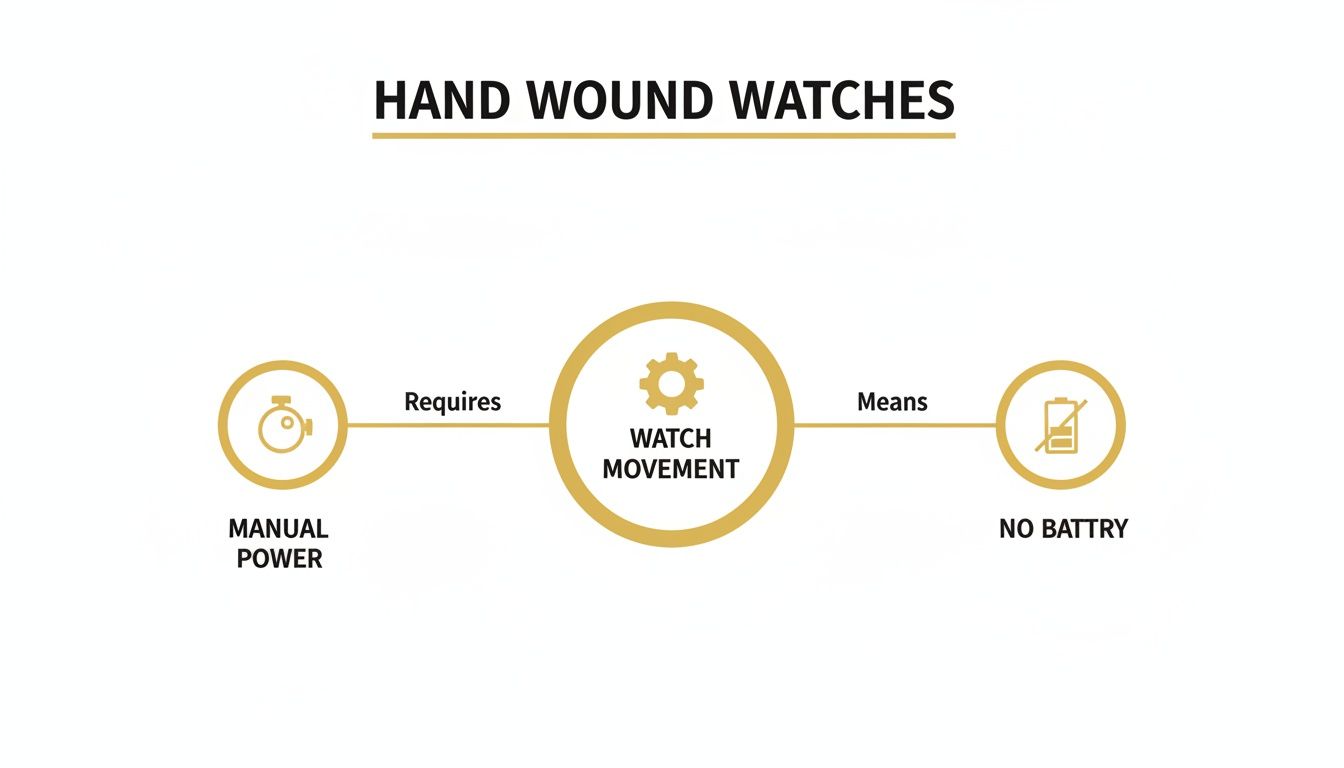
As you can see, your power goes from the crown directly into the gears and springs. There's no battery, no rotor, just pure, unadulterated mechanics.
At-a-Glance Comparison
To help you see the differences side-by-side, let's lay out how these three "engines" really stack up against each other. For an even deeper dive, you can also check out our detailed guide comparing manual vs. automatic watches.
The real question isn't which one is "best"—it's about which one is best for you. Are you looking for a daily connection, effortless convenience, or dead-on accuracy? Your answer will point you to the perfect movement.
Here’s a quick-reference table to make the decision a little easier.
Movement Type Comparison: Hand-Wound vs. Automatic vs. Quartz
| Feature | Hand-Wound Mechanical | Automatic Mechanical | Quartz |
|---|---|---|---|
| Power Source | Manual winding via crown | Wrist motion (rotor) | Battery |
| User Interaction | Daily winding ritual | Wear to keep wound | Occasional battery change |
| Accuracy | Good, can vary | Good, can vary | Excellent, highly precise |
| Maintenance | Service every 3-5 years | Service every 3-5 years | Battery replacement |
| Case Profile | Often slimmer and lighter | Typically thicker and heavier | Can be very thin |
Ultimately, each movement type offers a unique ownership experience. The slim, classic feel of a hand-wound, the convenient engineering of an automatic, or the set-it-and-forget-it reliability of a quartz—all have their place in a great watch collection.
Mastering the Daily Ritual of Winding and Care
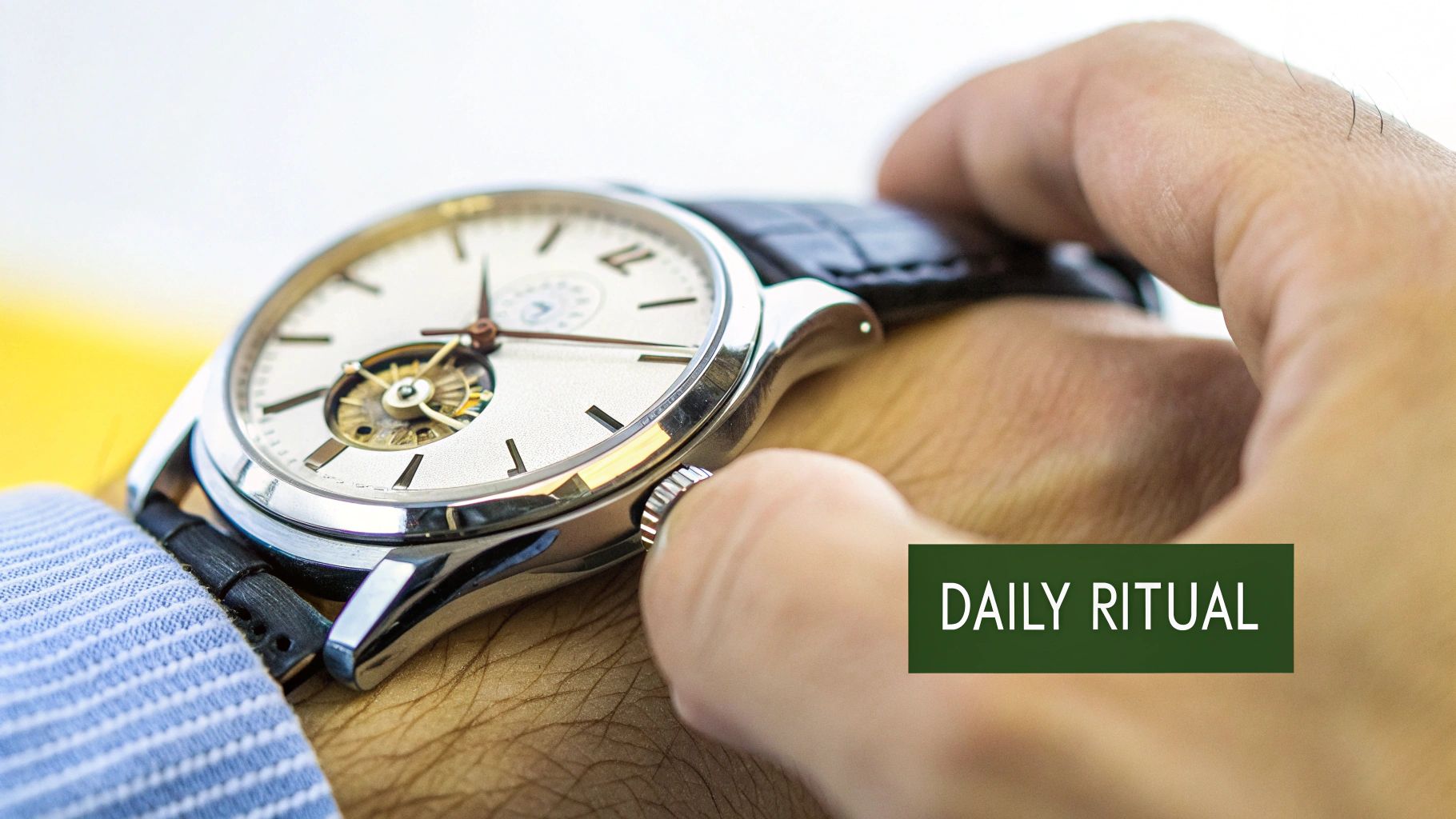
Owning a hand-wound watch isn't just about telling time; it's about taking part in a daily ritual. It’s that quiet moment of connection each morning that literally breathes life into your timepiece. Learning the right way to do it is simple, and it's the key to making sure your watch performs beautifully for a lifetime.
The whole process is about being gentle. Grip the crown between your thumb and forefinger and turn it clockwise. You should feel and hear a faint, satisfying clicking—that's the sound of the mainspring tightening.
Keep turning until you feel a firm resistance. This is the most important part: stop there. Forcing it past this point can damage the movement. That resistance is the watch’s way of telling you its power reserve is full. Most modern hand-wound watches will run for about 38 to 42 hours on a full wind.
Building a Consistent Routine
When it comes to accuracy, consistency is everything. Winding your watch around the same time each day—maybe as you're having your morning coffee—keeps the mainspring's tension stable. A stable tension means more reliable and accurate timekeeping.
Think of it like watering a plant; a regular schedule helps it thrive. The same goes for the intricate mechanism ticking away inside your watch.
Establishing a daily winding habit is more than just maintenance; it’s about appreciating the mechanical artistry you wear on your wrist. It's a small, deliberate act in a world of automation.
Essential Care Beyond Winding
Proper care doesn't stop with the daily wind. You also need to protect your watch from a few common hazards to ensure it stays precise and pristine for years to come. Here are three critical things to keep in mind:
- Avoid Strong Magnetic Fields: Things you use every day, like speakers, tablets, and even some phone cases, can magnetize the tiny hairspring inside your watch. This can make it run erratically fast or slow. Just be mindful of where you set it down.
- Protect from Shocks: A hard knock or an accidental drop can be devastating to the delicate components of a mechanical movement. Even though many modern watches have some shock protection, it’s always a good idea to take it off before playing sports or doing any heavy work.
- Understand Water Resistance: That "30 meters" rating on the dial doesn't mean you can go diving with it. It's really just for splashes or getting caught in the rain. Always double-check your watch's specific rating before you even think about getting it wet.
Following these simple rules, along with having it professionally looked at every few years, will protect your investment. To see what goes into a proper check-up, you can learn more about our professional watch servicing options and how we keep these tiny engines running perfectly.
The Realities of Owning a Hand Wound Watch
Before you get swept away by the charm of a manual timepiece, it’s worth taking a moment to think about the day-to-day realities. Owning one is a completely different experience than strapping on a set-and-forget quartz watch. Understanding this balance is the key to knowing if this classic style is right for you.
The biggest "pro" is the incredible connection you build with your watch. The daily ritual of winding it creates an intimate bond that you just don't get with other types of movements. You’re not just wearing the watch; you’re its power source, an essential part of its timekeeping.
The Upside of Simplicity and Beauty
The very design of hand wound mechanical watches comes with some fantastic aesthetic perks. Since they don’t need the bulky rotor found in automatic movements, these timepieces are often much slimmer and more elegant. They slide beautifully under a shirt cuff, giving you a refined look that’s hard to beat.
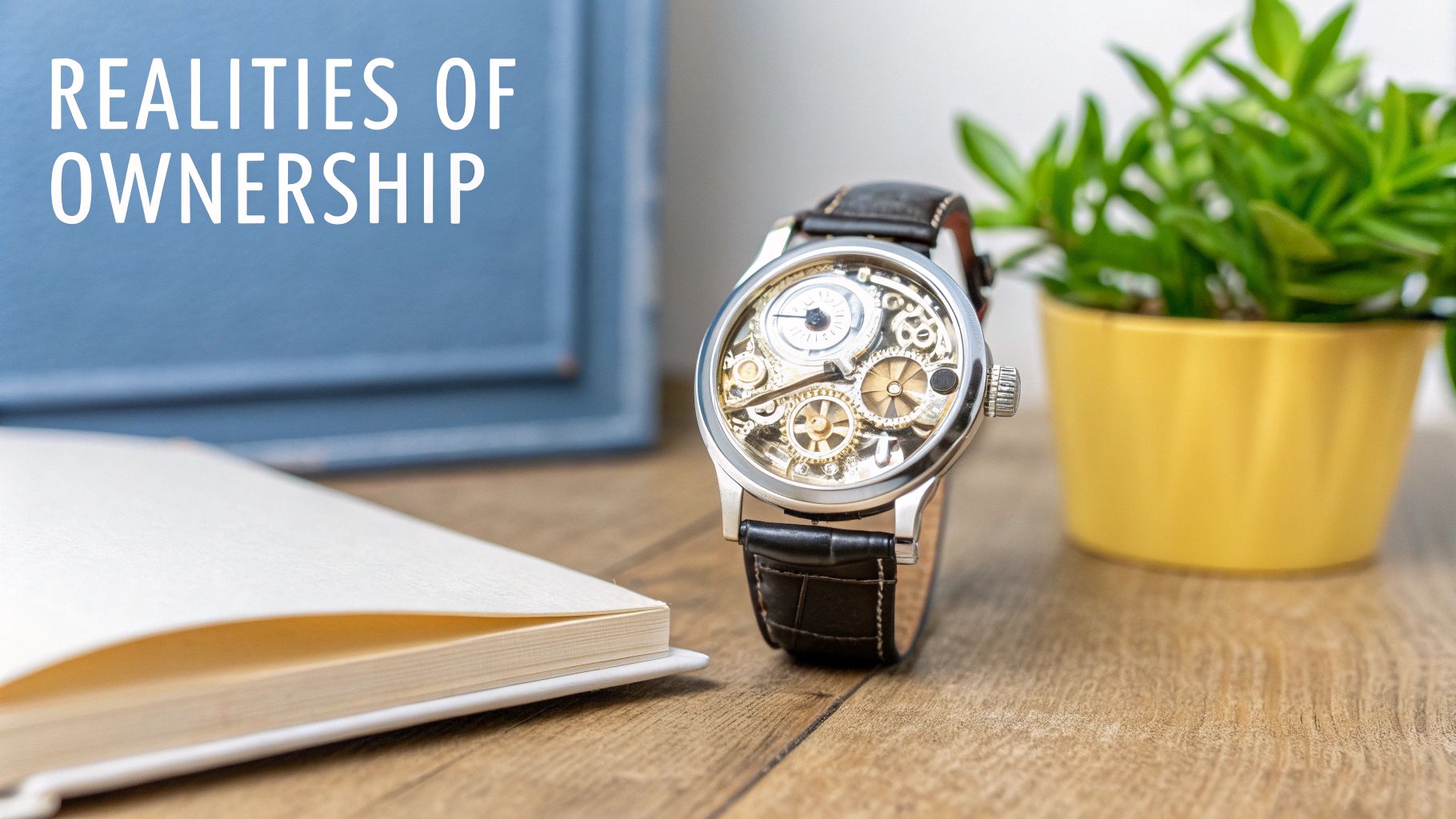
This simpler construction opens the door for something else watch lovers adore: the exhibition caseback. This is a sapphire crystal window on the back of the watch that lets you see the intricate movement inside.
Without a rotor blocking the view, you get a front-row seat to the mesmerizing dance of gears, springs, and jewels. It’s like having a tiny, mechanical sculpture on your wrist—a constant source of fascination.
This blend of personal connection and mechanical artistry is what makes a hand-wound watch so special for those who appreciate pure, old-school craftsmanship.
The Practical Considerations of Ownership
Now for the other side of the coin. That daily winding ritual, while a joy for many, is an absolute necessity. If you forget, your watch will simply stop, and you’ll have to reset the time. This demands a bit of routine and mindfulness that might not fit everyone's lifestyle.
Then there's precision. A well-maintained mechanical watch is a wonderfully accurate machine, but it will never have the pinpoint accuracy of a battery-powered quartz movement. A variation of a few seconds per day is perfectly normal and part of the mechanical charm.
Finally, you have to think about upkeep. Just like the engine in a classic car, a mechanical watch movement needs professional servicing to keep its hundreds of tiny parts clean, lubricated, and running smoothly. Plan on taking it to a qualified watchmaker every 3 to 5 years.
This commitment to daily interaction and long-term care is really the price of admission. For those who value the experience, however, these so-called "cons" are just part of the rewarding journey of owning a true piece of watchmaking history.
How to Buy a Pre-Owned Hand Wound Watch

Stepping into the world of pre-owned hand wound mechanical watches is a bit like a treasure hunt. It’s your chance to find rare models and timeless designs that aren't on the shelves anymore. But with great reward comes a bit of risk, so a sharp eye is your best tool. Knowing what to look for can be the difference between a sound investment and a costly mistake.
Think of it like being a detective. Your first task is to confirm the watch's identity. Every genuine luxury watch has a unique serial number and a model reference number. Your job is to check that these numbers line up with the watch’s known production period and features. This one step is your best defense against fakes and "Frankenwatches"—those cobbled-together pieces made from a mishmash of unrelated parts.
The Essential Pre-Purchase Inspection
With the basics confirmed, it's time to get up close and personal. The condition of the dial, hands, and case can tell you a lot about the watch’s past life. Here’s a quick rundown of what to zero in on:
- Dial Authenticity: The text and logos on the dial should be sharp and clean. If anything looks smudged, blurry, or uneven, you might be looking at a refinished or "redialed" watch, which takes a serious hit on its value.
- Original Hands and Lume: Make sure the hands are the correct style for the watch's era. The luminous material, or "lume," on the hands and hour markers should also look consistent in color and age. If the lume on the hands glows brighter than on the dial, parts have likely been replaced.
- Case Condition: Check the lines and edges of the case and lugs. Are they sharp? Over-polishing can round them off, erasing the watch's original factory finish and reducing its value. A few light scratches are perfectly normal for a vintage piece, but deep gouges or dings are another story.
Provenance—the story and documentation of a watch—is paramount. A timepiece accompanied by its original box and papers is not just more valuable; it’s a verified piece of history that provides peace of mind and confirms its authenticity.
Understanding Provenance and Service History
The watch itself is only half the story; its history is just as crucial. This is where provenance and service records become incredibly important. A "full set" with the original box, warranty card, and receipts is what every collector hopes for. These documents confirm the watch's origin and create a clear ownership trail, making it a much more secure and sought-after piece.
A detailed service history is the watch’s medical file. It proves that the tiny, intricate movement inside has been cared for by a professional. Regular servicing keeps all those delicate gears and springs clean, lubricated, and running as they should. Buying a watch without any service records is a gamble—you never know what expensive mechanical problems might be lurking inside. To get a better handle on the secondary market, you can explore our comprehensive guide to buying used luxury watches.
The appetite for these incredible timepieces isn't slowing down. The U.S. watch market is on track to reach USD 16.2 billion in 2025 and is projected to climb to USD 27.1 billion by 2034. This growth shows a real, sustained passion for fine watches, and authenticated pre-owned pieces are a huge part of that. With this checklist in hand, you can confidently navigate this exciting world and find a hand-wound watch you'll treasure for years.
Why Trust Perpetual Time with Your Timepiece?
Buying a luxury watch, especially a pre-owned one, is all about trust. We get it. That's why we've built our entire business around earning yours, one timepiece at a time. The market for beautiful mechanical watches is booming—it's expected to hit USD 125.6 billion by 2034. But with that growth comes a lot of noise and uncertainty. Our mission is to cut through it all and give you total confidence in your purchase. You can read more about the trends driving the pre-owned market if you're curious.
What makes us different? We aren't a marketplace connecting you to anonymous sellers. Perpetual Time is a dealer-owned retailer. Simply put, we own every single watch we sell. We stand behind our inventory because we've invested in it and vetted it ourselves.
Our Commitment to You
We’ve designed our process to eliminate the risks and guesswork that can make buying pre-owned watches so stressful. Here’s what you can always expect from us:
- A Rigorous Multi-Point Inspection: Before a watch ever makes it to our site, it goes through a painstaking examination. We check for authenticity, originality of parts, and mechanical health. If it doesn't meet our standards, we don't list it.
- What You See Is What You Get: We only use high-resolution photos of the actual watch you’ll receive. No stock images, no surprises.
We believe that buying a fine watch should be a secure and enjoyable experience. As a dealer-owned business, not a faceless platform, our reputation is attached to every single timepiece we offer.
This direct accountability is our promise to you. It’s how you know you’re getting a genuine, accurately described watch every single time. It's the foundation of our business and why so many collectors have put their trust in us. Learn more about our story and commitment to our clients.
Common Questions About Hand Wound Watches
Stepping into the world of hand wound mechanical watches is exciting, but it naturally brings up a few questions. Let's tackle some of the most common concerns so you can feel confident about owning one of these incredible timepieces.
The biggest fear for first-time owners? "Overwinding." It's a valid concern, but the good news is, you really can't do it. A manual watch is designed to protect itself. As you wind the crown, you'll eventually feel a distinct, firm resistance. That's the mainspring telling you it's fully wound. Just stop there, and you're golden.
Accuracy and Maintenance Expectations
Another hot topic is accuracy. A mechanical watch is a tiny, intricate machine, not a digital circuit. It won't ever be as dead-on accurate as a battery-powered quartz watch, and that's part of its charm. A healthy hand-wound watch running within -10 to +20 seconds per day is considered to be in great shape.
To keep it that way, you'll need to think about routine maintenance.
Think of it like a tune-up for a classic car. Every 3 to 5 years, a watchmaker needs to take the movement apart, clean and lubricate every component, and put it all back together.
This regular service is crucial for preventing wear on those tiny gears and springs, ensuring your watch keeps ticking for decades. Costs can range from a few hundred dollars to over a thousand for more complex, high-end models, but it's a necessary investment in a lifelong companion. For more answers, our detailed FAQs on watch ownership cover all the bases.
Understanding these practical points—the winding limit, the nuances of accuracy, and the need for long-term care—is just part of the experience. They're small trade-offs for the deep satisfaction that comes from owning a piece of pure, mechanical history.
At Perpetual Time, we ensure every pre-owned timepiece is meticulously inspected and authenticated, providing you with the confidence and transparency you deserve. https://perpetualtime.com


