
Cart
0
Let's be real—walking into the pre-owned Rolex market can feel a bit like the Wild West if you don't have a good guide. That’s exactly what this is. We're here to show you why, in 2026, buying a used Rolex isn't just a good idea; it's one of the smartest moves you can make as a collector. It's your ticket to bypassing the infamous waitlists, sidestepping recent price increases, and getting your hands on some truly special discontinued models.
Your Guide to Buying a Pre Owned Rolex in 2026
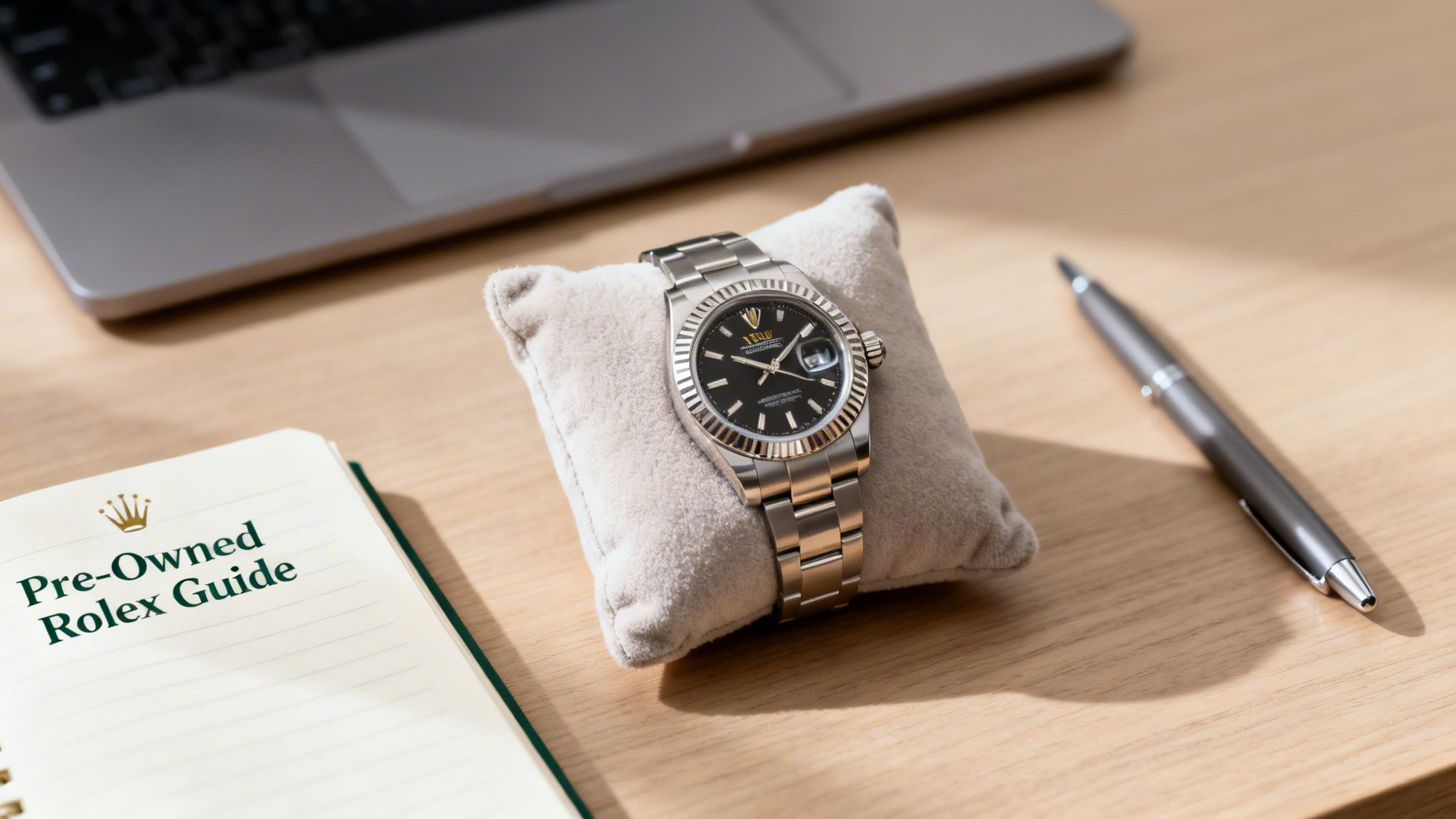
Forget dry, textbook definitions. We're going to give you a practical framework for navigating your options, from certified dealers to specialized online sellers. Think of us as a seasoned advisor in your corner, cutting through the noise to help you make a confident and secure purchase. We'll cover all the legitimate places to find your next watch and break down what you need to know about each one.
The Smart Money Moves to Pre Owned
The conversation around Rolex has changed. In 2026, the smart money is increasingly flowing into the pre-owned market, and for good reason. After Rolex’s global retail price hikes on January 1, the value proposition became undeniable. Steel sports models in the US saw prices jump by 7-9% on average, while precious metal watches climbed an even steeper 9-15%.
What does that look like in practice? A gold or two-tone Rolex that carries a retail price of $40,000 to $50,000 can often be found on the secondary market for $3,000 to $8,000 below MSRP, often in mint condition. For a deeper dive into the numbers, you can explore the pre-owned Rolex market value on Ritzherald.com.
But it’s not just about saving money. It's about access.
The secondary market offers immediate access to the exact references and dial configurations you want. No endless waitlists, no groveling for dealer relationships—just the watch you've been searching for, available now.
The advantages of going pre-owned are more compelling than ever. You get to:
- Avoid Initial Depreciation: A used watch has already absorbed its biggest initial drop in value, making your purchase a more stable asset from day one.
- Access to Discontinued Models: The pre-owned world is the only place to hunt for sought-after vintage and neo-vintage references that Rolex no longer produces.
- Immediate Availability: Forget the multi-year waits quoted by authorized dealers. You can have a pre-owned Rolex on your wrist in a matter of days.
This guide is built to give you the complete picture. If you're looking for a great starting point, check out our companion piece on buying used luxury watches safely and securely.
So, you’ve decided to buy a pre-owned Rolex. The big question now is, where do you even start looking? The world of used watches isn't one big shop; it's more like a sprawling market with many different avenues. Each path comes with its own set of pros and cons, and the right choice for you really boils down to what you value most—is it absolute certainty, the best possible price, or the widest selection?
Think of it like buying a used car. You can go straight to an official dealership for a certified pre-owned model with a factory warranty, but you'll pay a premium for that peace of mind. Or, you could head to a trusted independent lot known for having quality cars at fair prices. Then there’s the massive online marketplace, where you're navigating deals with countless private sellers. Every option has a different balance of risk and reward.
Let's walk through the main channels for buying a used Rolex so you can figure out which route makes the most sense for you.
Rolex Certified Pre-Owned Program
For those who want the highest level of security, the most straightforward option is Rolex’s own Certified Pre-Owned (CPO) program. Rolled out in recent years, this initiative empowers select Authorized Dealers to sell pre-owned Rolex watches that have been officially authenticated, serviced, and guaranteed by the brand itself.
When you buy a CPO watch, you're essentially getting a timepiece with Rolex's direct stamp of approval. Every watch in the program is at least three years old, has passed a battery of meticulous checks, and comes with a new two-year international guarantee card. It's the gold standard for anyone who doesn't want to leave anything to chance.
Of course, that level of assurance comes with a hefty price tag. Rolex CPO watches command top-of-market prices, often sitting well above what you'd pay for the same model from a top-tier independent dealer. The selection can also feel a bit narrow, as it tends to focus on more common and recent models rather than the rare or vintage gems many collectors are after.
Trusted Independent Dealers
For a lot of buyers, this is the sweet spot. Reputable independent dealers, like us here at Perpetual Time, offer a fantastic blend of security, value, and selection. The key difference between these dealers and a marketplace is that they own 100% of their inventory. They aren't just a middleman; they have skin in the game.
Because every single watch is their own, they are fully accountable for its authenticity and condition. The process is thorough and built on trust:
- In-House Authentication: Expert watchmakers take apart and inspect every watch, checking everything from the movement's health to the bracelet's authenticity and verifying all serial numbers.
- Professional Servicing: Before a watch is even listed, it’s typically serviced by professionals to ensure it runs perfectly and meets performance standards.
- Total Transparency: You get high-resolution photos of the actual watch you're buying—no stock images. Listings are paired with detailed reports on the watch's condition.
Dealers like this give you a huge amount of confidence, often back their watches with a warranty, and do it all at prices that are far more competitive than the Rolex CPO program. You’ll also find a much more interesting and diverse inventory, including the neo-vintage and discontinued models that really get collectors excited. If you'd like to dig deeper, our guide on the best places to buy used watches explains what truly sets a great dealer apart from the rest.
Online Marketplaces
Platforms like Chrono24 and eBay act as the world's largest digital storefronts for pre-owned Rolexes. Their main draw is, without a doubt, the sheer volume. You can find just about any reference number from any period, listed by sellers all over the globe, which lets you compare prices from hundreds of dealers and private individuals at once.
Marketplaces offer an unmatched selection but introduce a higher level of risk. Your experience depends almost entirely on the individual seller you choose, not the platform itself.
While these sites do provide buyer protection tools like escrow services, the responsibility to vet the seller falls squarely on your shoulders. You're often buying from a stranger, so you have to be incredibly careful to spot fake listings, misleading photos, or problems the seller conveniently forgot to mention. The marketplace is just the facilitator; the transaction is ultimately between you and the seller.
Comparing Pre Owned Rolex Buying Channels
Navigating these options can be tricky, so here’s a table to help you see the trade-offs at a glance. It compares the most common channels based on the factors that matter most to buyers.
| Buying Channel | Authenticity Guarantee | Price Point | Selection | Buyer Protection |
|---|---|---|---|---|
| Rolex CPO Program | Highest (Rolex-backed) | Highest | Limited | Excellent |
| Independent Dealer | High (Dealer-backed) | Competitive | Diverse | Strong |
| Online Marketplace | Varies (Seller-dependent) | Variable | Widest | Platform-based |
| Auction House | High (Expert-vetted) | Unpredictable | Unique / Rare | Good |
| Private Seller | None | Lowest | Very Limited | Minimal / None |
As you can see, there's a clear relationship between price, security, and selection. Choosing the right channel is about finding the balance that feels right for your budget and your tolerance for risk.
Auction Houses and Private Sellers
For the serious collector hunting for something truly special—perhaps a historically important Paul Newman Daytona or a military-issued Submariner—auction houses like Sotheby's and Christie's are the place to be. Every watch is meticulously vetted by world-class experts and comes with extensive documentation. The catch? Pricing is entirely unpredictable, and you'll have to pay a hefty "buyer's premium" on top of the final hammer price.
Finally, we have the private seller, the riskiest path of all. You might find these sellers on watch forums or local classifieds. This route can offer the absolute lowest prices because there's no business overhead involved. However, it comes with zero guarantee of authenticity, no warranty, and almost no way to get your money back if the deal goes south. This is a journey best reserved for seasoned experts who can confidently authenticate a watch themselves and are comfortable with the high stakes.
How to Verify Authenticity and Avoid Red Flags
Finding the right place to buy a used Rolex is a great start, but knowing how to inspect the watch itself is what truly protects you. You have to be able to tell a genuine masterpiece from a clever fake, and that involves more than just a quick glance at a serial number. It's a hands-on process.
Think of it this way: you wouldn't buy a classic car without getting behind the wheel. You want to hear the engine, feel the steering, and check for any odd vibrations. A real Rolex is no different—the subtle details and the overall feel of the watch are what give away its true identity.
The Feel of Authenticity
One of the first things you'll notice is the weight. Rolex uses premium materials like its proprietary 904L steel or solid precious metals, giving the watch a substantial, hefty feel. Fakes often cut corners with cheaper, lighter metals that just feel flimsy or hollow in your hand.
Next, watch the second hand. There’s a common myth that it sweeps in one perfectly fluid motion. In reality, a genuine Rolex movement makes eight tiny ticks per second, creating a distinctively smooth glide. This is a world away from the clunky, one-second "thunk" of a typical quartz watch. That smooth movement is your first sign of a high-performance engine at work.
A genuine Rolex movement is a marvel of micro-engineering. That smooth glide of the second hand is the most immediate and visible sign of the complex, high-beat caliber working inside. A jerky, ticking second hand is an instant red flag.
Diving deeper into the world of authentication is a smart move for any serious buyer. For a comprehensive look at what the experts check, this guide on How to Authenticate Rolex Watches is an excellent resource.
Examining the Finer Details
You don't need a jeweler's loupe to spot some of the most common mistakes counterfeiters make. Just focus your attention on a few key areas:
- The Cyclops Lens: On a real Rolex, the magnification window over the date is precisely 2.5x. The date should appear large, crisp, and fill the entire lens. Fakes usually miss the mark with weaker magnification, often around 1.5x, which makes the date look small and off-center.
- Dial Text and Printing: Rolex craftsmanship is perfect, right down to the text on the dial. Every letter should be flawlessly formed with sharp, clean edges and perfect spacing. If you see any fuzzy printing, smudges, or uneven fonts, you're looking at a fake.
- The Rehaut Engraving: Modern Rolex watches feature a "ROLEXROLEXROLEX" engraving on the rehaut (the inner metal ring between the dial and the crystal). It should be sharp and clean, with the watch's serial number perfectly aligned at the 6 o'clock position. Messy or misaligned engravings are a dead giveaway.
Deciding where to buy involves balancing safety, price, and selection. This flowchart can help you map out a path based on your personal priorities.
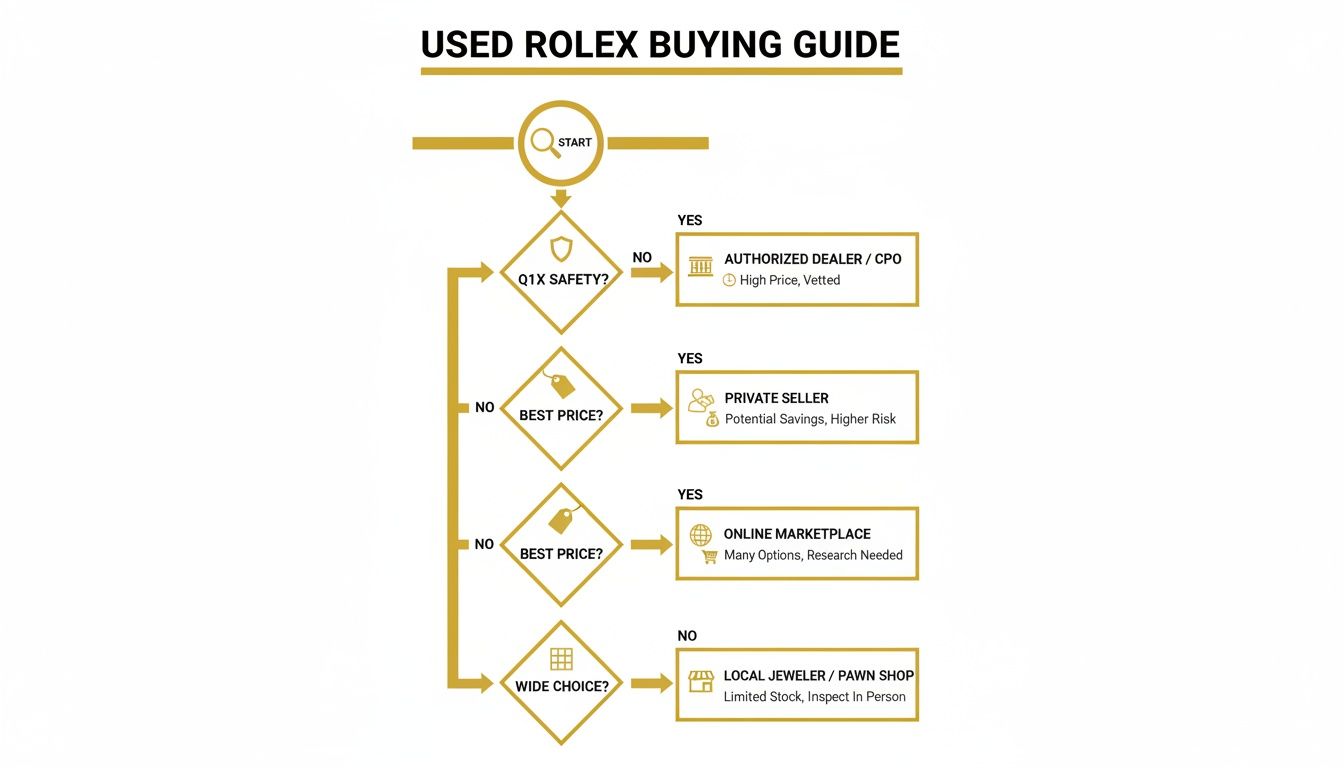
As you can see, prioritizing absolute safety points toward certified dealers, while chasing the widest selection might lead you to marketplaces where you need to be extra vigilant.
Spotting Seller Red Flags
Inspecting the watch is crucial, but so is vetting the seller. Even a watch that looks great in photos can be part of a bad deal if the seller is dishonest. If you want to go even deeper on this topic, our own guide on how to tell if your Rolex is real covers even more detail.
Keep an eye out for these classic warning signs:
- Using Stock Photos: A legitimate seller will always provide clear, high-resolution pictures of the actual watch they're selling. If all you see are generic images from the Rolex website, they’re almost certainly hiding something—damage, a fake, or the fact they don't have the watch at all.
- Refusing Third-Party Inspection: Any seller who is confident in their watch will have no problem with you taking it to an independent expert for verification. If they refuse, walk away. It's a massive red flag.
- Creating False Urgency: Watch out for high-pressure sales tactics like "deal ends today" or claims that they have "tons of other offers." This is just a trick to make you panic and skip your due diligence.
- Vague or Incomplete Descriptions: A proper listing should include the model reference number, the serial number (partially hidden is fine), condition details, and whether it includes the original box and papers. A seller who is sparse on details is either clueless or, more likely, hiding something.
When you combine a thorough physical inspection with a sharp eye for seller behavior, you'll be in a much stronger position to make a smart, secure purchase.
Understanding Pre-Owned Rolex Pricing and Value
Ever wondered why two Rolex Submariners, looking almost identical side-by-side, can have a price difference of thousands of dollars? Welcome to the nuanced world of pre-owned Rolex valuation. It's a place where the price isn't just about age and condition; it’s a complex blend of history, completeness, and market demand.
Think about it like the classic car market. A 1965 Ford Mustang that's all-original with low mileage and a rare engine is in a different league than one that's been heavily modified and driven hard. The same principles apply to a fine Swiss watch. Knowing what to look for is the first step toward making a smart purchase and truly understanding a watch's worth.
The Vocabulary of Rolex Value
To get a handle on pricing, you need to speak the language of collectors and dealers. These aren't just buzzwords; they're the core elements that tell a watch's story and determine its place in the market.
-
Reference Number: This is the watch's model number (like 16610 for a classic Submariner). It’s the single most important piece of information, defining the watch's specific generation, materials, and design. It's the starting point for all valuation.
-
Box and Papers: This term refers to the original presentation box and, more importantly, the warranty papers or card from its initial sale. Having a "full set" with both is a huge deal—it proves the watch's authenticity and origin, often increasing its value by 10-20%.
-
Condition: This is way more than just a quick glance for scratches. Experts assess if a watch has ever been polished, how much, and if it still has its sharp, original factory lines. For many collectors, an "unpolished" watch with honest wear is far more desirable than one that’s been polished to look brand new, as polishing can soften the original case geometry.
A watch’s reference number is its DNA, defining its core identity. Its condition and the presence of its original box and papers act as its verified history, telling the story of its life and directly influencing its desirability and price.
These three factors are the bedrock of any pre-owned Rolex's value. For a deeper dive into how these elements affect what you'll pay, our guide to Rolex resale value breaks it down even further.
Market Forces That Drive Prices
Once you've sized up the watch itself, you have to look at the bigger picture. A Rolex's value doesn't exist in a vacuum; it’s constantly fluctuating based on supply, demand, and global economic shifts.
A model’s popularity, for example, is a massive driver. Steel sports models like the Daytona, GMT-Master II, and Submariner are in such high demand that they consistently trade for prices far above their original retail cost. On the other hand, certain Datejust configurations are more readily available, presenting an opportunity to get into a fantastic Rolex for much less than a new one.
Even global trade policies can make waves in the watch market. With US tariffs on Swiss imports still in place, the cost of bringing new watches into the country has gone up. This has naturally pushed more buyers toward the pre-owned market, which isn't subject to the same duties. With new Swiss imports now 30-40% costlier in some cases, the secondary market has become more attractive than ever. If you're curious about the specifics, Debonar Watches provides analysis on how tariffs are shaping the market.
Getting comfortable with this terminology and keeping an eye on market trends is what separates a casual browser from a confident buyer. It gives you the ability to look at a listing, understand the story behind the price tag, and know a great deal when you see one.
Why a Trusted Independent Dealer Is Your Best Bet
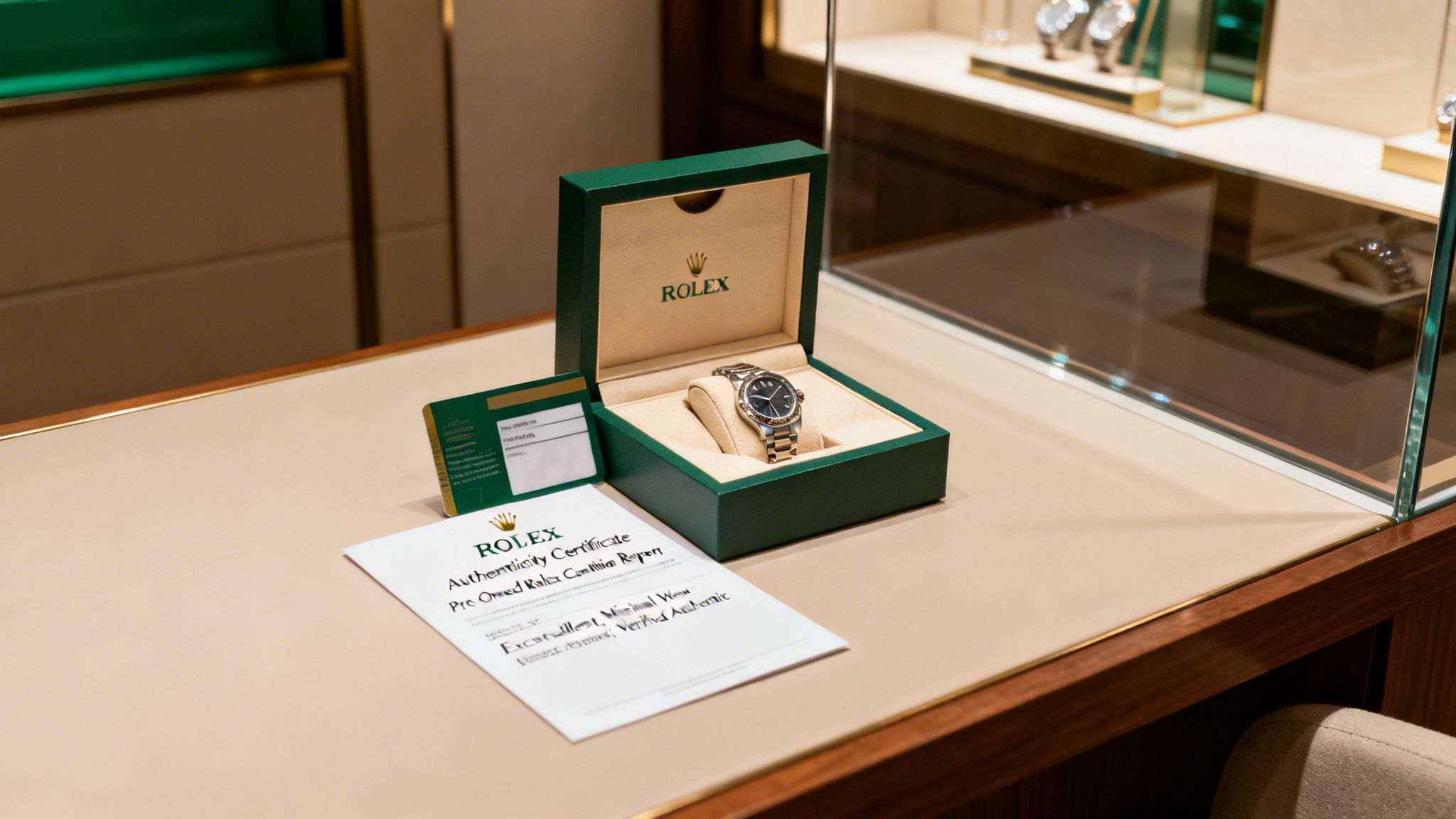
So, after looking at all the different ways to buy a pre-owned Rolex, where do you land? It can feel like a choice between paying a huge premium for a brand-certified program or rolling the dice with an anonymous seller on a marketplace.
There's a middle ground, and frankly, it's the sweet spot. For smart collectors who want real value without sacrificing peace of mind, a trusted independent dealer is the way to go. It strikes the perfect balance of safety, expertise, and fair pricing.
The most important difference comes down to one simple thing: ownership. A peer-to-peer marketplace is just a digital middleman, connecting strangers and taking a cut. A reputable independent dealer, like us at Perpetual Time, owns every single watch we sell. Our name and our reputation are on the line with every timepiece in our collection.
Think about it. When we have our own money invested in a watch, our goals are perfectly aligned with yours. We are driven to guarantee that every watch is 100% authentic and in fantastic shape. A marketplace, on the other hand, just needs the transaction to happen. The burden of vetting the watch—and the seller—falls entirely on you.
Built on a Foundation of Trust
A business model built on ownership has to run on transparency. For us, that means a rigorous in-house inspection process that goes far beyond a quick look. We dig deep into every watch's history and mechanics.
This isn't just about selling watches; it's about building confidence with every client, whether you're buying your first luxury timepiece or adding to a seasoned collection. Here’s a glimpse of what happens behind the scenes:
- Serial Number Verification: We meticulously check every serial number against global databases to confirm the watch's history and ensure it has never been reported lost or stolen.
- Multi-Point Inspection: Our in-house experts conduct a head-to-toe examination of the movement, dial, case, and bracelet to verify every component is original and to assess its precise condition.
- Performance Testing: Before a watch is even considered for listing, it's put through its paces to ensure its timekeeping is accurate and reliable.
Because we handle every watch ourselves, we know its story inside and out. That’s a level of due diligence you simply can't get when buying from a stranger online.
What You See Is What You Get—Guaranteed
Another non-negotiable for a top-tier independent dealer is total honesty in our listings. In the world of online luxury, photos are everything. If you see a dealer using generic stock images, that's a massive red flag.
A trusted dealer will always show you high-resolution photos of the actual watch for sale. The timepiece in the pictures is the exact one you’ll receive. No guesswork, no surprises.
This is always paired with a detailed and honest condition report. We'll clearly describe any signs of wear, outline the watch's production details, and tell you exactly what’s included, like the original box and papers. It’s about giving you complete clarity so you can buy with absolute confidence.
This model of trust is more important than ever. While Rolex continues to dominate the pre-owned market in 2026, recent data reveals its market share took a 3.3% dip in 2025 after years of intense resale activity. This shows that savvy buyers are starting to look for value in other brands, too. A dealer-owned operation like Perpetual Time in Los Angeles stands out by applying this same process of in-house verification and transparent listings to all timepieces, not just Rolex. To learn more about what's driving these changes, you can discover insights on 2026 watch market trends on gamzoandco.com.
At the end of the day, choosing an independent dealer means you’re partnering with an expert who is just as invested in the quality of your watch as you are. It’s the smartest, most secure way to buy in the pre-owned market.
Finding Used Rolex Watches in Los Angeles
If you're a watch collector in Southern California, you've got a home-field advantage. Los Angeles isn't just a big city; it's a global center for luxury goods, which means the market for pre-owned Rolexes is incredibly active and full of specialists.
This completely changes the buying experience. Instead of just scrolling through photos online, you can actually see the watch you're considering in person. There's nothing like feeling the solid weight of the bracelet, seeing how the light plays across the dial, and getting a true sense of its condition with your own eyes. It’s a level of confidence you just can't get from a screen.
Building a Local Relationship
Buying locally is about more than just a single transaction. It’s your chance to find a trusted dealer you can build a real relationship with—someone who becomes your go-to expert for years to come. Think of them as a partner in your collecting journey, someone who can offer advice on your next purchase, help with trades, and be there for ongoing service.
Here at Perpetual Time, we're proud to be a key part of the Los Angeles watch community. We believe in building that trust face-to-face, inviting local collectors to schedule private viewings of our collection or to sit down with us when they're ready to sell.
While our roots are firmly planted in L.A., our expertise isn't limited by geography. We ship every watch we sell nationwide with full insurance, giving clients across the country the exact same meticulous service our local customers enjoy. For a deeper dive into the local scene, take a look at our guide to the best watch stores in Los Angeles.
Common Questions About Buying a Used Rolex
As you get ready to make a move, a few common questions are probably bouncing around in your head. Let's tackle them head-on, so you can feel completely confident in your decision.
Is Buying a Used Rolex a Good Investment?
It certainly can be, and often a very smart one. In the 2026 market, where you can wait years for a new model and face constant price increases, the pre-owned market is where the real value is. You neatly sidestep the initial depreciation that happens the second a new watch is sold.
In fact, many of the steel sports models don't just hold their value—they often appreciate. It's one of the few luxury purchases that can genuinely be considered a tangible asset.
How Important Are the Original Box and Papers?
Think of the "box and papers" as a watch's original birth certificate and provenance. They absolutely add to the story and completeness of the piece, often boosting its resale value by 10-20%.
But here's the crucial part: their absence doesn't automatically signal a fake, particularly with older vintage watches where these items were easily lost. A reputable dealer's authentication is paramount.
I'd always tell a client to choose a genuine watch without papers from a trusted seller over a counterfeit piece that comes with a convincing fake set. The watch itself is what matters most.
Will a Used Rolex Lose Value After I Buy It?
For the most part, no. The biggest hit to a watch's value occurs the moment it goes from "new" to "pre-owned." When you buy a used Rolex at a fair market price, you're buying after that initial drop has already happened.
As long as you purchase an in-demand model in great shape from a transparent seller, you'll find its value is remarkably stable. Many, as we mentioned, will even climb over time. The key is buying the right watch from the right source.
Is It Safe to Buy a Used Rolex Online?
It is 100% safe, provided you do your homework and buy from the right people. The danger lies in anonymous forums and peer-to-peer marketplaces where you have little to no recourse if something goes wrong.
The safest route by far is to work with an established dealer who owns their own inventory. A business like that guarantees authenticity, provides fully insured shipping as a standard, and stands behind every single watch they sell. It completely removes the risk and guesswork from buying online.
When you're ready to find a timepiece that is authenticated, transparently listed, and backed by experts, the team at Perpetual Time is here to help. Explore our curated collection of certified pre-owned luxury watches at https://perpetualtime.com.


