
Cart
0
A client once came in convinced he wanted a Day-Date 40. Then he put on a Rolex Day Date 41mm 218238 and stopped talking for a second. That pause is why this reference still matters.
The Brief but Bold Era of the 41mm Day-Date
A buyer will usually know within thirty seconds whether the 218238 makes sense. I have seen it happen plenty of times. Someone comes in expecting the familiar shape of a Day-Date, then the 41mm case and full yellow gold weight change the conversation from brand recognition to fit, presence, and whether this is a watch they will keep wearing.
That reaction explains the reference better than a spec sheet does.
Rolex launched the Day-Date II 218238 as the first 41mm Day-Date, and it had a short production life before the brand shifted to the Day-Date 40. For collectors, that matters less as trivia and more as context. The 218238 is not the standard modern Day-Date. It is Rolex’s brief experiment with a larger, broader, more overt version of the President.
Why the 218238 stands apart
The 36mm Day-Date is the baseline. It is the traditional choice, easier to wear under a cuff, easier to justify if you value continuity with earlier references, and usually easier to integrate into a collection that already has larger sports watches.
The Day-Date 40 is the cleaner modern option. Its case proportions are more resolved, and many buyers find it easier to wear daily because it gives them extra size without pushing too far into statement-watch territory.
The 218238 sits in a different lane. It wears wider, looks heavier, and has more visual spread on the wrist than buyers expect from a one-millimeter jump over the 40. That difference sounds small on paper. In practice, it changes the watch’s role in a collection.
This is the Day-Date for the buyer who wants the President bracelet and day-date display, but does not want the watch to read as discreet.
A watch tied to its era
The 218238 came out during the period when the market rewarded larger luxury watches, and Rolex answered in its own restrained way. The brand did not turn the Day-Date into a sports watch. It kept the core formula intact and gave it more mass, more dial presence, and more wrist authority.
That short-lived approach is exactly why the reference still has a following. Rolex moved back from 41mm fairly quickly, which left the 218238 as the outlier in the family. If you know the Day-Date line well, you spot it immediately.
Collectors who only compare release dates miss the practical point. The 218238 is the modern yellow gold Day-Date for buyers who want the strongest physical presence without stepping outside the President identity.
What that means for a modern buyer
Start with wrist size. On a smaller wrist, the 36mm usually looks intentional and balanced. On a medium-to-larger wrist, the choice between 40mm and 41mm comes down to appetite for weight and visibility. The 218238 is rarely the cautious option.
Then consider budget. The 36mm often gives the strongest value if the goal is entry into the Day-Date line with long-term flexibility. The 40mm tends to appeal to buyers who want the current design language and are willing to pay for that refinement. The 218238 makes the most sense when the extra size is the reason to buy, not a side benefit.
Collection strategy matters too. If this will be your only gold Rolex, the 218238 can cover a lot of ground because it has real event-watch presence. If you already own a yellow gold sports model or another bold precious-metal piece, the 40mm may overlap less awkwardly. The 36mm, by contrast, often works best as the long-term classic.
That is why I rarely describe the 218238 as a simple middle step between the old 36 and the newer 40. It is the reference for a buyer who wants a Day-Date with more swagger, accepts the added wrist presence, and sees the short production run as part of the appeal rather than the whole story.
For broader context on the Day-Date’s place in the brand’s image, this article on why Rolex remains the ultimate status symbol is a useful companion.
Inside the Caliber 3156 and 218238 Case
I’ve seen this happen more than once. A buyer tries on a 218238 after wearing a 36mm Day-Date for years, expects a modest bump in size, and then stops talking for a second once the watch settles on the wrist. The surprise is not the diameter alone. It is the combination of width, gold weight, and the broader case shape. That is what separates the Day-Date II from both the 36mm classic and the later 40mm.
The case is the reason this reference exists
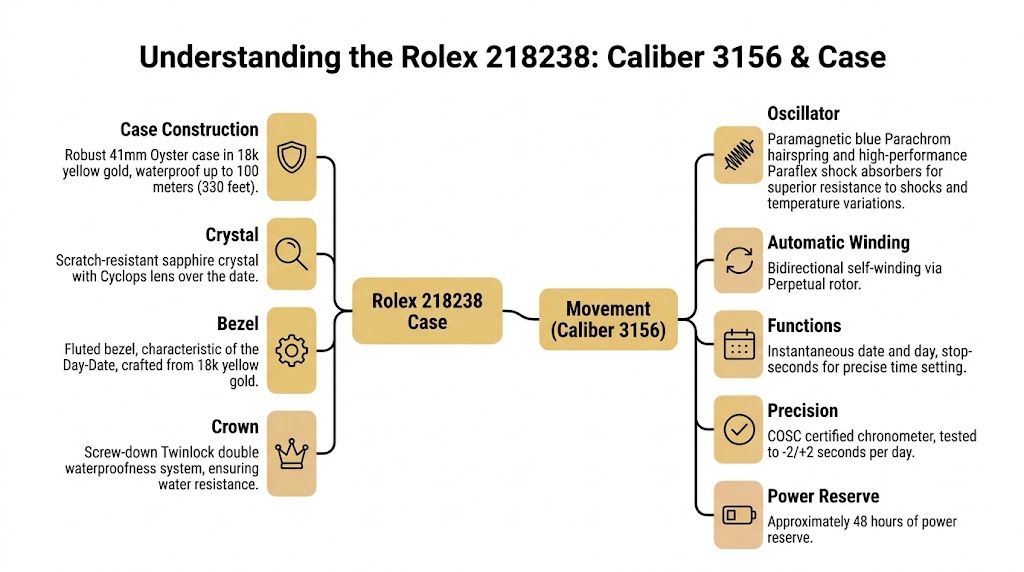
The 218238 uses a 41mm Oyster case in 18 karat yellow gold with the familiar fluted bezel, sapphire crystal, screw-down crown, and President bracelet with concealed Crownclasp. On paper, that sounds like a simple size increase. In hand, it feels like Rolex pushed the Day-Date into a different category.
The 36mm reads classic. The 40mm reads refined and current. The 218238 reads large, warm, and deliberately visible.
That distinction matters because buyers often shop this reference as if it were a cheaper route into a bigger Day-Date. It is better understood as the boldest modern yellow-gold Day-Date configuration. If the watch needs to slide under a cuff every day, the 40mm usually does that job better. If the goal is a gold Rolex that announces itself the moment it catches light, the 218238 does it with less restraint than either sibling.
Wrist fit is less forgiving, too. A smaller wrist can physically wear the watch, but visual balance is the ultimate test. The broad bezel, wide bracelet, and full gold construction make the case look larger than the spec sheet suggests.
Why the Caliber 3156 still makes sense
Inside the 218238 is the Caliber 3156, one of Rolex’s most practical day-date movements for regular ownership. It gives you hacking seconds, independent day and date setting, and the kind of durable architecture that dealers like because it tends to be familiar territory for competent Rolex-trained service work.
For the owner, the value is simple. The watch can leave the rotation for a day or two, and bringing it back is quick. Set the time precisely, click through the calendar without fuss, and put it on. That sounds minor until you compare it with older calendar watches that make every reset feel like a chore.
The 3156 also sits in an important place in Rolex movement history. It is closely related to the 31xx family that built the brand’s reputation for long-term dependability. Buyers who want that broader context should read this overview of the 3135 movement Rolex lineage.
This is one area where the 218238 can make more sense than collectors expect. The case is louder than a 36mm Day-Date, but the movement is straightforward to live with. You get presence without adding ownership drama.
What to check when one is in your hands
Condition matters more on this reference than many first-time buyers realize, because weight and softness in gold can hide wear until you handle the watch carefully.
Here is what I check first:
- Bracelet sag and articulation. The President bracelet should drape fluidly, not feel loose, stretched, or uneven.
- Crown action. Winding and setting should feel precise. Any grinding or vagueness deserves closer inspection.
- Case proportions. Overpolishing shows quickly on a large fluted Day-Date case. Look at the bezel sharpness, lug shape, and case sides together.
- Clasp closure. The concealed Crownclasp should close firmly and sit flush.
- Overall balance on wrist. The watch should feel substantial, but not unstable or top-heavy.
A clean 218238 feels dense, planted, and coherent. A tired one feels flashy for the wrong reasons.
The practical trade-off
The 218238 case gives you more theater than a 36mm and more heft than a 40mm. That is the benefit and the cost.
What works well:
- Strong wrist presence
- Easy-to-use calendar
- Classic Rolex durability in a formal precious-metal watch
- A distinct identity within the Day-Date line
What gives some buyers pause:
- The size can overpower smaller wrists
- Yellow gold at 41mm attracts constant attention
- It overlaps awkwardly if you already own another large gold Rolex
- Some collectors still prefer the tighter proportions of the 36mm or 40mm
The 218238 succeeds when the buyer wants that extra mass and visibility on purpose. If the movement is the same level of convenience you can get elsewhere in the line, the case is what decides the purchase. On this reference, the case is not a detail. It is the whole argument.
Decoding the Dials and Bracelets of the 218238
I have seen buyers get the case size right on a 218238 and still miss the watch. The mistake is usually the dial.
On this reference, the dial does more than change color. It changes how the 41mm case wears, how loudly the yellow gold announces itself, and how easy the watch will be to live with if your collection already includes a 36mm Day-Date or a newer 40mm model. That is the part many spec-driven guides skip.
Dial combinations that define the reference
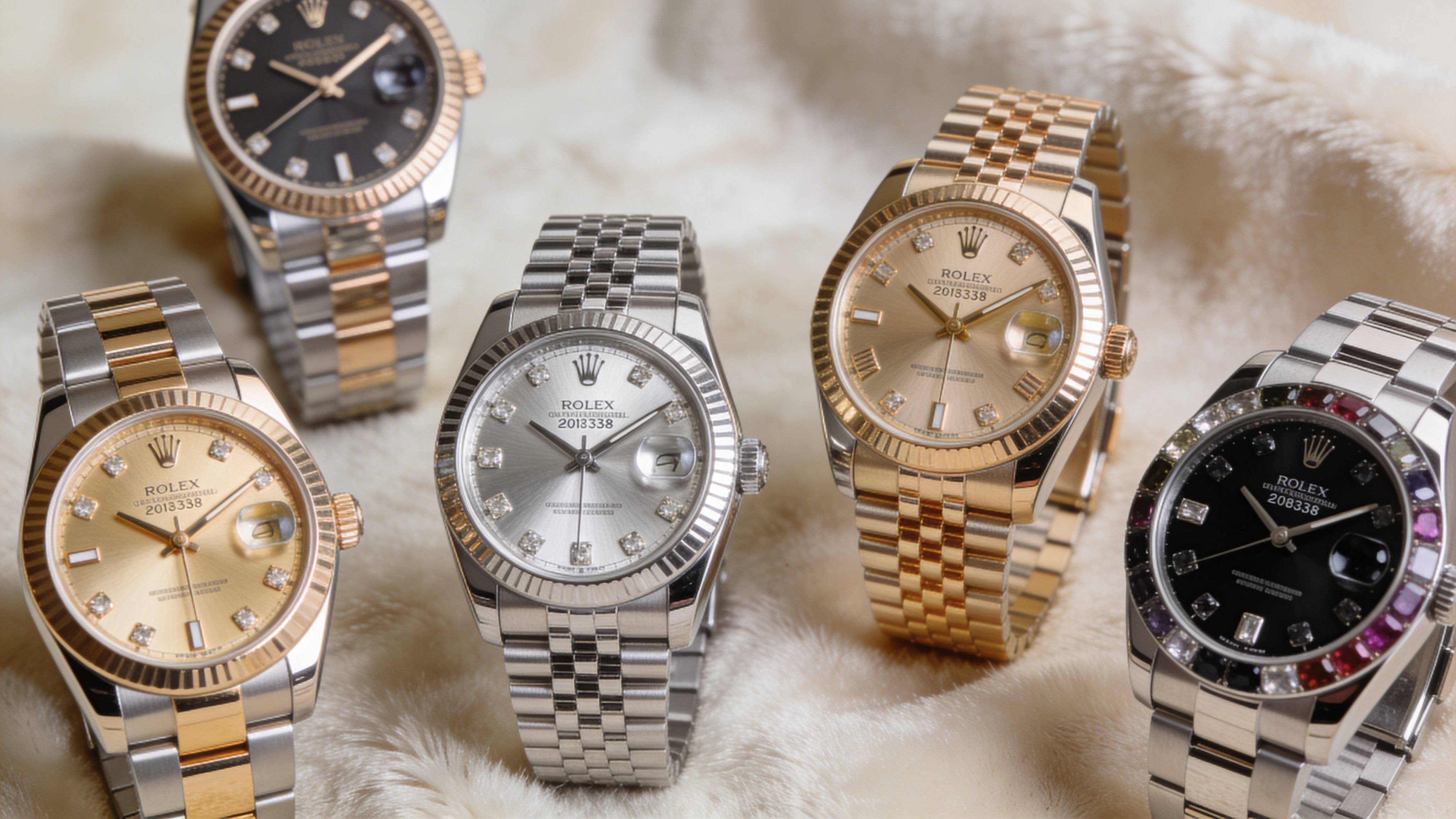
The 218238 was offered in several familiar Day-Date directions. You will regularly encounter champagne dials with Roman numerals or diamond markers, white Roman dials, and more assertive options such as black patterned dials with Arabic numerals. The point is not just variety. Rolex gave the Day-Date II enough dial range to either calm the oversized case or push it further.
That choice matters more here than it does on a 36mm. A classic dial on a 36mm usually stays classic. On a 41mm yellow-gold Day-Date, the same design can read restrained, flashy, or slightly oversized depending on the contrast, texture, and marker style.
Which dials make the most sense
Champagne with Roman numerals is the safe buy for a reason. It delivers the traditional Day-Date image buyers expect, and it keeps resale broad because it does not ask the next owner to share a very specific taste. If you want one gold Day-Date in the box and do not plan to rotate several, this is usually the smartest entry point.
White Roman is often the better choice for a buyer who likes the 218238 case but worries about visual weight. The lighter dial breaks up the mass of the bezel, case, and bracelet. On wrist, it usually feels cleaner than champagne and less insistent than darker, busier dials.
Black patterned dials with Arabic numerals suit the buyer who accepts that the Day-Date II is a product of a specific Rolex era. This look gives the watch more attitude, but it also narrows the audience later. I like these for collectors who already own a more traditional Day-Date and want the 218238 to do a different job.
The practical rule is simple. The larger the dial looks, the larger the whole watch feels. On a 41mm Day-Date, clean layouts usually keep the watch more balanced.
The bracelet carries half the watch
The President bracelet and concealed Crownclasp are part of the 218238's appeal, but they are also part of its risk. On a watch this heavy, a tired bracelet changes comfort, appearance, and value all at once.
A strong bracelet should drape with some weight and stay coherent link to link. It should not collapse into itself, kink, or show uneven wear near the clasp. On a smaller Day-Date, buyers sometimes forgive moderate bracelet wear because the watch still sits compactly. On the 218238, bracelet condition is less forgiving because the case already asks the bracelet to carry more mass.
Check these points closely:
- Link shape should stay even across the bracelet
- Clasp closure should feel positive and sit flush
- Finishing should look consistent between links and clasp
- Drape should feel fluid, not sloppy
This is one area where the 41mm can cost more over time than its siblings. Bracelet work on a full gold President is expensive, and a weak bracelet is harder to ignore on the wrist than it is on a 36mm.
Style versus collection strategy
Collectors sometimes chase the rarest dial first and justify it later. That approach works best if the watch fills a clear gap in the collection.
If the 218238 is your only Day-Date, conservative dials are usually the better buy. If you already own a 36mm in a classic configuration, the case size alone may not be enough separation, so a more modern dial can make the 218238 feel like a distinct watch rather than a larger version of what you already have. Buyers comparing older Day-Date generations can also review the Rolex Day-Date 36 single quick and double quick evolution to understand how design and daily use changed across eras.
| Buyer priority | Better fit |
|---|---|
| Traditional Day-Date look | Champagne Roman |
| Cleaner, less dense 41mm presence | White Roman |
| Strong period character | Black patterned dial |
Buy the dial that still makes sense after the first week of excitement passes. On the 218238, the bracelet gives the watch its authority, but the dial decides whether that authority feels classic, modern, or excessive.
Navigating the Pre-Owned Market for the 218238
I see the same pattern with the 218238 all the time. A buyer decides he wants the discontinued 41mm Day-Date, opens a dozen tabs, and assumes the spread in asking prices is mostly dealer margin. It usually is not.
With this reference, small differences in condition change the ownership experience more than many buyers expect. The 41mm case has more surface area, the President bracelet carries more visual weight, and any softness in the metal shows up quickly. A mediocre 218238 can still look impressive in photos. On the wrist, the shortcuts are easier to spot.
What actually drives value
Price on a pre-owned 218238 usually comes down to five things.
- Case condition. The bezel should still read cleanly, and the case should retain definition. Heavy polishing hurts this reference more than it hurts a 36mm because the Day-Date II already has a broader, more squared profile.
- Bracelet integrity. Stretch, uneven link wear, and loose feel matter a lot on a full-gold President. Repairs are expensive, and a tired bracelet makes the watch feel older than it is.
- Dial and handset correctness. A desirable dial helps, but correct parts matter more than chasing a flashy configuration with unanswered questions.
- Accessories and provenance. Box and papers do not make a bad watch good, but they reduce friction when you buy and when you eventually sell.
- Service history. Recent, documented work lowers the chance that your first year of ownership starts with an immediate trip to the bench.
The short production run helps keep the 218238 distinct in the market, but that alone should not justify overpaying for a weak example. I would rather buy a cleaner watch with a standard dial than a compromised one with a rarer configuration.
Why cheap listings can get expensive
The wrong way to shop this reference is by sorting listings from low to high and stopping at the first one that looks close enough.
The better question is what the discount is buying you. On a 218238, the answer is often hidden in polished case edges, bracelet fatigue, replacement parts, missing links, or vague service language. Those problems cost real money to correct, and some cannot be fully reversed.
That trade-off matters more here than it does on some other Day-Date references. A 36mm can tolerate a little more visual age without losing its character. The 41mm depends on crisp geometry. Once that sharpness is gone, part of the appeal of the Day-Date II goes with it.
How I sort listings
When I evaluate a 218238 for stock or for a client, I put it into one of three groups first. That tells me how hard the watch will be to own later, not just how hard it was to buy.
| Listing type | What it usually means for the buyer |
|---|---|
| Clean, complete, well-photographed | Lower inspection risk, easier resale, stronger chance the watch will feel right in person |
| Honest but incomplete | Can make sense if the watch itself is strong and the missing pieces are reflected in the price |
| Cheap with weak documentation | Higher chance of hidden costs, tougher exit later, and more work before you can trust what you bought |
Photos matter, but consistency matters more. Sellers who show the clasp, bracelet side profile, case flanks, and tight dial shots usually understand what informed buyers will ask. Sellers who avoid those angles often know why.
Buying strategy for different buyers
If this will be your only Day-Date, buy the best physical watch you can afford before you start paying up for novelty. The 218238 already gives you a distinct look because of the case size. You do not need every variable turned up at once.
If you already own a Day-Date 36, the 218238 works best when it feels intentionally different. That can mean a cleaner, more modern dial, but it still starts with condition. A worn 41mm does not add useful variety to a collection. It just overlaps badly with a stronger 36.
If you are also considering the 40mm generation, be disciplined with pricing. The 218238 should usually win because you want the specific Day-Date II stance and short-run identity, not because it happened to be the first gold Day-Date you found in budget.
Collectors who want a tighter process should review this guide on how to buy a used Rolex before comparing sellers.
The best 218238 buys are rarely the absolute cheapest or the most hyped. They are the watches that still feel honest in the metal, with a strong bracelet, clean case lines, correct parts, and no awkward explanations attached.
How the 218238 Compares to Other Day-Date Models
Most buyers don’t struggle with whether they want a Day-Date. They struggle with which Day-Date they want to live with.
That’s where the Rolex Day Date 41mm 218238 becomes interesting. It isn’t just larger than the 36mm and slightly different from the 40mm. It occupies a different buying logic.
The fast comparison
| Feature | Day-Date 36 (e.g., 118238) | Day-Date II 41 (218238) | Day-Date 40 (228238) |
|---|---|---|---|
| Case impression | Traditional and compact | Broad and assertive | Modern but more refined |
| Wrist presence | Understated | Strongest of the three | Strong, but less blocky |
| Fit for smaller wrists | Usually easier | More demanding | Often more forgiving than the 41 |
| Collection role | Core classic | Distinct transitional model | Current-generation modern pick |
| Style signal | Heritage-first | Bold statement | Balanced luxury |
The point isn’t that one is better. The point is that each one solves for a different buyer.
Against the Day-Date 36
The 36mm Day-Date remains the reference point for the entire line. It carries the original proportions, and for many collectors that’s the whole argument.
The 218238 wins if you want more visual authority. It loses if you want restraint.
A 36mm in yellow gold can move between formal, business, and daily settings with very little friction. The 41mm asks for more confidence from the wearer. If your wardrobe leans structured, minimal, or conservative, the 36 often integrates more naturally.
If your wrist is larger, though, the 36 can read as elegant but slightly too quiet. That’s where the 218238 becomes compelling. It keeps the Day-Date design language but scales it to match a buyer who wants the watch to register immediately.
Against the Day-Date 40
This is the harder comparison because many buyers cross-shop these two directly.
The 40mm generally feels more resolved. Rolex trimmed the concept into something that preserves presence without the same broad-shouldered effect of the 41mm. If you want a larger Day-Date with cleaner proportioning, the 40 often wins on pure balance.
The 218238 wins on character.
It looks like a product of a specific era, and for some collectors that’s exactly the attraction. It doesn’t try to hide its size. The bezel, dial opening, and case stance all combine to create a bigger visual statement than the 40.
The Day-Date 40 is often the safer answer. The 218238 is often the more interesting answer.
Wrist, wallet, and collection strategy
Buyers should be brutally honest about these factors.
Wrist
If your wrist is on the smaller side, the 36 is usually the low-risk choice. The 40 is often the modern middle ground. The 41mm works best when you want size and can carry it.
The 218238 was built with dimensions that generally suit wrists 15 to 16 cm or larger, as noted in the earlier reference details. That’s not a style opinion. It’s practical fit guidance.
Wallet
The wrong Day-Date is expensive in a way that doesn’t show up immediately. You won’t necessarily lose sleep on day one. You’ll just wear it less.
A 36mm buyer who stretches into a 41mm for status can end up with a watch that feels too loud. A 41mm buyer who settles for a 36mm because it seems safer can end up with a watch that never quite scratches the itch.
The smarter wallet move is buying the watch you’ll keep.
Collection role
Ask what the watch is supposed to do in your lineup.
- If you want the cornerstone Rolex dress watch, choose the 36.
- If you want a modern Day-Date with broad appeal, the 40 is the obvious route.
- If you want a discontinued model with a stronger point of view, the 218238 stands apart.
Who should buy the 218238
The ideal 218238 buyer usually fits one of these profiles:
- The larger-wrist collector who finds the 36 elegant but undersized.
- The buyer with sport models already covered and wants a gold piece with presence.
- The collector who values short-run references that represent a clear transition in Rolex design.
- The buyer who prefers the bolder look of the Day-Date II over the more polished feel of the Day-Date 40.
Who probably shouldn’t buy it?
Someone chasing the most universally accepted Day-Date. That person is usually happier with a 36 or 40. The Rolex Day Date 41mm 218238 rewards a buyer who understands why it exists and wants exactly that.
Authenticating and Acquiring Your 218238 with Confidence
The most expensive mistake with a Day-Date usually isn’t buying a fake that looks obviously wrong. It’s buying a watch that’s technically real but compromised. Overpolished case. Weak bracelet. Service parts that change the character. Incomplete disclosure.
That’s why inspection discipline matters so much with the 218238.
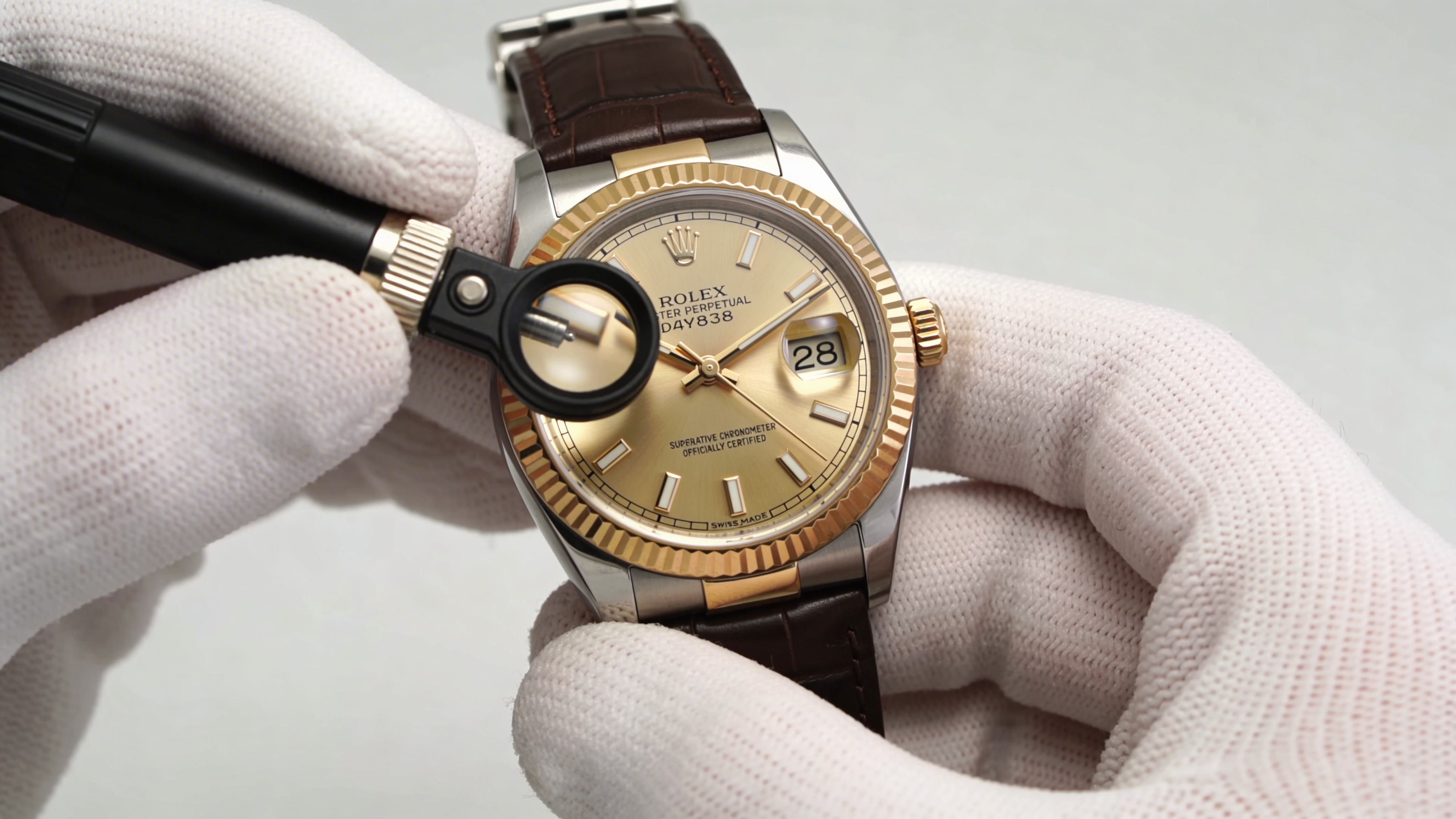
Start with the feel before the details
A genuine 218238 should feel coherent. The case, bracelet, clasp action, crown operation, and dial quality should all belong to the same level of manufacturing.
If one part feels off, slow down.
The common checkpoints are simple, but they matter:
- Weight and balance. A full yellow-gold Day-Date should feel substantial and properly distributed on the wrist.
- Bracelet behavior. The President bracelet should articulate smoothly.
- Dial quality. Printing should look clean and deliberate, with no muddy text or awkward spacing.
- Date magnification. The Cyclops should present the date clearly and proportionally.
- Clasp and engravings. They should look precise, not approximate.
Check condition with a collector’s eye, not a casual buyer’s eye
A polished 218238 isn’t automatically a bad buy. Most pre-owned gold watches have seen some level of refinishing. The key question is whether the work preserved the watch’s shape.
Look closely at:
Case lines
The case should still read as strong and intentional. If the edges are soft and the surfaces have lost definition, the watch won’t wear the same way.
Fluted bezel
The bezel is one of the first places where excessive wear or poor refinishing shows up. Crispness matters because it affects how the whole watch catches light.
Bracelet stretch
This isn’t only cosmetic. On a heavy gold watch, a worn bracelet changes comfort and can make the watch feel tired.
Matching overall condition
The dial, hands, case, and bracelet should make sense together. If one part looks dramatically fresher than the rest, ask why.
Buy the best metal and bracelet condition you can find. Those are harder to fix correctly than many buyers assume.
Movement checks still matter
The 218238’s Caliber 3156 gives buyers practical things to test during handling. The hacking seconds should allow precise time-setting, and the double quickset should let the day and date advance independently. Those functions aren’t just convenience features. They also tell you a lot about how the watch is behaving mechanically, as discussed earlier in the article.
If the crown action feels rough or the setting response is inconsistent, don’t explain it away. Investigate it.
A movement can run and still not be right.
Documents and disclosure
A strong seller should be comfortable answering direct questions. Not with vague reassurance. With specifics.
Ask for:
- Reference confirmation
- Serial verification
- Condition notes
- Service information, if available
- Whether the watch includes box and papers
- Photos of the exact watch, not generic stock images
That last point is essential for serious buying. A Day-Date has too many condition variables to purchase confidently from generic imagery alone.
Where buyers usually go wrong
The mistakes are predictable.
One buyer gets fixated on dial rarity and ignores bracelet wear. Another sees a low asking price and underestimates what restoration or servicing might involve. A third assumes every yellow-gold Day-Date carries the same liquidity, regardless of condition quality.
Those errors are avoidable if you keep your priorities in order:
- Authenticity
- Originality
- Condition
- Completeness
- Price
Switch that order around and regret tends to show up later.
For buyers who want a broader checklist before pulling the trigger, this guide on how to authenticate Rolex watches is useful preparation.
The Rolex Day Date 41mm 218238 is worth buying with care. It’s a reference where the difference between a merely acceptable example and a great one is easy to feel once you’ve handled both.
If you’re ready to buy, sell, or trade a Rolex Day-Date with confidence, Perpetual Time offers a straightforward dealer-owned experience built around authentication, exact-watch photography, transparent condition notes, and attentive support from a team that handles the inventory directly.


