
Cart
0
A lot of Rolex owners arrive at the same moment in the same way. The watch still looks right from across the room, but on the wrist it no longer feels right. The bracelet hangs lower than it used to, makes more noise when you set it down, and has that loose drape collectors usually call stretch, even though what you're often seeing is wear in pins, tubes, and link connections rather than the metal itself stretching.
That can be unsettling, especially if the watch has been with you for years. A bracelet is part of the identity of a Datejust, Submariner, GMT-Master, or Day-Date. When it gets sloppy, the whole watch starts to feel older than it should. The good news is that rolex bracelet refurbishment is a real, established service category now, and the right solution depends less on slogans and more on your priorities: originality, budget, turnaround, and how the watch fits into your collection.
That Familiar Jangle The First Sign of a Worn Bracelet
Bracelet wear isn't typically noticed all at once. It shows up in small moments. You pick up the watch from a nightstand and hear more rattle than you remember. You fasten it and the head shifts on the wrist. You look down and the bracelet no longer has that tidy, controlled curve Rolex bracelets are known for.
I see this often with owners who have lived with the watch long enough that the change felt gradual. Then one day they compare it to another piece, or even to an old photo, and the difference is obvious. That familiar jangle isn't always a disaster. Sometimes it's honest aging. Sometimes it's the first clear sign that the bracelet needs structural attention.
For bracelets that have been worn consistently, especially Oyster and Jubilee styles, this kind of wear is part of the ownership story. It doesn't mean the watch has been abused. It usually means it has been used as intended. The issue is whether that wear has crossed from character into reduced comfort, poor fit, or risk of further damage.
A bracelet in good condition should still articulate freely, sit naturally, and support the case without feeling sloppy. If it doesn't, refurbishment can restore much of the original wearing experience without forcing you into a full replacement.
A worn Rolex bracelet changes the way the whole watch feels. Owners usually notice the comfort issue before they notice the mechanical cause.
That matters more than many first-time buyers expect. Wrist presence on a 36 mm Rolex often comes down to bracelet behavior as much as case diameter, which is part of why fit is such a recurring theme in collector conversations about how a 36 mm Rolex wears on the wrist.
The key is not to panic and not to guess. Some bracelets need a careful rebuild. Some only need selective repair. Some should be left alone except for cleaning and monitoring. The smart move starts with an honest assessment.
Assessing Your Rolex Bracelet Condition at Home
Before you send anything out, get a baseline. You don't need special equipment to tell the difference between normal play and a bracelet that's asking for help.
Start with the dangle test
Hold the watch by the case and let the bracelet hang freely. Don't shake it. Just let gravity show you what the links are doing.
Look for these signs:
- Healthy articulation: The bracelet curves smoothly and still looks controlled.
- Noticeable looseness: The bracelet hangs with more sideways slack and uneven drape.
- Advanced wear: Sections look collapsed, twisted, or overly limp near high-friction areas.
This isn't a lab test, but it's useful because it reveals how much play has developed in the link system. On a worn bracelet, the head can appear heavier because the bracelet no longer supports it with the same structure.
Check the problem areas by bracelet type
Not all Rolex bracelets age the same way.
- Oyster bracelets: Wear often shows up as looseness in the main link chain, especially near the clasp and the sections that flex most during daily wear.
- Jubilee bracelets: These demand a closer look because the multi-link construction can hide uneven wear. A Jubilee can still look attractive from above while feeling sloppy in motion.
- President bracelets: Owners should pay close attention to consistency across the bracelet. Uneven sag between sections often tells you more than surface finish does.
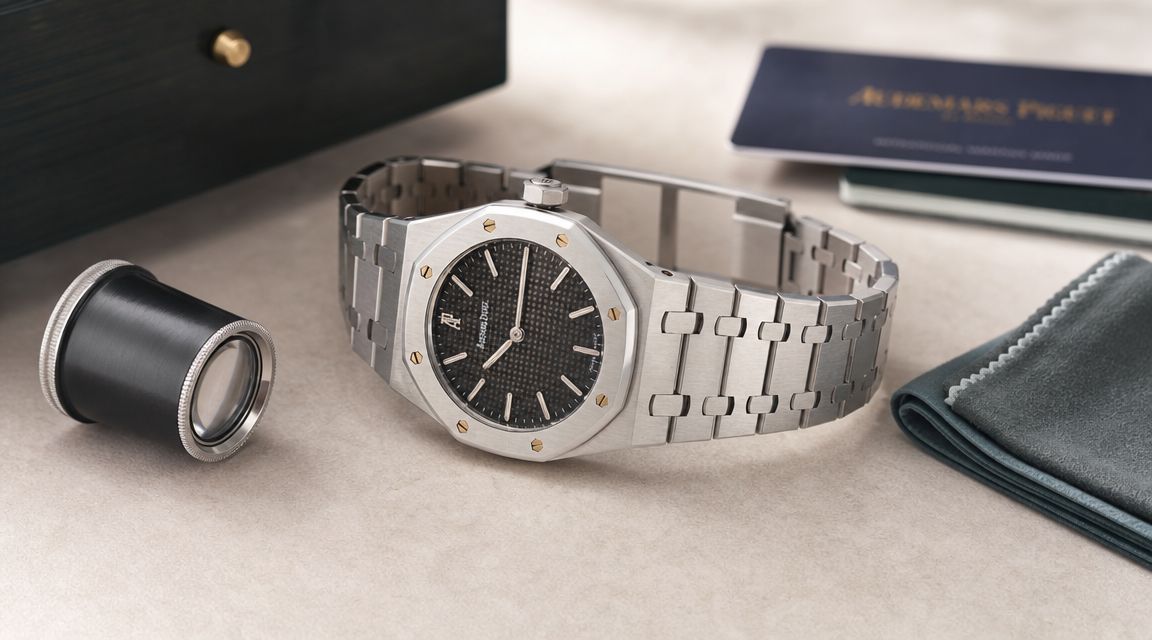
A good comparison point is any high-end bracelet watch with strong geometry. For example, the Audemars Piguet Royal Oak Black Dial on Bracelet band 56303ST.OO.0789ST uses a stainless steel bracelet on a 33mm automatic case, and like any integrated or semi-architectural bracelet design, its appeal depends heavily on clean articulation and controlled drape.
Use touch, not just sight
Run a fingertip across the links and clasp.
Ask yourself:
- Does the bracelet feel smooth in motion? Roughness can point to wear, grime, or distorted alignment.
- Do certain sections move more than others? Localized looseness often means the issue isn't uniform.
- Does the clasp close with confidence? A bracelet can have acceptable link wear but still need clasp attention.
Practical rule: If the bracelet feels loose enough that you notice it every day, it's worth getting an opinion before wear gets worse.
Condition matters beyond comfort. Buyers look closely at bracelet integrity because it affects the overall impression of care and ownership history, which is one reason bracelet condition often feeds into conversations about Rolex resale value.
Choosing Your Refurbishment Path Rolex vs Independent
The key decision. Not whether the bracelet is worn, but who should work on it.
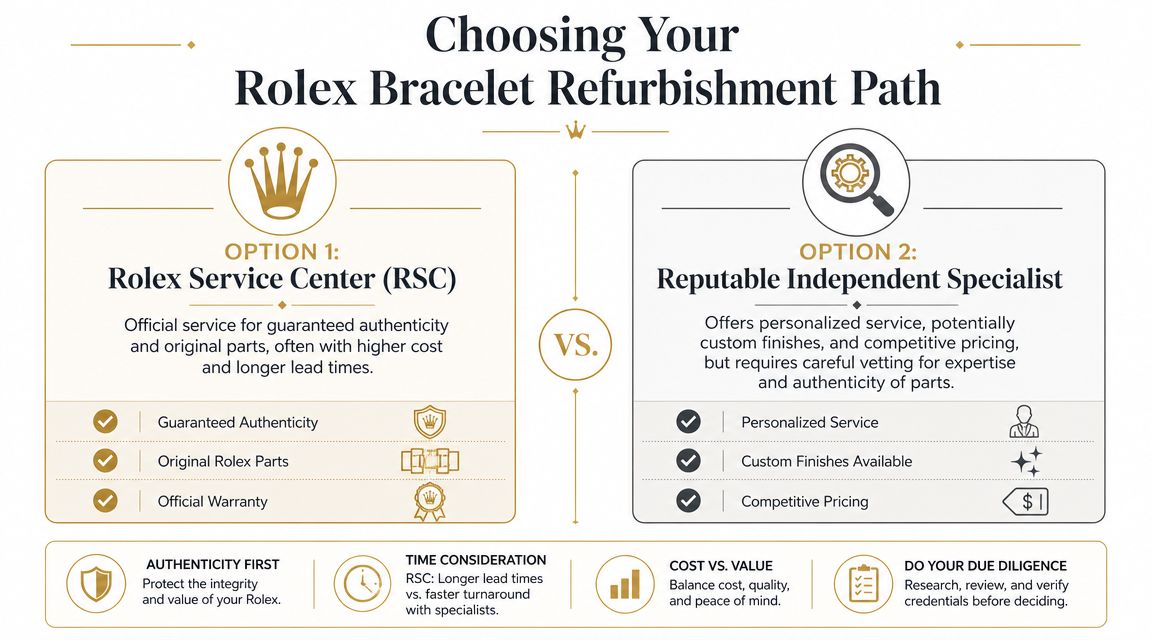
Some owners assume Rolex is automatically the right path. Others assume independent means cheaper and therefore better. In practice, neither shortcut helps much. The right answer depends on the watch and on what you care about most.
Rolex vs Independent Refurbishment At a Glance
| Factor | Rolex Service Center (RSC) | Independent Specialist |
|---|---|---|
| Primary strength | Official brand process and parts handling | Focused bracelet repair expertise and more individualized decisions |
| Cost position | Often tied to broader service decisions | Bracelet refurbishment is often a lower-cost alternative to replacement |
| Typical pricing visibility | Less transparent upfront for bracelet-only scenarios | Public price anchors are easier to find |
| Originality approach | Follows Rolex service standards | Can sometimes preserve more of the original bracelet character, depending on the specialist |
| Turnaround style | Structured and formal | Often more conversational and case-specific |
| Best fit | Modern watches, owners wanting official handling | Vintage-sensitive work, targeted bracelet repair, owners prioritizing preservation |
What the market tells you about cost
Independent bracelet repair has become a defined service category with visible pricing. Elite Watch Co says bracelet repair services start at $250 and that customers typically receive an estimated range capped at $600 to $900 after images are reviewed, while Luxury Watch Service places Rolex band repair in a broader range of $150 to $600+ depending on stretch severity, link count, and bracelet type, as noted on Elite Watch Co's bracelet repair page.
Those numbers matter for one reason. They frame refurbishment as a specialized repair in the mid-hundreds of dollars, not automatically as a replacement-level decision. For many owners, that's the first sign that saving the original bracelet is commercially sensible as well as historically sensible.
When Rolex makes the most sense
If the watch is modern, you want official handling, and you're already considering a broader service event, Rolex is often the cleanest path. Some clients sleep better knowing the watch passed through the brand's own process. That preference is legitimate.
Rolex is also a sensible choice when the owner doesn't want to referee decisions about finish, parts, or restoration philosophy. You hand over the watch and accept the brand standard.
When an independent specialist is the better call
For bracelet-specific problems, especially visible stretch or sloppy articulation, a true bracelet specialist can be the sharper choice. Independent specialists often treat the bracelet as its own project rather than as a side issue attached to full watch service.
That distinction matters on older pieces. A specialist may be more willing to preserve original character, discuss minimal refinishing, or work selectively rather than steering toward replacement.
If the bracelet is the problem, use someone whose daily work is bracelets. Not every excellent watchmaker is an excellent bracelet rebuilder.
The originality question owners worry about most
Collectors often ask whether independent work hurts value. Sometimes it can. Sometimes it protects it. The answer depends on the watch and the quality of the work.
For a modern daily wearer, buyers usually care that the bracelet feels right, presents authentically, and hasn't been badly refinished. For a vintage collector piece, the bar is higher. Sharp edges, original profile, and restraint matter more than chasing a "like new" look.
A reputable seller or advisor can help you think through that trade-off before the watch goes anywhere. At Perpetual Time's guide to certified pre-owned Rolex dealers, the broader point is the same one I give clients in person: provenance, condition, and quality of work all travel together.
The Refurbishment Process Explained Start to Finish
Owners are often surprised by how involved proper bracelet restoration really is. Good work isn't a quick squeeze and polish. It's a controlled rebuild.
What happens first
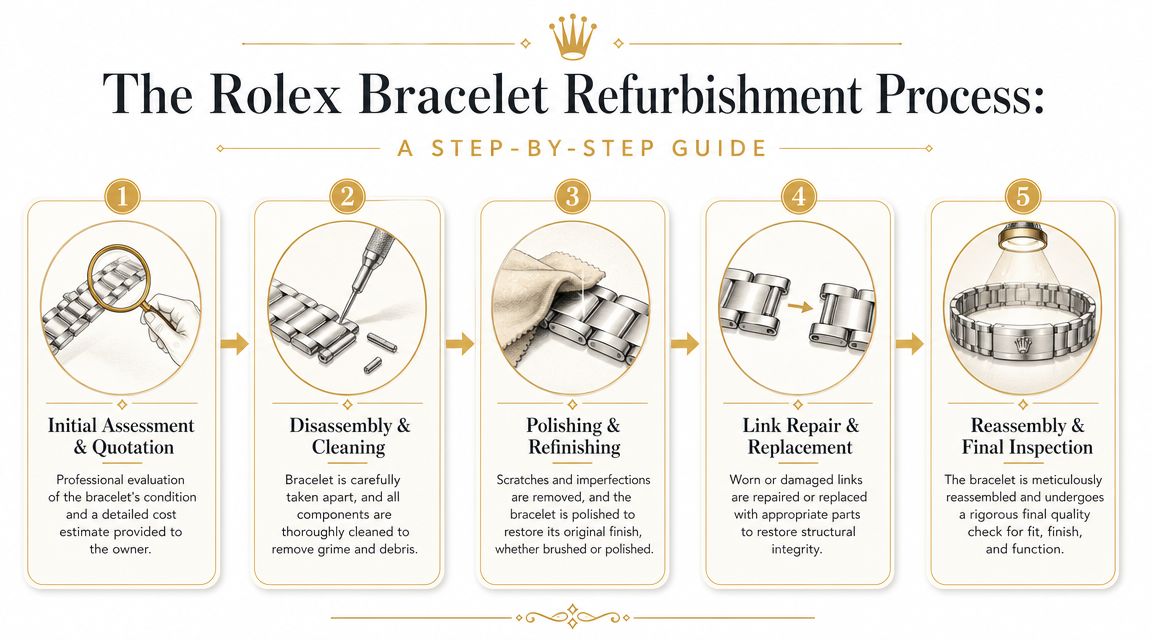
The process starts with inspection. The specialist checks how the bracelet hangs, where the looseness is concentrated, whether certain links are distorted, and whether the clasp or deployant has its own issues.
Then comes the quote. Serious specialists usually want photos first, and the best ones will still reserve final judgment until they have the bracelet in hand.
The structural work
Luxury Watch Service describes a restoration sequence that includes assessment, ultrasonic cleaning, pin and link replacement, tightening and rebuilding, finishing, and quality control on its Rolex bracelet repair overview. That sequence is important because it shows rolex bracelet refurbishment is a structural repair, not just cosmetic cleanup.
A typical workflow looks like this:
-
Disassembly
The bracelet is taken apart so each worn connection can be assessed individually. -
Cleaning
Dirt and residue are removed, often with ultrasonic cleaning, so the specialist can evaluate the metal and moving points accurately. -
Pin and connection repair
Worn pins, tubes, or compromised link interfaces are addressed, leading to much of the improvement. -
Rebuilding and reassembly
The bracelet is brought back together with close attention to tension, alignment, and articulation. -
Surface finish
If requested, polishing and brushing are done to restore a more coherent appearance.
What good technicians pay attention to
The best bracelet work doesn't chase maximum tightness. It aims for the right balance between firmness and movement. A bracelet still has to articulate naturally on the wrist.
That is why the finishing stage should come after the structure is right, not before. If the internal wear hasn't been addressed properly, a fresh polish only hides the issue for a moment.
A good restoration should make the bracelet feel controlled again, not frozen.
Final inspection is usually where quality shows. The bracelet should move freely, sit evenly, close properly, and look like itself. Not like a different bracelet wearing a fresh shine.
Risks Authenticity and Managing Expectations
Bracelet refurbishment can be excellent work. It can also be overdone, poorly explained, or misjudged for the watch in question. In such situations, candid advice matters most.
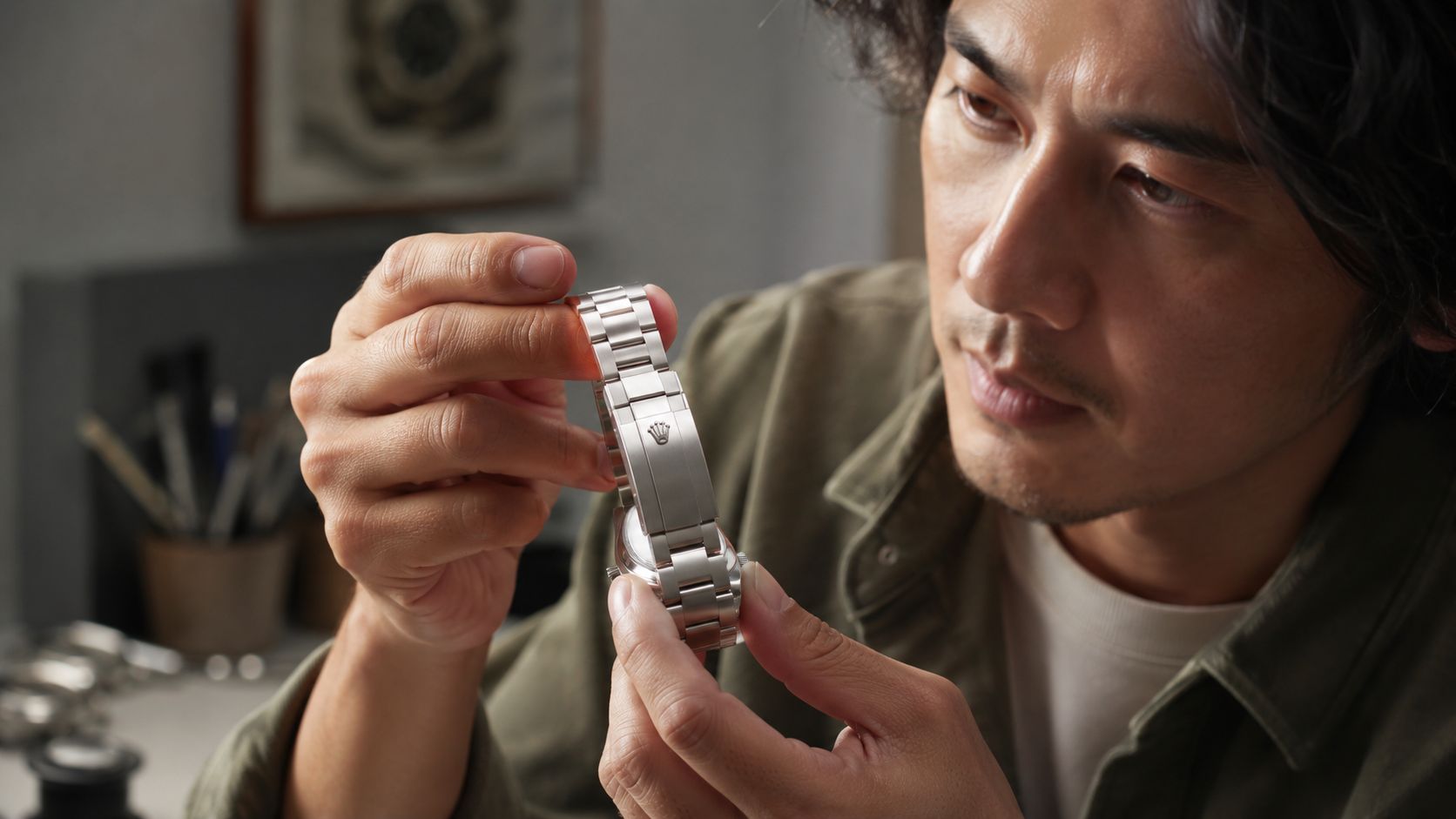
The bracelet will improve, but it won't become untouched
Owners sometimes expect a restored bracelet to return looking factory-fresh in every respect. That's usually the wrong expectation. A skilled refurbishment can tighten wear, improve feel, and clean up the finish. It doesn't erase the fact that the bracelet has lived a life.
That's not a flaw. For many collectors, it's the honest result they want. The goal is a tighter, healthier, more wearable original bracelet, not a fake sense of newness.
The biggest technical mistake is over-tightening
Practitioners who work on loose and stretchy Rolex bracelets warn that if the gap between links is closed too much during re-compression, the links can bind and lose articulation. That turns a wearable bracelet into a stiff one, as explained in ChronoStreet's discussion of Rolex bracelet tightening and restoration.
For Jubilee bracelets, that warning matters even more. Link order and profile alignment have to stay consistent. Uneven reassembly can create binding and accelerate wear rather than solving it.
Refinishing is where opinions split
Some owners want the bracelet refinished to match the renewed structure. Others want every surface mark left in place. Neither instinct is automatically correct.
Use this framework:
- Modern daily wearer: Light refinishing often makes sense if the goal is cohesive presentation and a cleaner overall look.
- Older collector piece: Restraint usually matters more. Heavy polishing can soften edges and reduce the crispness collectors notice immediately.
- Mixed-use watch: Ask for structural work first, then decide how much cosmetic intervention you want.
Ask the specialist direct questions
A good conversation before the job prevents a lot of disappointment later.
- What parts will you replace? You want clarity on whether the repair involves pins, tubes, links, or only adjustment.
- How much refinishing will you do? "Light touch-up" and "factory-style refinish" are not the same thing.
- Will the bracelet remain fully articulated? This is a simple way to test whether the technician understands the over-tightening risk.
- How do you handle vintage pieces differently? If they don't have an answer, keep looking.
Owners who are cautious about originality should also understand how the watch will be represented later if sold. Buyers increasingly scrutinize cases, dials, and bracelets together, which is why it's useful to understand the broader standards behind how to authenticate a Rolex watch.
The best refurbishment is the one that solves the wearing problem without creating a new collector problem.
Aftercare Tips for Your Restored Rolex Bracelet
A restored bracelet can stay healthy for a long time if you treat it like a moving mechanical component rather than just jewelry.
Keep grit out of the links
Dust, skin oils, and fine debris work their way into the moving points of any bracelet. Rinsing and gentle cleaning help reduce the abrasion that builds up over time.
- Use mild soap and water: Clean the bracelet gently and dry it thoroughly.
- Focus on the undersides: That's where residue often hides.
- Don't ignore the clasp: Dirt there affects feel as much as dirt in the links.
If you're thinking about deeper cleaning tools, understand the limits and the right use cases before buying anything. A basic overview of ultrasonic watch cleaner considerations can help you decide what should stay at home and what should go to a professional.
Fit matters more than people think
A bracelet that's too loose tends to move more, and more movement means more wear over time. That doesn't mean you want it tight. You want controlled, comfortable fit.
Pay attention after seasonal changes or after removing links. If the watch starts shifting heavily around the wrist, correct that early rather than letting months of excess movement pile up.
Store it like a bracelet, not a paperweight
When the watch is off the wrist, don't leave the bracelet twisted under the case or hanging awkwardly off a hard edge.
- Lay it flat or naturally curved
- Avoid pressure on the clasp
- Get it checked if articulation changes noticeably
The best aftercare habit is simple. If it starts feeling different, don't wait for it to become obvious.
Rolex Bracelet Refurbishment FAQs
Is refurbishment better than replacing the bracelet?
Often, yes, if the original bracelet is structurally restorable and you care about keeping the watch closer to how it left the factory. Replacement can make sense when wear is too advanced or when the bracelet has prior damage that compromises repair.
Can a stretched Rolex bracelet be fully fixed?
It depends on the extent and location of the wear. Many bracelets can be tightened and rebuilt to feel much better, but the result should be judged as a restoration of function and character, not as a total reset of age.
Does independent bracelet work automatically hurt value?
No. Poor work can hurt value. Thoughtful, well-documented work can preserve usability and support the watch's overall presentation. Vintage pieces need more caution than modern daily wearers.
Should you polish the bracelet during refurbishment?
Only if it fits the watch and your goals. Structural correction and cosmetic refinishing are separate decisions. Some bracelets benefit from both. Others should get the lightest possible cosmetic touch.
How do you choose the right service path?
Start with three questions:
- Is originality your top concern?
- Is the bracelet the only real issue?
- Are you restoring a wearable watch or preserving a collector piece?
Those answers usually tell you whether Rolex, a general independent watchmaker, or a bracelet specialist is the better fit.
If you're weighing rolex bracelet refurbishment and want a grounded second opinion, Perpetual Time can help you think through the trade-offs before you commit. We work with collectors and first-time buyers every day, and that often starts with a simple question: preserve, repair, refinish, or leave it alone.


