
Cart
0

You notice it while taking the watch off for the evening. The bracelet still looks solid, but grime has built up between the links, the clasp feels sticky, and a quick wipe has stopped making much difference. That is usually when collectors start looking at an ultrasonic watch cleaner and asking the wrong first question.
The first question is not whether the machine can clean a watch. It can. The question is which part of the watch, if any, belongs in that bath.
At Perpetual Time, we treat ultrasonic cleaning as a controlled workshop process. It has real value for the right component, usually a removed metal bracelet or clasp. It is a poor choice for an assembled luxury watch, where vibration, moisture, loosened residue, aging seals, adhesives, and delicate finishing all sit too close to expensive consequences.
That distinction matters more than many collectors expect. A bracelet and a watch head do not carry the same risk profile. Neither does a steel link bracelet and a leather strap. The safest approach is part by part, not watch as a whole.
Water resistance adds confusion here. Collectors often assume a sealed case can handle an ultrasonic bath, but water resistance only answers one part of the problem, and never with permanent certainty. If you need a clearer baseline before making that call, review what water resistance on a watch means in practice.
Our advice starts from asset protection. Clean the removable parts that are built for it. Keep the case, movement, dial, crystal assemblies, crowns, pushers, and straps out of the machine unless a watchmaker has already separated and assessed them. That is the framework that prevents a simple cleaning job from turning into a repair.
Should You Use an Ultrasonic Cleaner on Your Watch
The short answer is sometimes, but rarely on the watch itself.
An ultrasonic watch cleaner has a place in careful maintenance, especially for removable metal bracelets and certain fully separated components. That doesn't mean the machine is appropriate for the assembled watch sitting on your wrist. In fact, the safest default for any collector is to assume the complete watch should stay out unless a trained watchmaker has already disassembled it.
Why collectors get into trouble
The appeal is obvious. The machine looks gentle. There's no hard brushing. Dirt seems to disappear from tight spaces that cloth and soap can't reach.
That's exactly why people get overconfident.
The problem isn't only water. It's vibration, trapped residue, unknown seal condition, and materials that don't respond well to cavitation. Luxury watches combine polished metals, coatings, gaskets, adhesives, spring-loaded parts, jewels, and often delicate finishing. One cleaning method doesn't suit all of them.
Practical rule: If you can't clearly identify which part you're cleaning, remove it from the ultrasonic process.
What we actually recommend
For most collectors, home ultrasonic use should be limited to durable, removable metal bracelets or clasps, and only after separation from the watch head. That's the difference between maintenance and risk.
What doesn't work is the common DIY approach:
- Dropping in the whole watch: That exposes the case, seals, crown, dial-side components, and movement to stress they were never meant to take in this context.
- Treating all straps the same: Metal behaves very differently from leather, fabric, and mixed-material assemblies.
- Assuming “quick” means “safe”: Damage doesn't need a long cycle to happen if the wrong component is in the bath.
Collectors who protect value think in terms of reversibility. Dirt can be removed later. Water intrusion, loosened components, or damage to a movement can't be undone cheaply or casually.
If your goal is to freshen up a bracelet, an ultrasonic cleaner may be useful. If your goal is to clean the watch as a whole, stop there. That's watchmaker territory.
Preparing Your Watch for an Ultrasonic Bath
A collector brings in a Royal Oak with grime packed between the bracelet links and asks the same question we hear all the time. Can the watch go in as-is for a quick clean? The answer is no. Preparation is the whole decision. If the part cannot be isolated safely, it should not go into the tank.
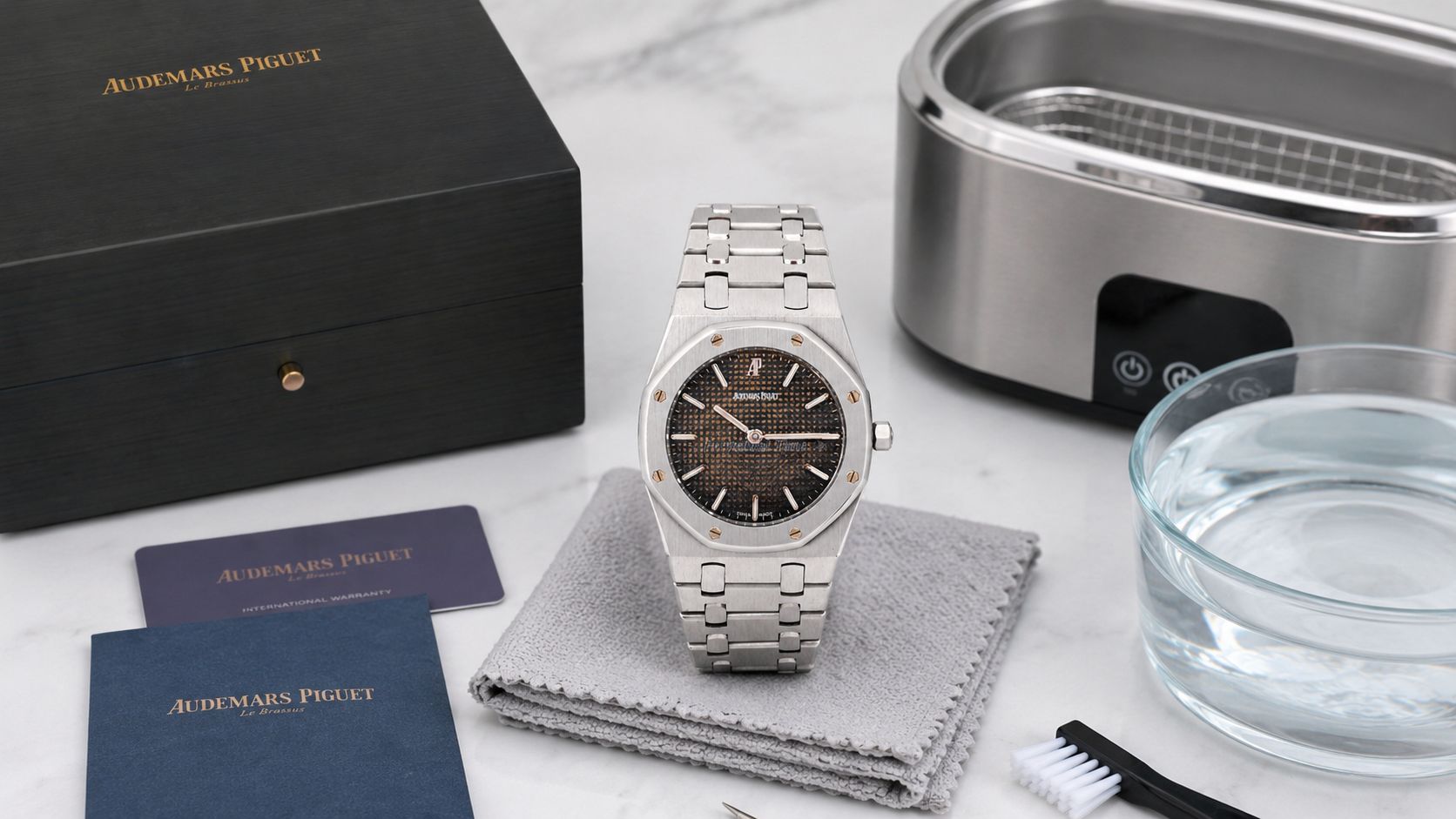
Take the Audemars Piguet Royal Oak Black Dial on Bracelet band 56303ST.OO.0789ST as a practical example. It is listed at $18,500 and in stock. That matters because mistakes on a watch at this level are expensive, and the cleaning plan must reflect that. The removable stainless steel bracelet may be a candidate for ultrasonic cleaning. The watch head, with its case, crystal, seals, crown, dial, and automatic movement, stays out.
Separate only what you can remove cleanly
At the bench, we start with the attachment points. If the bracelet or clasp can be removed with the right tools and proper support for the lugs, that is the first step. If the screws are marked, the spring bars are stubborn, or the case can be scratched by a slip, stop and handle the dirt another way.
Collectors get into trouble when they force disassembly on a watch they do not fully understand. A scratched inner lug, a burred screw head, or a bent spring bar is not a cleaning win.
Use this filter before the machine is even filled:
- Removable solid steel bracelet: Usually the strongest candidate.
- Metal clasp: Often suitable if there are no loose blades, worn springs, or decorative inserts.
- Gold bracelet: Possible, but only if the piece is structurally sound and free of soft solder repairs or fragile set elements.
- Leather strap: Keep it out.
- Fabric, textile, or composite strap: Keep it out.
- Rubber strap with bonded parts, color inlays, or metal inserts: Treat it as a separate material problem, not a default ultrasonic job.
If your watch also needs service, keep that work separate. A rushed cleaning session is the wrong time to combine strap removal, battery access, and case handling. Quartz owners should treat Cartier watch battery replacement as its own maintenance task with its own risk controls.
Prepare the bath properly
The tank setup matters as much as the part selection. We do not let bracelets sit directly on the tank floor because metal-on-metal contact can mark the piece and reduce cleaning consistency. Watch Repair Tutorials advises suspending parts in a basket and degassing fresh solution before use in its ultrasonic cleaner best practices.
A sound prep sequence looks like this:
- Fill the tank with the chosen cleaning solution.
- Run the bath first to degas fresh solution.
- Place the bracelet or clasp in a basket.
- Confirm the part is not touching the tank floor or crowded against other metal pieces.
- Check for loose screws, stretched links, worn pins, cracked inserts, and any sign of past repair.
That inspection is not optional in practice. Ultrasonic action does a good job of exposing weak points. If a link is already loose or an insert is already lifting, the bath may finish the failure.
Inspect construction, not just surface dirt
Surface grime can hide more serious issues. On luxury bracelets, pay close attention to repaired links, polished-over screw slots, aftermarket pins, missing collars, and decorative sections that may be glued rather than mechanically fixed. Those details determine whether cleaning is routine or risky.
At Perpetual Time, we treat ultrasonic prep as a sorting process, not a cleaning ritual. The goal is to protect the watch first and remove dirt second. A dirty bracelet can wait. A damaged bracelet becomes a repair problem immediately.
Which Watch Parts Are Safe for Ultrasonic Cleaning
This is the decision point most articles skip. They explain the machine, then blur together “watch cleaning” as if every component belongs in the same category. It doesn't.
Many watch repair communities explicitly warn that ultrasonic machines are “not for cleaning watch movements” because aggressive vibrations can damage delicate components, as noted in this NAWCC community discussion. That warning should sit at the center of any collector's decision framework.
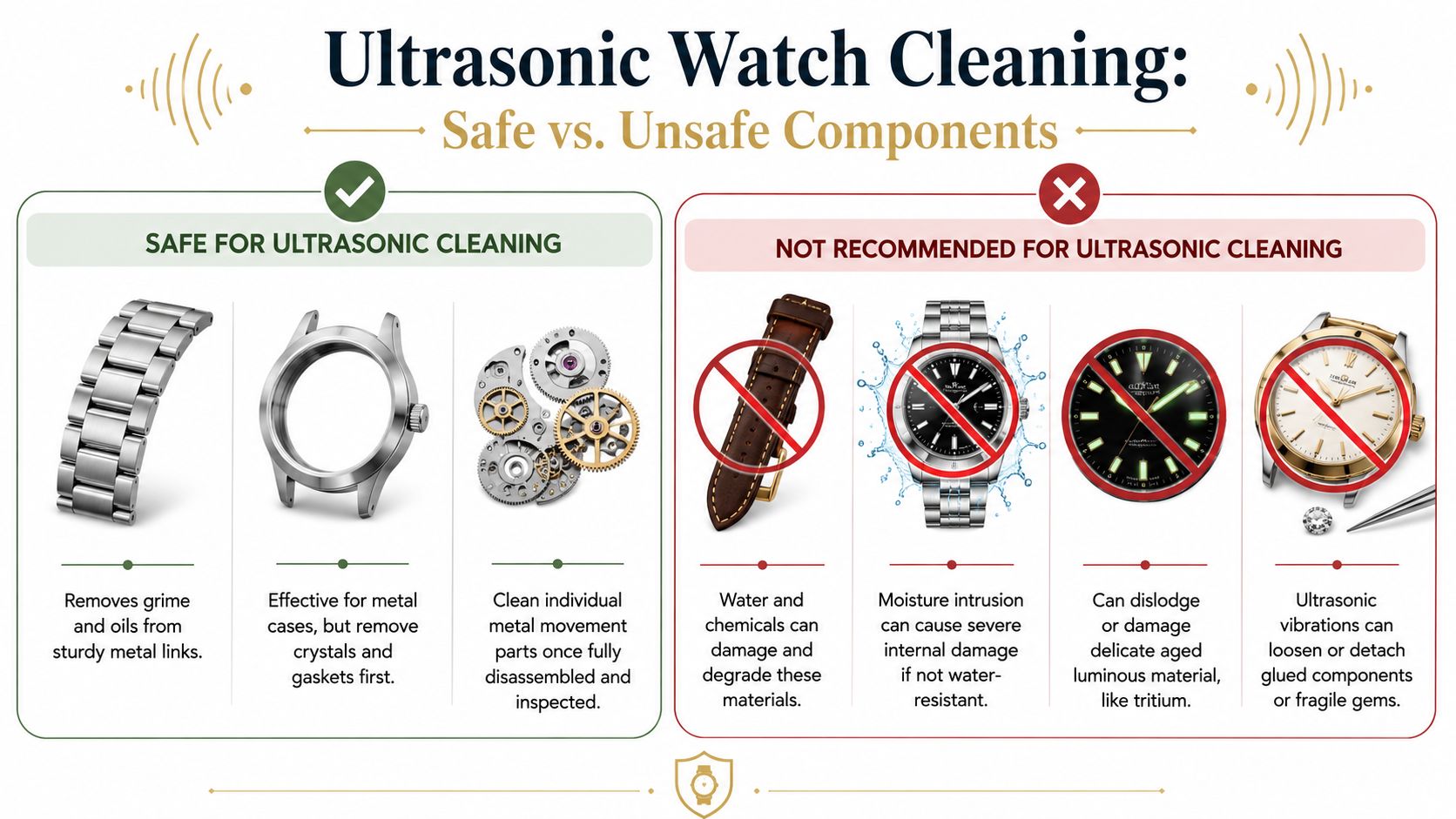
The practical sorting method
Think in three categories. Safe, risky, and never.
Safe doesn't mean “throw it in without concern.” It means the part is generally a plausible candidate if it is removable, structurally sound, and made of suitable material. Risky means there may be construction details that make the ultrasonic bath a poor choice. Never means exactly that.
| Component/Material | Safety Level | Reasoning |
|---|---|---|
| Solid stainless steel bracelet | Safe | Durable metal links usually respond well when removed from the watch and cleaned on their own. |
| Metal clasp | Safe | Often accumulates grime in tight joints and can benefit from controlled cleaning if structurally sound. |
| Fully disassembled metal movement parts handled by a watchmaker | Risky for collectors | Professionals may clean separated components, but this is not a DIY task and should not be treated as home maintenance. |
| Watch case with crystal, crown, and gaskets installed | Never Clean | Too many sealed and finished components remain at risk. |
| Complete assembled watch | Never Clean | The collector cannot control internal exposure or protect sensitive assemblies once the full watch is submerged. |
| Mechanical movement | Never Clean | Delicate components are vulnerable to aggressive vibration. |
| Dial and hands | Never Clean | Finishes, printing, lume, and attachment points are too easy to disturb. |
| Leather strap | Never Clean | Organic material and stitching don't belong in an ultrasonic bath. |
| Fabric or textile strap | Never Clean | These materials can retain moisture and degrade in ways that aren't obvious immediately. |
| Parts with glued stones, inserts, or decorative elements | Risky | Vibration can expose weak adhesion or fragile construction. |
| Coated or highly specialized surface finishes | Risky | The material may survive, but the finish may not. |
Safe doesn't mean careless
Collectors are often surprised by one point. A detachable metal bracelet may be suitable, while the matching case remains completely off-limits. That seems inconsistent until you think like a watchmaker.
A bracelet is a wear component. A watch head is a system.
The bracelet's job is external and structural. The watch head contains the movement, crystal, seals, dial, hands, crown tube, and often finishing that can be difficult or impossible to restore perfectly. One is meant to take abuse. The other is meant to be protected from it.
A note on crystals and fitted components
Even hard materials can become part of a risky assembly once they're installed. If you're evaluating a case, crystal construction matters, and so do the surrounding seals and interfaces. If you want context on one of the most common crystal materials, this guide to sapphire crystal watches is useful background, but hardness alone doesn't make an assembled case suitable for ultrasonic treatment.
Clean the simplest removable part, not the most expensive assembled one.
That mindset protects both originality and serviceability.
Choosing the Right Settings and Cleaning Solution
A collector drops a full watch into a cheap ultrasonic unit, adds a strong jewelry cleaner, and lets it run because the grime looks stubborn. That is how a simple bracelet-cleaning job turns into a repair estimate.
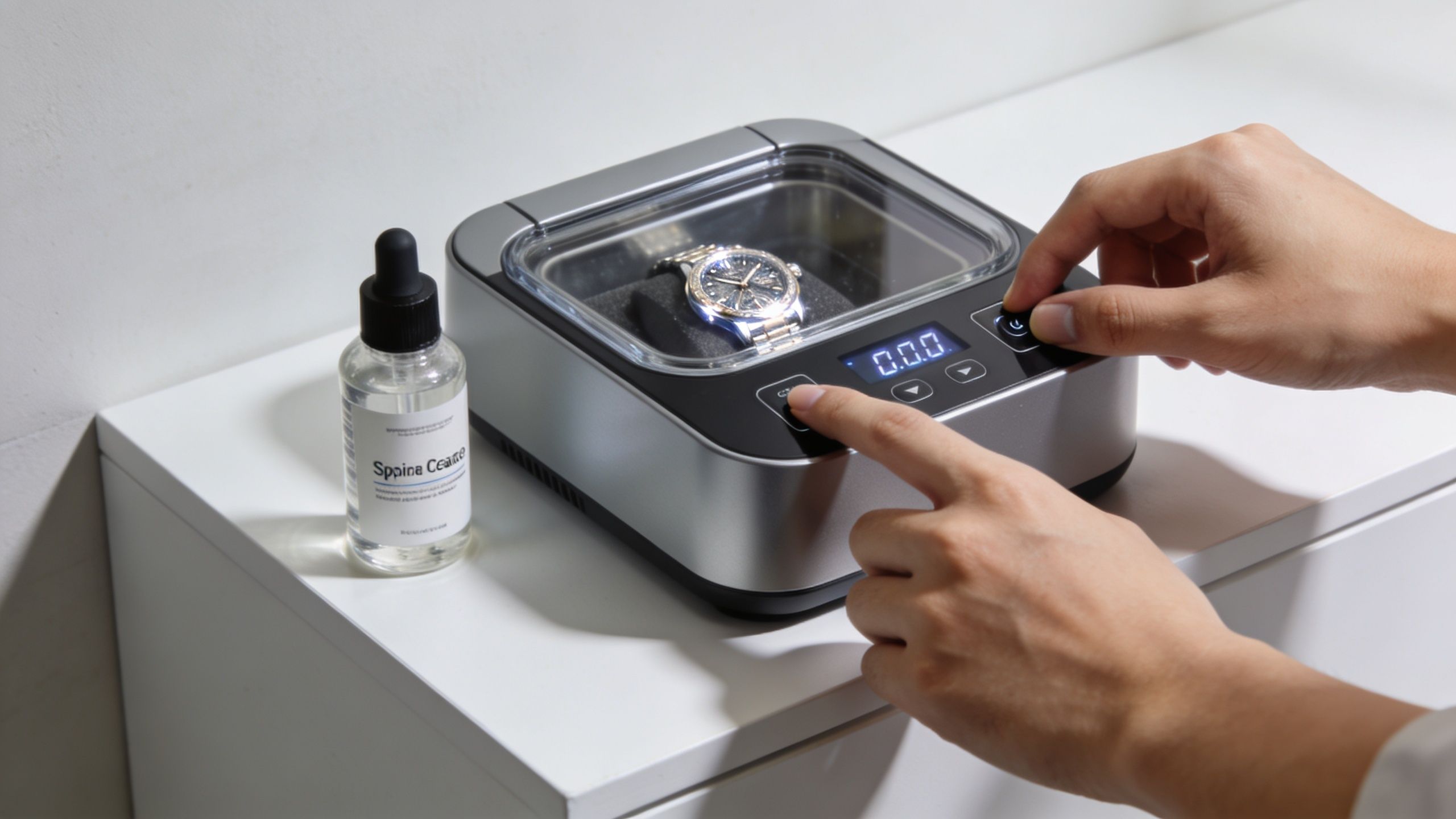
For home use, the machine should be set up for one narrow task. Clean removable metal parts gently, with the least aggressive settings that will do the job. If you need more force, more chemistry, or more time, stop and reassess. Dirt is cheaper than damage.
Set the machine conservatively
Frequency matters more than marketing language on the box. For a detachable steel bracelet or metal clasp, a mid-range setting is usually the safest place to start because it cleans tight joints without being unnecessarily aggressive.
If your machine lets you choose frequency, stay around the standard fine-cleaning range commonly used for delicate metal items. If it does not, control what you can control: cycle length, solution strength, and inspection between runs.
Start with a short cycle. Remove the bracelet, inspect the link gaps and clasp recesses, and repeat only if residue remains. One careful second pass is far safer than one long, lazy run.
A simple approach works well:
- Use the gentlest practical setting available
- Start with a brief cycle rather than a full timer run
- Check the bracelet after each pass
- Stop as soon as the visible contamination is gone
At Perpetual Time, we treat runtime as a risk variable, not a convenience feature.
Use a mild cleaning solution
The safest solution for a removable metal bracelet is plain lukewarm water with a small amount of gentle soap. That handles skin oil, sweat residue, and ordinary dirt without introducing unnecessary chemical risk.
Avoid strong household cleaners. Avoid ammonia-heavy products, acidic formulas, abrasive additives, and undiluted concentrates. Be careful with general jewelry cleaners as well. They may be harmless on one item and leave staining, residue, or finish problems on another.
Collectors often assume the liquid does the hard work. In ultrasonic cleaning, the liquid supports the process. It should not be asked to strip, bleach, or dissolve contamination aggressively.
If the solution sounds harsh, it is the wrong solution for a luxury watch bracelet.
Match the settings to the part, not the dirt
A grimy bracelet tempts people to turn everything up. That is the wrong instinct. The goal is controlled loosening of debris from metal joints, not maximum cleaning force.
Solid steel bracelets usually tolerate a cautious ultrasonic cycle well. Mixed-material bracelets need more restraint. Gold, plated surfaces, black coatings, ceramic elements, and decorative set pieces deserve individual judgment before they go near the tank. If there is any doubt about construction, adhesive use, or previous repair history, skip the bath.
That caution applies even more if the watch belongs to a line known for expensive case refinishing or specialized components. Owners weighing risk on higher-value pieces often decide that a professional Breitling watch repair service is cheaper than correcting one cleaning mistake.
The machine should never be used to compensate for neglect, worn parts, or uncertainty about what is detachable and safe. Conservative settings and a mild solution protect the bracelet. Good judgment protects the watch.
After the Clean and When to Call a Watchmaker
A bracelet can come out of the tank looking clean and still be handled badly enough to leave water marks, trapped moisture, or fresh wear in the clasp. The work after the cycle is what keeps a safe cleaning job from turning into a preventable mistake.
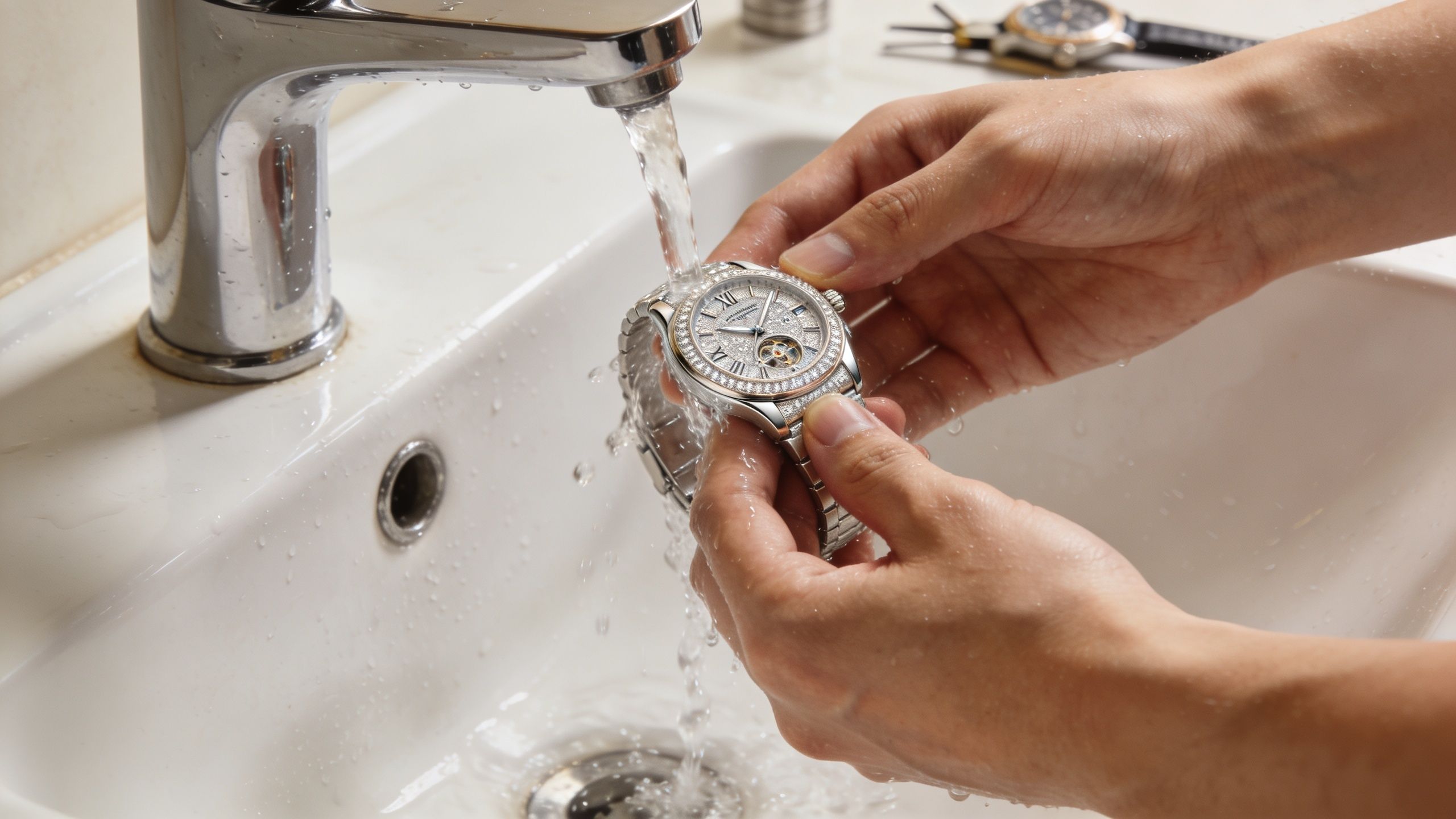
Finish the bracelet properly
Lift the bracelet or clasp out carefully. Rinse it well with clean water so the solution does not dry back onto the metal, then dry it with a soft cloth that will not scratch polished surfaces.
Do not stop there.
Open the clasp, work through the inner link gaps, and check screw heads, spring bar holes, and hinge points for retained moisture. Those are the places that stay wet longest. If water remains in the bracelet and the watch head is reattached too soon, the collector often blames the cleaner when the problem was incomplete drying.
At the bench, we treat drying as part of the cleaning process, not an afterthought. Home cleaning can be adequate for a removable metal bracelet, but it does not replace the controlled rinsing, inspection, and drying used during professional service.
What home cleaning can do, and what it cannot
The useful result from a careful ultrasonic bath is narrow. It can remove dirt from a suitable detachable bracelet and improve how the bracelet feels on the wrist. It cannot confirm water resistance, correct stretch, fix worn pins, restore damaged finishing, or tell you what is happening inside the case.
That distinction protects expensive watches. A clean exterior can hide a loose tube, a tired gasket, corrosion around a spring bar, or wear in the clasp that no bath will solve.
| Task | Home collector approach | Professional watchmaker approach |
|---|---|---|
| Bracelet cleaning | Suitable for removable metal bracelets if construction is known and drying is thorough | Done with inspection of wear, fit, and condition |
| Rinsing | Manual rinse with clean water | Process-controlled rinse designed to clear residue from tight spaces |
| Drying | Cloth drying plus patient air drying | Equipment and technique aimed at removing hidden moisture |
| Case and movement assessment | Outside the scope of cleaning | Checked as part of repair or service work |
| Fault diagnosis | Limited to visible issues | Includes mechanical and sealing concerns |
Signs to stop and hand the watch over
Collectors should stop the home process and call a watchmaker when any of the following shows up:
- A screw backs out or a pin looks proud: The bracelet may be unsafe to wear.
- The clasp feels loose, gritty, or uneven after cleaning: Dirt may have been masking wear.
- There is any sign of moisture near the case, crystal, or crown: That is a service issue, not a cleaning issue.
- The watch has unknown repair history or older construction: Previous work, adhesive use, and aging materials change the risk.
- Timekeeping, winding, or chronograph operation already feels off: Cosmetic cleaning should not sit on top of a mechanical problem.
A part-by-part decision is most critical. A steel bracelet may be perfectly suitable for ultrasonic cleaning, while the case, movement, strap, and seals remain completely off-limits. Mixing those categories is how collectors turn simple maintenance into expensive repair work.
If the watch already needs technical attention, put cleaning inside the repair plan instead of treating it as a separate DIY task. For higher-value sports watches and chronographs, a specialist route such as Breitling watch repair service is usually the lower-risk choice.
A clean bracelet only tells you the bracelet is clean.
The collector's standard
At Perpetual Time, we judge every cleaning decision against one question. Does it reduce risk, or does it create a new one?
For a detachable solid metal bracelet in known condition, careful ultrasonic cleaning can make sense. For the watch head, the movement, or any component with seals, finishing, adhesives, or uncertain history, the safer answer is to leave it out and let a watchmaker assess it properly.
Final Thoughts on Ultrasonic Cleaning and Watch Care
The safest way to think about an ultrasonic watch cleaner is this. It's a specialized tool for a narrow job.
That job is usually a removable, durable metal bracelet. Not the assembled watch. Not the movement. Not the dial side. Not leather straps, fabric straps, or mixed-material parts with uncertain construction.
The simple rule worth keeping
If the part is structural, metal, detachable, and easy to inspect, ultrasonic cleaning may be appropriate. If the part contains delicate watchmaking, finishing, seals, adhesives, or moisture-sensitive material, keep it out.
That rule protects more than appearance. It protects originality, fit, and future service options.
A collector's routine doesn't need to be complicated:
- Wipe the watch regularly: Prevent buildup before it hardens into grime.
- Clean bracelets selectively: Use ultrasonic cleaning only when the part and setup are clearly suitable.
- Maintain the machine too: Replace dirty solution, keep the tank clean, and don't reuse contaminated fluid.
- Store watches properly: Good storage reduces the dirt, moisture, and neglect that lead people toward aggressive cleaning in the first place.
Thoughtful ownership always beats aggressive intervention. The same mindset applies to storage and rotation, especially if you keep multiple automatic pieces in use. If that's part of your collection, it helps to understand what a watch winder is and where it fits into proper care.
When in doubt, choose the slower path. A watch can wait for proper treatment. That patience is often what separates a well-kept collection from one that slowly accumulates avoidable damage.
If you'd like a second opinion before cleaning a bracelet or evaluating a pre-owned luxury watch, Perpetual Time offers a straightforward, collector-focused point of reference grounded in careful inspection, accurate presentation, and long-term watch care.


