
Cart
0
When it's time for a Cartier watch battery replacement, you can generally expect to pay between $95 and $200. This isn't just a simple swap; it's a specialized service that should be done every 2 to 3 years to keep your watch running perfectly and protect its value. Trusting an expert is non-negotiable—the delicate mechanics inside are too precious to risk.
Keeping Your Cartier Ticking
When a timepiece as iconic as a Cartier stops, it feels like more than a simple inconvenience. It's a hiccup in a long history of precision craftsmanship. While a dead battery is the usual culprit for a quartz model, how you handle the replacement makes all the difference. This is about preserving the soul of a finely tuned instrument, not just getting the hands moving again.
Think of it like servicing a classic car. You wouldn't trust just any mechanic with a vintage Porsche, right? The same logic applies here. A Cartier watch demands a specialist with the right tools and expertise. One wrong move can compromise the water-resistant seals or, even worse, damage the sensitive electronic movement inside, leading to a much more expensive repair down the line.
The Heartbeat of Your Watch: The Battery
To give your Cartier the care it deserves, it helps to know a few basics. Most Cartier quartz watches, from the classic Tank to the bold Santos, need a new battery every 2 to 3 years. Some models might stretch this to five years under ideal conditions, but that's the exception, not the rule. This regular service is a small price to pay for the reliability and elegance these watches are known for.
For a quick look at what's involved, this chart breaks down the key aspects of a professional battery service.
Cartier Battery Replacement Quick Reference Guide
| Aspect | Details |
|---|---|
| Typical Lifespan | 2-3 years on average. |
| Signs It's Time | Watch stops, loses time, or second hand jumps in 4-second intervals (EOL indicator). |
| Estimated Cost | $95 - $200, depending on the model and service provider. |
| Service Time | Can range from under an hour (if done locally) to several weeks (if sent to a service center). |
This table serves as a handy guide so you know exactly what to expect when your Cartier needs a little power boost.
The infographic below gives a great visual summary of everything from battery life to the signs you need a replacement.
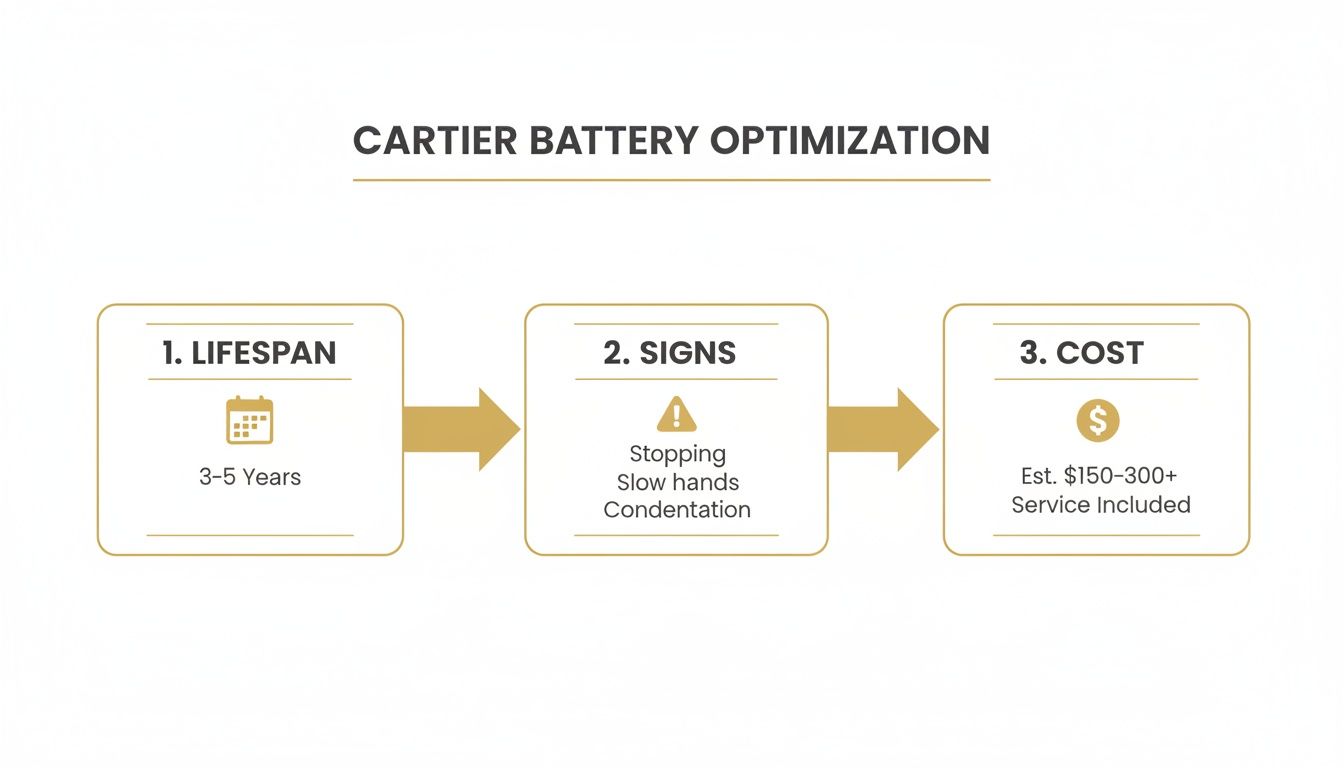
It’s all about being proactive. Recognizing the warning signs and knowing the costs involved helps you stay ahead of any issues.
Why You Should Always Go Pro
A proper battery replacement is a multi-step process. A true professional will carefully open the case, inspect the movement, clean the battery contacts, and install a fresh, high-quality Swiss battery.
But the most critical step comes last: pressure testing. After the watch is sealed back up, it's put through a test to ensure its water-resistance gaskets are doing their job perfectly. Skipping this leaves your treasured timepiece vulnerable to moisture and dust, which can cause irreversible damage.
Think of a professional battery service as a mini check-up for your watch. It’s not just about restoring power. It’s a chance for a trained eye to catch small issues before they become big, expensive problems, protecting your investment for the long haul.
Ultimately, staying on top of this simple maintenance ensures your Cartier will continue to be a reliable and beautiful accessory for years. To appreciate the legacy you're preserving, you can explore the rich history behind these iconic timepieces.
Recognizing the Signs of a Dying Battery
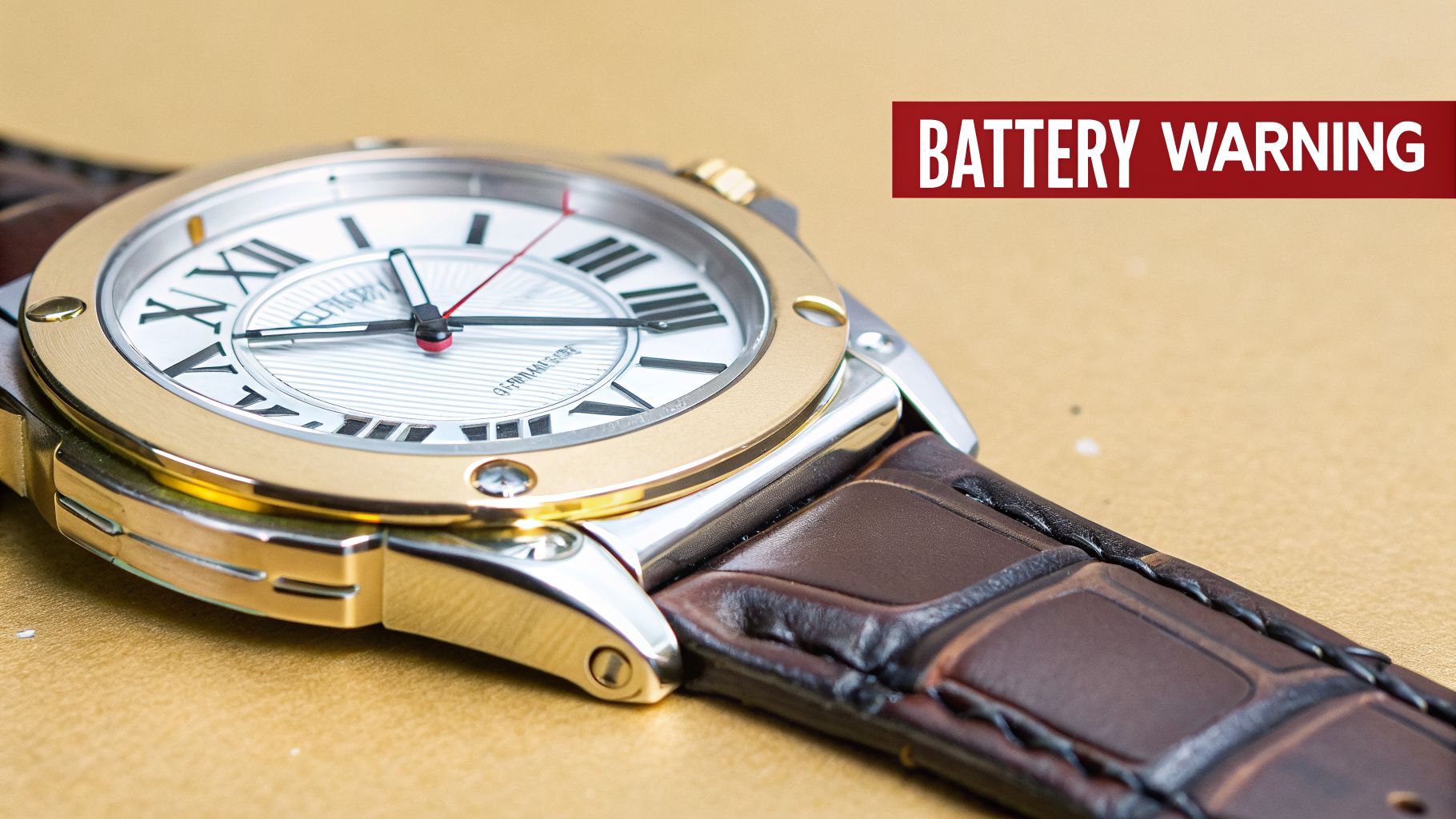
A Cartier watch has a way of communicating its needs with the same quiet elegance found in its design. Of course, the most obvious sign of a dead battery is a watch that's stopped altogether, but your timepiece will almost always give you a heads-up long before that happens. Think of these signals like the check engine light in a performance car—they're engineered to alert you to an issue before it becomes a real problem.
Ignoring these clues means more than just being late. A fully depleted battery can start to leak over time, and that leakage can cause serious corrosive damage to the delicate, intricate movement inside. Catching the early warnings is a huge part of being a responsible owner and is the first step in a proper Cartier watch battery replacement.
The Telltale Jump of the Second Hand
The most clever and intentional warning sign Cartier builds into its quartz watches is the End-of-Life (EOL) indicator. It's a fantastic feature. When the battery's voltage dips below a certain point, the movement is programmed to change its behavior.
Instead of ticking smoothly once per second, the second hand will suddenly start jumping in four-second intervals. It will pause for a few seconds, then leap forward to make up the distance in one distinct tick. This is a brilliant way to conserve the last bit of the battery's energy while giving you a clear, impossible-to-miss visual cue that it’s time for a new one.
The EOL feature is a masterful piece of micro-engineering. It’s designed to give you plenty of time—usually weeks, sometimes even a couple of months—to get the watch serviced professionally before it stops completely. No sudden surprises.
It's a surprisingly overlooked feature. Data from luxury watch service centers shows that the most obvious signs of a failing battery, like the four-second jump, are missed by up to 80% of quartz owners every year. These indicators, which are triggered by low voltage hitting the quartz oscillator, have been a standard feature ever since Cartier embraced quartz movements back around 1972.
Other Subtle Clues to Watch For
While the EOL jump is the gold standard for warnings, other symptoms can also point to a failing power source. And if your particular Cartier model doesn't have a second hand, you'll need to rely on these more subtle signs.
- Intermittent Stopping and Starting: You might notice your watch has stopped, only to see it running again a few hours later. This kind of erratic behavior is a classic sign the battery can no longer deliver a steady, consistent current.
- Losing Time: Is your watch constantly a few minutes slow, even right after you’ve reset it? A weak battery often struggles to provide enough juice to power the movement properly, causing it to lag.
- Chronograph Malfunctions: On models with a chronograph, you might see the stopwatch hands stutter, refuse to start, or fail to snap back perfectly to the zero position when you reset them.
These clues are your watch's way of asking for a little attention. To get a better sense of the timeline, it helps to understand how long a watch battery lasts in general for quartz timepieces. Paying attention to these signs allows for proactive care, which is the best way to protect the heart of your watch. And if you're curious about the mechanics that make these alerts possible, you might enjoy our guide on finding the best watch movement.
Understanding the Cost of a Professional Battery Change
When your Cartier stops ticking, the first question that probably comes to mind is, "How much is this going to cost?" It's a fair question, but it's helpful to reframe it. You're not just buying a tiny battery; you're investing in the health and longevity of a precision timepiece. The price reflects a meticulous service, not just a part.
Think about it: this isn't like swapping AAs in a remote. A professional watchmaker uses specialized tools to open the delicate caseback without a single scratch. They'll install a premium, Swiss-made battery that meets Cartier's exact specifications and take a moment to inspect the movement for any sneaky dust or moisture. This is the difference between a proper service and a risky shortcut.
Breaking Down the Price Tag
So, what exactly are you paying for when you get the final bill? The total cost covers several critical steps, and the price differences you'll see between providers usually come down to how thoroughly these services are performed.
Here’s a look at what goes into a professional battery service:
- The Battery Itself: Pros don't use generic batteries. They use high-quality, Swiss-made cells from brands like Renata, which Cartier specifies for their reliability and long lifespan.
- Expert Labor: You're paying for a watchmaker's steady hand and years of training. These are people who understand the intricate, and often delicate, inner workings of a luxury watch movement.
- Pressure Testing: This is a non-negotiable step for any watch with water resistance. Your Cartier is placed in a special chamber to ensure its seals and gaskets are perfectly seated, preserving its ability to keep out water and dust.
- Light Cleaning: Most services include a gentle cleaning of the case and bracelet, which removes built-up grime and helps restore some of that original shine.
When you add it all up, the cost ensures your Cartier comes back to you not just ticking, but fully protected and ready for years more of faithful service.
Comparing Service Providers
You essentially have two paths you can take: an official Cartier boutique or a trusted independent watch specialist. Both can get the job done right, but they operate with different pricing and service models.
For a professional replacement, you can expect to pay anywhere from $9.95 to $45 in major US markets. This price point covers the precision work required for these luxury quartz watches without cutting corners. If you go directly to an official Cartier boutique, you can expect to pay 20-50% more, often landing somewhere between $50 and $100 for the same basic service.
An independent specialist often provides fantastic value. You're getting the same high-quality battery and expert service, but usually with a much faster turnaround and a more personal touch. On the other hand, an authorized dealer provides the unique peace of mind that comes with brand-specific certification.
To get a better handle on what to budget for watch maintenance in general, checking out a guide on the cost of watch battery replacement can be incredibly helpful.
What to Expect for Turnaround Time
Time is another huge factor. How quickly you get your watch back on your wrist depends almost entirely on where you decide to take it.
- Local Independent Specialist: If you have a reputable watchmaker nearby, this is by far the fastest option. The job can often be done while you wait or within the same day, usually taking just 30 to 60 minutes. They have all the right tools and batteries right there.
- Official Cartier Boutique or Service Center: Going the official route takes more patience. Unless the boutique has a watchmaker on-site, they’ll have to securely ship your watch to a regional service center. The whole process can take anywhere from one to four weeks, factoring in shipping and their current workload.
Ultimately, your choice boils down to what you value most. Are you looking for speed and direct communication with the person working on your watch, or is having the official paperwork from the brand more important to you? Either way leads to a professionally serviced timepiece, ready to go.
The Hidden Risks of a DIY Battery Swap
Let's be honest, the thought of a quick DIY Cartier watch battery replacement has probably crossed your mind. You see a kit on Amazon, watch a couple of YouTube videos, and think, "How hard can it be?" The truth? It’s surprisingly easy to cause very expensive, and sometimes irreversible, damage. Trying to service a Cartier at your kitchen table is a bit like attempting your own dental work—you just don’t have the right tools or training, and the potential for a painful outcome is huge.
What starts as a plan to save a few bucks can quickly spiral into a repair bill for hundreds, if not thousands, of dollars. The very things that make a Cartier feel so special—the precision, the finish, the tight tolerances—are exactly what make it so vulnerable to an untrained hand. Before you even think about prying that caseback off, you need to understand the real-world dangers you're inviting.
Scratches, Slips, and Vanishing Screws
The trouble usually starts at the very first step: opening the case. Cartier casebacks are beautifully finished, often with a mirror-like polish or a delicate brushed texture. Using the wrong tool, or even the right tool without the proper technique, will almost certainly leave deep, ugly scratches in the steel or gold. These aren't just little scuffs; they're permanent scars that tank the watch's resale value.
Get inside, and a new set of problems awaits. The screws holding the movement are microscopic—smaller than a grain of rice—and require specialized, magnetized watchmaking screwdrivers. One little slip with a generic screwdriver from a hardware store can send one of these critical components flying across the room, lost forever. Or worse, you could strip the screw head, making it impossible to remove without drilling.
We see the same DIY disasters all the time: deep gouges on the caseback from using the wrong opener, and stripped screw heads inside the movement. A simple task meant to save $50 instantly turns into a $500+ bill for case refinishing and movement repair.
And then there's static electricity. It's completely harmless to you, but it can be a death sentence for a quartz movement. If you're not properly grounded, a small static discharge from your fingers can fry the watch's sensitive electronic circuits. Just like that, you've turned a simple battery change into a full movement replacement, which is a much bigger and more expensive job.
The Silent Killer: Destroying Your Water Resistance
Maybe the single biggest risk of doing this yourself is ruining the watch's water resistance. Every Cartier is sealed with a system of tiny rubber gaskets. These precision-engineered rings sit in grooves around the caseback, crown, and crystal, and they are the only things keeping water, humidity, and dust out of the watch's delicate heart.
The moment you open the watch, you’ve broken that factory seal. A professional watchmaker has a strict, non-negotiable process for restoring it:
- Gasket Inspection: The old gasket is carefully removed. A trained eye looks for any signs of drying, cracking, or flattening. Honestly, in any professional service, it's just replaced with a brand-new one as a rule.
- Proper Lubrication: The new gasket is lubricated with a specific silicone grease. This is a vital step—it allows the gasket to create a perfect seal and prevents it from getting pinched or torn when the caseback is tightened.
- Correct Torquing: The caseback is closed using a professional press that applies perfectly even pressure. This ensures the gasket seats correctly without being over-compressed or twisted.
- Pressure Testing: This is the final, crucial step. The re-sealed watch is put into a special machine that uses both air and water pressure to guarantee its water resistance rating is back to factory spec.
Without this meticulous process, you're just guessing. A poorly seated gasket is a ticking time bomb. The next time you wash your hands or get caught in a rainstorm, moisture will find its way inside. Once it’s in, it can stain the dial, rust the hands, and corrode the entire movement, causing total failure. Trust me, saving a little money on a battery is never worth the risk of drowning your Cartier.
Choosing Between an Authorized Dealer and an Independent Specialist
When the time comes for a new battery, you’re faced with a choice: send your Cartier back to an official service center, or take it to a trusted independent watchmaker? Both are valid options for a professional Cartier watch battery replacement, but they offer vastly different experiences when it comes to cost, timing, and the overall service. Knowing what to expect from each path is the key to making the best decision for you and your timepiece.
Going through an authorized Cartier service center is the manufacturer-approved route. Think of it like taking a high-end car back to the dealership. You’re guaranteed original parts, and the work comes with a Cartier-backed warranty. For many, this official seal of approval is non-negotiable, especially as it adds an official service entry to the watch’s history, which can be a plus if you ever decide to sell.
The trade-offs? This route almost always costs more and takes a lot longer. You’ll be sending your watch away, often for several weeks, just for a relatively simple battery change. For some owners, that’s a frustratingly long time to be without their watch.
The Case for an Independent Specialist
A great independent watchmaker, on the other hand, is like that expert local mechanic everyone trusts. These are typically master craftspeople who have spent years, sometimes decades, honing their skills on luxury timepieces from all the big brands, Cartier included. They represent a fantastic combination of deep expertise, better value, and real convenience.
The most noticeable benefits are speed and cost. A skilled independent can usually swap out the battery in under an hour, sometimes even while you wait. Because they don't have the same corporate overhead, the price for the same high-quality work is often far more reasonable. You also get the huge advantage of speaking directly to the person who will be handling your watch, building a personal relationship founded on trust.
A great independent watchmaker combines the precision of a surgeon with the practical knowledge of an engineer. They have the same access to high-quality Swiss-made batteries and modern pressure testing equipment as the official centers. The key is finding one with a proven track record.
The only catch is that the homework is on you. You need to make sure the specialist you choose is reputable and has plenty of experience with luxury Swiss brands. A true pro will always be happy to walk you through their process and show you their equipment.
Comparing Service Options: Cartier Authorized vs. Independent Specialist
To really see the difference, it helps to put the two options side-by-side. This table breaks down what you can expect from each when you need a simple battery service.
| Feature | Authorized Cartier Service | Trusted Independent Specialist |
|---|---|---|
| Parts | Guaranteed authentic Cartier parts. | High-quality Swiss parts (e.g., Renata batteries). |
| Cost | Typically higher, often 20-50% more than independents. | More competitive and affordable pricing. |
| Turnaround Time | Slower, often 1-4 weeks due to shipping and processing. | Much faster, usually under an hour or same-day service. |
| Service Warranty | Backed directly by Cartier. | Backed by the independent business itself. |
| Personal Connection | Impersonal; you deal with a service advisor, not the technician. | Direct communication with the watchmaker working on your watch. |
| Documentation | Official service record logged with the Cartier brand. | Detailed receipt and often a personal service record. |
So, what’s the verdict? There really isn't a single "right" answer—it all comes down to your priorities. If an official brand service history is paramount and you don't mind the higher cost and longer wait, the authorized route is a perfectly safe bet.
However, if you prioritize speed, value for money, and building a relationship with the expert caring for your watch, a top-tier independent specialist is an equally excellent choice. For those leaning this way, you can learn more about how to find a trusted professional to service your watch and ensure your Cartier gets the expert attention it deserves.
How Proper Maintenance Protects Your Investment
A Cartier watch is so much more than a way to tell time. It's a piece of wearable art, a family heirloom in the making, and a tangible asset. That's why treating its maintenance—even something as simple as a Cartier watch battery replacement—as a critical part of owning it is the key to protecting its long-term value. This isn't just about keeping the hands moving; it's about preserving its integrity and financial worth for decades to come.
Think of your watch's service history as its pedigree. A detailed and documented record of professional maintenance, especially from an authorized dealer or a respected specialist, gives future buyers incredible confidence. It’s proof that the watch has been cared for properly, assuring them that the movement is pristine and the seals are sound.
The Value of a Clean Service Record
In the world of pre-owned luxury watches, a complete service history can make a significant difference in price. Appraisers and experienced collectors always look for this documentation as proof of responsible ownership. It simply erases any doubt about the watch's internal condition.
On the other hand, a history of questionable repairs or DIY attempts raises immediate red flags. An unqualified technician can easily cause problems that tank a watch's value, like:
- Scratched Casebacks: This is the most obvious sign of amateur work and instantly lowers its appraisal value.
- Compromised Water Resistance: A hidden but severe problem that can lead to catastrophic damage to the movement.
- Voided Warranty: Unauthorized service will void any remaining manufacturer's warranty, a major turn-off for a potential buyer.
A professional battery service isn't just another expense; it's an investment in your watch's future. Every service receipt adds a chapter to its story, reinforcing its value in the competitive secondary market.
Protecting Your Warranty and Future Resale
A botched service goes beyond physical damage; it can have serious contractual consequences. If your Cartier is still under its original warranty, any work done by an unauthorized party will almost certainly void it. That means if a more serious problem pops up later, Cartier won't cover the repair, leaving you with a potentially huge bill.
This is a massive consideration if you ever plan to sell your watch. A timepiece with a voided warranty or visible signs of amateur tampering will be much harder to sell and will always fetch a lower price.
Sticking to proper service channels is the single best way to protect your Cartier's integrity, both mechanically and as a financial asset. To learn more about how condition and history impact value, you can read our guide on what to look for in a Cartier watch certified pre-owned. Ultimately, professional care ensures your watch remains a treasured—and valuable—heirloom.
Your Top Cartier Battery Questions, Answered
Even after covering the basics, I know you probably have a few specific questions buzzing around. It's completely normal. When you own a beautiful timepiece like a Cartier, you want to get every detail right. Let's walk through the most common questions I hear from clients.
What Kind of Battery Does My Cartier Take?
That’s an excellent question, and the answer is surprisingly specific. There’s no single battery for all Cartier watches. The right one depends entirely on the watch's movement caliber—think of it as the specific model number of the engine ticking away inside. A Tank, a Santos, and a Pasha might look different on the outside, but their internal movements are what really dictate their power needs.
A true watchmaker won't just find a battery that fits; they'll identify the caliber number and cross-reference it to find the exact Swiss-made, silver-oxide battery Cartier specifies. Popping in the wrong cell, even if it seems to work, is a recipe for poor timekeeping or, worse, potential damage to the movement's sensitive electronics.
Will Replacing the Battery Ruin the Water Resistance?
Yes, it absolutely will if not done correctly. The moment the caseback is opened, the factory seal is broken. Your Cartier's water resistance isn't magic; it comes from a series of tiny, precisely engineered gaskets. These little rubber rings create a perfect seal that keeps out moisture, dust, and everything else that could harm the delicate movement.
Simply screwing the back on again isn't enough. A professional service is non-negotiable here. The process involves carefully replacing or reseating the gaskets and then performing a pressure test to certify the seal is as tight as the day it left the factory.
If you skip this, your watch is left exposed. Something as simple as washing your hands or getting caught in a sudden downpour could lead to condensation under the crystal and catastrophic damage to the dial and movement.
My Watch Sits in a Drawer. Do I Still Need to Change the Battery?
Without a doubt. It’s a common belief that a watch battery only drains when it's running, but that's not how quartz movements work. They draw a tiny but constant stream of power just to stay alive, whether the watch is on your wrist or tucked away in a safe.
So, the battery will die regardless of how often you wear it. But here’s the real danger: leaving a dead battery inside your watch is one of the worst things you can do. As they age, these cells can leak acid. That corrosive fluid will eat away at the fragile circuits of the movement, causing irreversible damage.
Getting that expired battery out promptly is crucial preventative maintenance. If you're passionate about the long-term health of your watch, especially older models, understanding the quirks of owning a vintage Cartier watch will show you just how important this kind of upkeep is.
At Perpetual Time, we know your timepiece is more than just an accessory; it's an investment. Our team is here to provide the expert service and guidance needed to keep it performing beautifully for generations. Take a look at our curated collection of certified pre-owned luxury watches at https://perpetualtime.com.


