
Cart
0
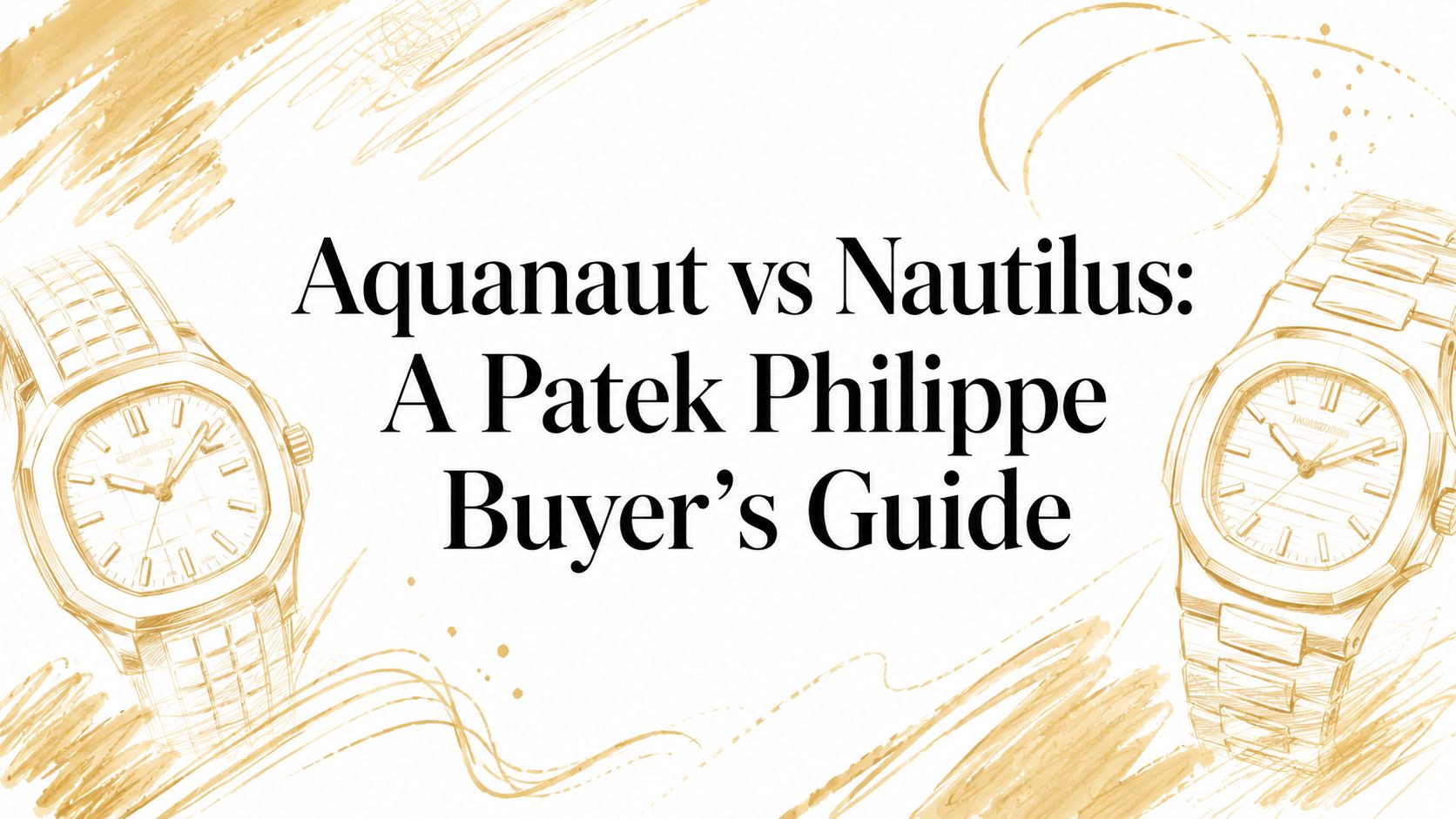
You're probably at the point where broad advice isn't useful anymore. You already know both watches matter. The key question is which one fits the way you dress, the way you collect, and the way you want the watch to feel every time you put it on.
That's why the Aquanaut vs Nautilus decision is rarely about “better.” It's about identity. One watch projects established taste with deep lineage. The other feels younger, more relaxed, and often more honest about daily use. Both carry the Patek Philippe name. They just express it differently.
Choosing Between Two Patek Philippe Icons
For many buyers, this is the moment when collecting becomes personal. Choosing between a Nautilus and an Aquanaut isn't like comparing two generic steel sports watches. You're choosing between two versions of luxury that share family DNA but land very differently on the wrist and in a collection.
Early in the process, buyers often focus on status signals. The Nautilus has the stronger instant-recognition factor. The Aquanaut can look simpler at first glance. But that first impression can mislead you. In practice, the better choice usually comes down to where the watch will live most of the time: under a cuff, on a plane, at dinner, on weekends, or in rotation with other serious pieces.
A quick side-by-side helps narrow the field.
| Category | Aquanaut | Nautilus |
|---|---|---|
| Collector identity | Modern, relaxed, understated | Historic, architectural, prestige-forward |
| Wrist personality | Sportier and more casual | More formal and more iconic |
| Strap or bracelet feel | Composite strap changes the whole experience | Integrated bracelet is central to the appeal |
| Best for | Daily wear, travel, active use | Business wear, legacy collecting, dressier sport-chic |
| Buying mindset | “I want Patek I'll actually wear often” | “I want the original statement piece” |
A lot of clients arrive after browsing roundups of luxury sports watches worth knowing, but this pair sits in its own category. The overlap is real, yet the ownership experience isn't the same.
Dealer's view: If you want your first Patek sports watch to disappear into daily life, start by taking the Aquanaut seriously. If you want your first Patek sports watch to anchor the collection, start with the Nautilus.
The wrong way to buy either is by chasing the loudest consensus. The right way is to match the watch to your habits. That's where the difference becomes obvious.
The Tale of Two Icons Historical Origins
The Nautilus came first, and that matters more than many buyers realize. The Nautilus and Aquanaut are separated by 21 years in launch history. Patek Philippe introduced the Nautilus in 1976 as its first stainless-steel sports watch, while the Aquanaut arrived in 1997 as a more modern, casual alternative, as noted in this historical comparison of the two lines.

Why the Nautilus carries more historical weight
When a watch arrives first and changes the conversation, collectors never forget it. The Nautilus wasn't just another model added to a catalog. It became the foundational sports expression in the brand's modern identity, and that origin is a major reason collectors still treat it as the more prestigious of the two.
That doesn't automatically make it the better buy. It does mean the Nautilus often enters a room with more historical authority. Buyers who care about first-generation significance, category-defining design, and lineage tend to feel that pull immediately.
The Nautilus feels like an inheritance piece even when you buy it for yourself.
You can see the same principle across the vintage and pre-owned market more broadly. A watch such as the Rolex Oyster Perpetual Date Original Stick Dial Dial on Oyster band 15203 carries appeal not because it copies modern trends, but because its period details, 34mm case, smooth bezel, Oyster bracelet, and two-tone construction place it clearly within a specific chapter of watch design. The Nautilus benefits from that same kind of historical clarity, just at a different level of category influence.
Why the Aquanaut feels more current
The Aquanaut was never meant to be a simple repeat. Its later debut explains why it reads as more contemporary. Patek Philippe used it to speak to a buyer who wanted the brand's sports-watch credibility without the full formality and visual structure of the Nautilus.
That timing shaped the model's personality. The Aquanaut has always felt less ceremonial and more wearable. It doesn't ask for a certain type of room or wardrobe to make sense. It slips more easily into modern life, and for many younger collectors or first-time Patek buyers, that isn't a compromise. It's the whole point.
Comparing Design Philosophy Case Dial and Bracelet
The fastest way to understand Aquanaut vs Nautilus is to ignore the logo for a minute and study the shapes. These watches share a family resemblance, but they don't communicate the same mood.

Case and bezel character
The Nautilus has the stronger architectural identity. Its case feels deliberate, composed, and slightly sharper in attitude. That's why it works so well with tailoring. Even before anyone notices the brand, they notice the shape and the bracelet integration.
The Aquanaut softens that approach. The case comes across as rounder and less formal, even though it still belongs to the same design family. On the wrist, that translates into less visual rigidity. It tends to feel easier, especially with casual clothing.
If you want a watch that reads like refined industrial design, the Nautilus usually wins. If you want one that feels athletic without becoming loud, the Aquanaut often makes more sense.
Dial language
The dial tells you what each watch wants to be.
- Nautilus dial uses horizontal embossing. It creates a calmer, more composed surface and usually feels more elegant from across the table.
- Aquanaut dial uses a checkerboard-style pattern. It adds texture in a more active, modern way and gives the watch more visual energy.
- Legibility impression differs too. The Aquanaut tends to feel more casual and immediate. The Nautilus tends to feel more restrained.
Buyers occasionally make an incorrect selection online. In photos, the differences can look minor. In person, the dials shift the personality of the watch more than most expect.
Bracelet versus strap
The bracelet or strap is not a small detail here. It's one of the central reasons these two references live differently.
The Nautilus bracelet is part of the identity. Remove that integrated metal look and much of the watch's magic goes with it. The Aquanaut is the opposite. Its composite strap is not a lesser substitute. It is one of the reasons the watch works so well.
For buyers thinking hard about comfort, fit, and long-term wear, it helps to understand how bracelet construction changes ownership. This overview of watch band types and wearing characteristics is useful background, especially if you're coming from bracelet-heavy collecting.
Practical rule: If you love the Nautilus but don't love integrated bracelets, don't force the purchase. With that watch, the bracelet is the experience.
The Nautilus wears like a luxury object that happens to be sporty. The Aquanaut wears like a sports watch enhanced by luxury finishing. That's the primary design divide.
Inside the Mechanism A Look at Patek Philippe Calibers
Many buyers assume the Nautilus must have a stronger technical case because it carries more historical prestige. In core time-and-date steel references, that isn't really how the comparison works.
The Aquanaut and Nautilus are technically very close in their current time-and-date steel references. Both have used Patek Philippe's self-winding Caliber 26-330 S C, which is described as adding stop-seconds and an instantaneous date jump compared with the older 324 S C, while keeping the same basic chronometric platform, according to this movement-focused comparison.
What that means in ownership terms
Stop-seconds, often called hacking, matters because it lets you set the watch precisely. When you pull the crown, the seconds hand stops. If you care about syncing the watch cleanly, that's a useful feature and one buyers appreciate more over time.
The instantaneous date jump is another quiet refinement. It doesn't transform the ownership experience on its own, but it reflects the kind of mechanical detail buyers expect from this level of watchmaking.
If you want a broader primer on how movement choices affect buying decisions, this guide to the best watch movement types for different buyers is a solid companion read.
Where buyers should focus instead
For most clients comparing standard Aquanaut and Nautilus references, the movement won't decide the purchase. The better question is whether you care more about case architecture and bracelet presence, or about comfort and everyday versatility.
That matters because there's no point paying a premium for the “idea” of superior mechanics if the practical movement gap isn't the thing separating the watches in the first place. In this matchup, lifestyle drives the decision far more than base-caliber hierarchy.
Living with a Legend Wearability and Lifestyle Scenarios
The Aquanaut often surprises people, despite both models being luxury sports watches on paper. On the wrist, they behave differently enough that one usually fits your life much better than the other.
The practical baseline is straightforward. Both lines are cited with 120 meters of water resistance, but the Aquanaut's rubber Tropical strap gives it a usability advantage for sweat, saltwater, and day-to-day abrasion, while the Nautilus bracelet is generally favored for a more formal, collectible feel rather than wet-environment comfort, as described in this wearability-focused guide.

When the Aquanaut makes more sense
If your watch has to handle real life, the Aquanaut is usually easier to own. It fits the buyer who wants to wear a Patek often, not just protect one carefully.
Think about the person who rotates between denim, knitwear, polos, travel clothes, and unstructured tailoring. The Aquanaut sits naturally in that wardrobe. It doesn't need a formal setting to justify itself.
A reference such as the white-gold 5168G-010 with its green dial and strap captures this side of the line well. It shows how the Aquanaut can feel expressive without losing the seriousness of the brand.
When the Nautilus earns its premium aura
The Nautilus tends to shine when presentation matters. It has a stronger sense of occasion, even when you're wearing it casually. That's why many collectors keep returning to it as the one they'd choose if they could own only a single Patek sports model with a more formal bent.
Use this simple filter:
- Boardroom and client dinners. Nautilus usually lands better.
- Weekends, travel, warm climates. Aquanaut often feels smarter.
- One-watch collection with broad daily use. Aquanaut is easier.
- Collection anchor with historical gravity. Nautilus is stronger.
If you spend your time protecting a watch from your life, you bought the wrong watch.
The Aquanaut disappears into wear. The Nautilus remains present. Neither trait is better on its own. The right answer depends on whether you want comfort to dominate the experience, or presence to.
Navigating the Market Pricing and Investment Value
No serious Aquanaut vs Nautilus discussion is complete without the secondary market. These watches aren't priced only by materials and mechanics. They're priced by access, collectibility, and buyer psychology.
The clearest hard data in this comparison comes from the Aquanaut side. A Chrono24 analysis of the Aquanaut 5167/1A-001 reported a retail list price of $25,958, a secondary-market level of about $75,000, and a peak near $120,000 in April 2024. Over the prior five-year period, the model appreciated by about 81%, or roughly $33,400, according to this Chrono24 market analysis of Aquanaut and Nautilus context.

What those numbers actually tell you
First, the Aquanaut is not the “cheap way into Patek sports watches” in any meaningful secondary-market sense. Demand has already pushed it well beyond simple retail positioning.
Second, buyers need to separate two ideas that often get blended together:
| Market factor | Why it matters |
|---|---|
| Historical prestige | Helps explain why the Nautilus often carries stronger symbolic weight |
| Wearability | Helps explain why the Aquanaut keeps attracting daily-use buyers |
| Scarcity and demand | Push both models into elevated secondary pricing |
| Reference selection | Changes value more than many first-time buyers expect |
How to think like a collector, not a speculator
If your primary goal is enjoyment, buy the watch you'll wear. A watch that sits in the safe because you admired the narrative more than the object is usually a bad purchase, no matter how famous the reference is.
If you are evaluating market behavior, keep the analysis narrow. Compare reference to reference, condition to condition, and completeness to completeness. Broad statements about “the Aquanaut” or “the Nautilus” don't help much once real money is involved.
This overview of how collectors approach luxury watch investing is useful if you're trying to build a disciplined framework rather than chase headlines.
For buyers considering the upper end of the Nautilus family, a piece like the Patek Philippe Nautilus Rose Gold 5980/1R-001 | Travel Time Chronograph | Rose gold Band| shows how far the line can extend beyond the core steel conversation. The catalog details matter here: a pre-owned 2016 rose-gold Nautilus with black gradient horizontal-embossed dial, CH 28‑520 automatic movement, and 120 meters of water resistance represents a very different market proposition from a simple steel time-and-date reference.
A Buyer's Guide to Acquiring Your Patek Philippe
By the time you're ready to buy, the model decision is only half the job. The other half is avoiding preventable mistakes. With Patek Philippe sports watches, small details can materially change both confidence and long-term satisfaction.
Start with the watch, not the story
A compelling seller narrative means very little if the watch itself doesn't check out. Look closely at the case profile, dial consistency, bracelet or strap condition, clasp behavior, and signs of over-polishing. With these models, sharpness and balance matter. Once they're lost, they usually don't come back.
Then verify the basics:
- Reference and serial alignment. They should match the watch and the paperwork presented.
- Dial and handset consistency. Lume color, printing, and finishing should make sense together.
- Wear pattern. Heavy stretch, softened edges, or inconsistent finishing deserve questions.
- Service evidence. Documentation helps, but the quality of the watch in hand matters just as much.
Don't treat box and papers as a formality
Collectors care about completeness for a reason. Original box and papers support provenance and help the next buyer understand what they're getting. Missing accessories don't automatically kill a deal, but they should change how carefully you review the watch.
This is also where many first-time buyers get tripped up. They focus on securing the model name and forget that the exact example matters more than the headline reference.
Buy the condition and the honesty of the offering. The prestige comes built in.
Choose the seller with the same care as the watch
If you're buying pre-owned, the seller should be able to explain what they checked and what they know about the specific watch. That includes serial and reference verification, movement review, case and dial inspection, and clear notes on originality and presentation.
A useful benchmark is how independent dealers handle their own inventory. For example, where to buy used watches safely becomes a much easier question when the seller owns the watch, photographs the exact piece being sold, and discloses box, papers, and condition transparently. Perpetual Time operates on that dealer-owned model and describes a review process that includes serial and reference verification plus multi-point inspection of the movement, case, dial, and bracelet.
If the seller gets vague when you ask direct questions, walk away. There will always be another watch. There won't always be another chance to avoid a bad one.
The best purchase usually feels calm. The details line up. The condition makes sense. The seller answers clearly. That's when you move.
If you're weighing an Aquanaut against a Nautilus and want a second set of experienced eyes, Perpetual Time offers dealer-owned inventory, exact-watch photography, and clear condition notes that help buyers compare important details before committing.


