
Cart
0
You're usually looking for a jewelry appraisal at the exact moment you'd prefer not to think about paperwork. A ring needs to be added to an insurance policy. A family watch has just come out of a safe deposit box. An estate is being divided, and everyone wants a number they can trust.
That's where a solid jewelry appraisal template earns its keep.
Most owners assume the appraisal starts with a loupe, a scale, or a microscope. In practice, it starts with structure. If the intake is incomplete, the valuation is weaker than it looks. Missing provenance, unclear purpose, poor photographs, and absent identifying details all create problems later, especially when the document has to stand up to an insurer, a buyer, or a dispute.
A good template doesn't make the appraiser's job bureaucratic. It makes the result more accurate, more defensible, and more useful.
Why a Solid Appraisal Starts with the Right Template
A proper appraisal begins before anyone assigns value. It begins when the owner and appraiser get the facts organized in a way that can be checked, documented, and defended.
That matters because an appraisal is not a casual note. A jewelry appraisal template is a structured intake document that typically collects client identity, item type, metal purity, gemstone details, estimated age, provenance, appraisal purpose, prior appraisal records, and photographs. Standardized appraisal forms have also long been used for gemstones, coins, and watches, and commercial form packs are still sold in 3-part carbon-copy formats in packages of 50, which shows how formal this recordkeeping has been in the trade for years, according to Typeform's overview of jewelry appraisal forms.
What the template actually protects
The owner gets a cleaner record of what the item is.
The appraiser gets a cleaner foundation for determining what the item is worth for the specific purpose at hand.
Without that structure, small omissions turn into large headaches. An owner may know a ring was inherited, but not whether the center stone was ever replaced. A watch may look complete, but value can change if the original accessories are missing. If you've ever reviewed the value implications of Rolex boxes and papers, you already know that supporting material can shape how an item is understood before the valuation even begins.
Practical rule: If a detail would matter after a loss, a claim, or a sale, it belongs in the template before the appraiser writes the conclusion.
What doesn't work
A loose email from the owner rarely works.
A sales receipt alone doesn't work.
A handwritten description like “gold ring with diamonds” definitely doesn't work.
What works is a repeatable checklist that captures identity, description, history, documentation, and intended use in one place. That's what turns an appraisal from an opinion into a professional record.
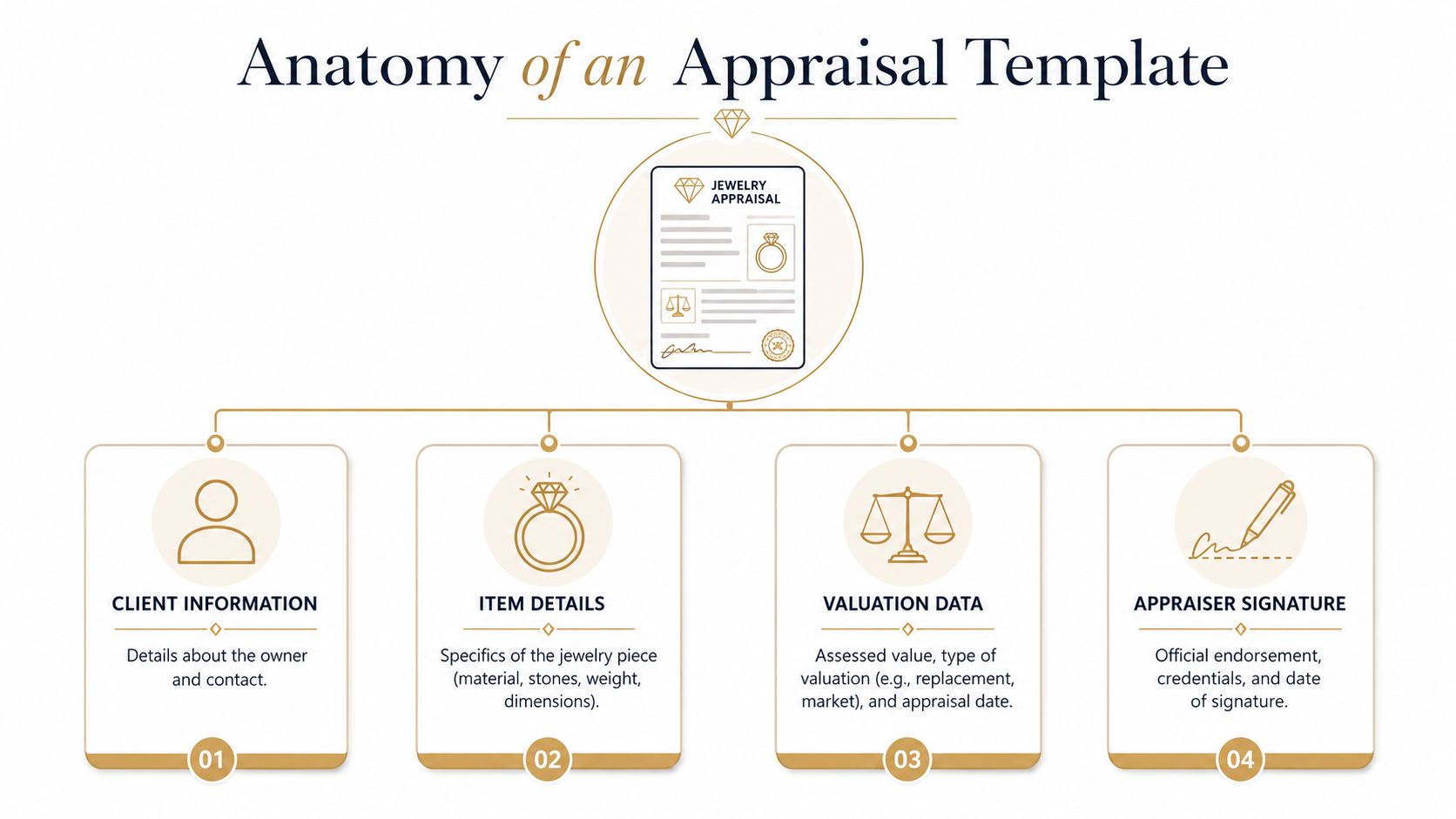
Anatomy of an Appraisal Template Key Fields Explained
A strong jewelry appraisal template has a simple job. It must gather enough information to identify the item accurately, support the valuation method, and leave as little ambiguity as possible.
Client and assignment details
Start with the owner's identity and contact information. This sounds administrative, but it also ties the document to the correct party and intended user.
Then record the assignment basics:
- Owner information helps establish who commissioned the work and who may rely on it.
- Date received and date examined create a clean timeline.
- Reason for appraisal tells the appraiser what standard to apply.
- Prior records can include old appraisals, receipts, lab reports, service papers, or family notes.
This is also where provenance belongs. If a client knows the piece came from a particular estate, jeweler, or collector, that history should be documented, then verified as far as the evidence allows.
Item description fields that cannot be skipped
This is often the first section that comes to mind, and for good reason. Description drives identification.
A complete template should capture:
- Item type such as ring, bracelet, pendant, brooch, watch, or loose stone
- Metal purity such as gold fineness or platinum content
- Gemstone details including what stones are present and how they're set
- Estimated age
- Measurements and weight
- Hallmarks, signatures, and serial-style identifiers
- Photographs
A piece can be valuable and still be poorly documented. Those are not the same thing.
Hallmarks and stamps matter because they help verify what the owner believes they have. Measurements matter because two pieces that look similar in a phone photo can be very different in scale. Photographs matter because they freeze condition at the time of inspection.
If the item is a watch, a generic jewelry description won't be enough. For example, a listing such as Cartier Delice White Gold SILVER ROMAN Dial on Black Leather w Deployment Buckle band WG800014 already shows why a watch supplement becomes necessary. The relevant identifying fields include Brand: Cartier, Series: Delice, Model Number: WG800014, Material: White gold, Size: 22mm, Dial: SILVER ROMAN, Bezel: Factory Diamond, Band: Black Leather w Deployment Buckle, Condition: Pre Owned, and Warranty Paper/Card: No. That is much more specific than “ladies Cartier watch with diamond bezel.”
If you're unsure where to find watch identifiers, reviewing common Rolex reference number locations and formats helps illustrate how exact this field needs to be.
Valuation and sign-off fields
The final group of fields makes the document official:
| Field | Why it matters |
|---|---|
| Appraisal purpose | Defines the assignment |
| Type of value | Determines the valuation basis |
| Effective date | Ties the conclusion to a specific point in time |
| Appraiser identity | Shows who performed the work |
| Signature and date | Formalizes the record |
This last step is where weak templates often fail. They gather description, but they don't tie that description to a specific valuation assignment.
Insurance Versus Resale Understanding Valuation Types
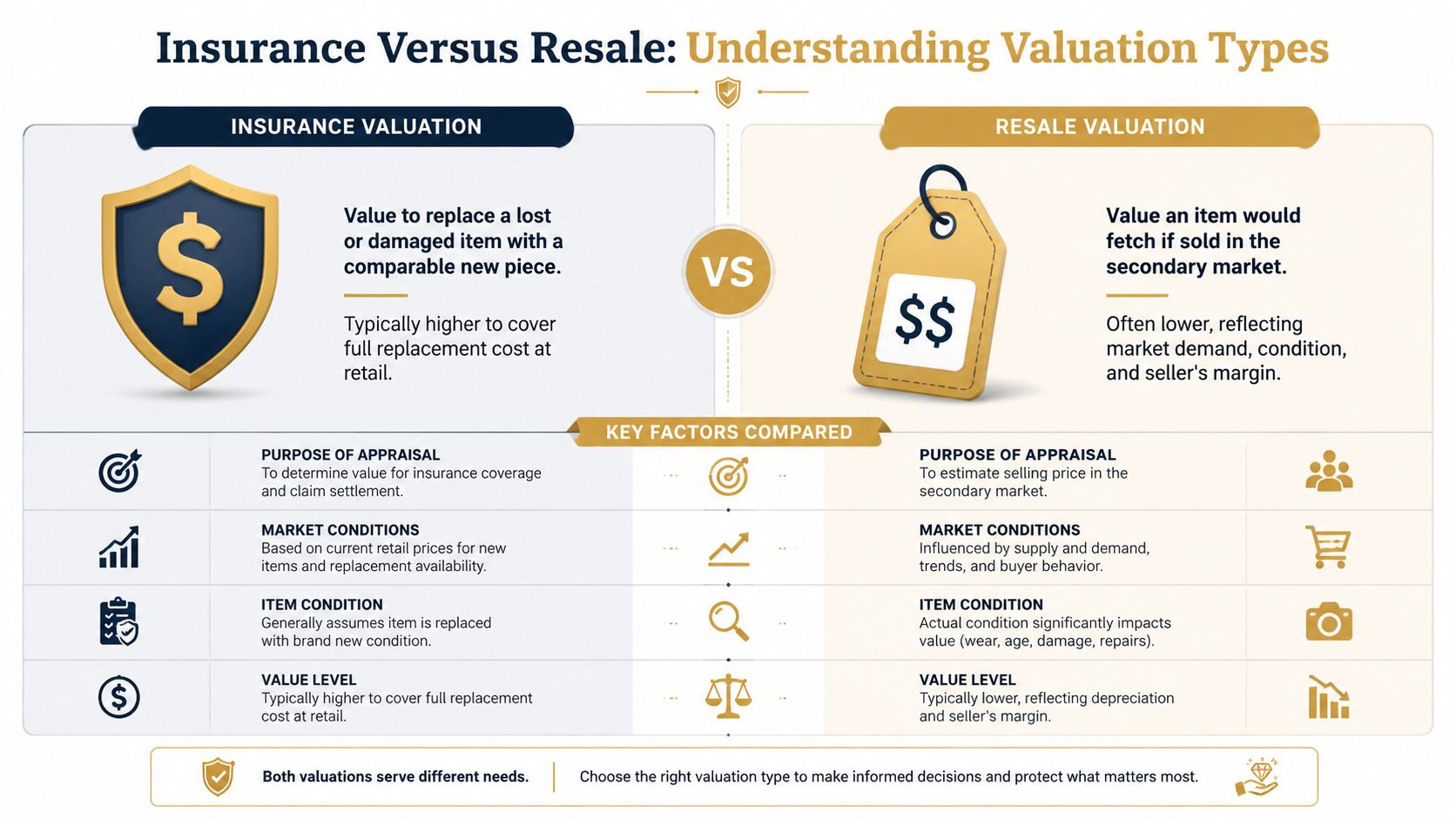
The same ring can produce different appraisal conclusions without anyone making a mistake.
That surprises owners, but it shouldn't. Value depends on purpose. Replacing an item through a retail channel is one question. Selling that same item into the secondary market is another.
Two common assignments
Consider real estate. The cost to rebuild a house is not the same as the amount a seller can expect from a quick sale. Jewelry works the same way.
A robust appraisal template should capture the intended use and type of value because USPAP-compliant reports are required to state the purpose or use, intended user, effective date of value, methods and resources used, comparative sales data, and a complete item description sufficient to identify the piece without a photo. That structure matters because the same object can support different conclusions under different value definitions, such as insurance replacement versus market value, as explained in the American Society of Appraisers guidance on gem and jewelry appraisal reporting.
A side-by-side view
| Valuation type | Used for | What the appraiser emphasizes |
|---|---|---|
| Insurance replacement | Coverage for loss or damage | Detailed description, replacement characteristics, current retail equivalency |
| Resale or market-focused valuation | Sale, estate review, division of assets | Condition, marketability, comparable secondary-market evidence |
The mistake I see most often is simple. The owner asks for “an appraisal,” but doesn't say what it's for. The appraiser then has to guess, or worse, uses a default that doesn't fit the actual need.
An appraisal without a stated purpose is incomplete, even if the description is excellent.
Where owners get tripped up
Insurance assignments usually require a document that helps support replacement. Resale discussions require a document grounded in what the piece can reasonably command in the market available to that seller.
If you're reviewing policy options, it can help to look at how scheduled-item coverage is explained in practical terms. This overview of Florida scheduled property solutions from Professional Insurance Advisors, LLC is useful because it frames how listed valuables are handled within an insurance context.
If the goal is sale rather than coverage, the process changes again. Owners preparing to move a timepiece should understand secondary-market expectations before they rely on an old insurance document. A guide to how to sell luxury watches is often more relevant than a replacement-style appraisal in that setting.
Downloadable Sample Appraisal Templates
A template should match the assignment. If you use one generic form for every scenario, you'll collect information unevenly and the report will drift off purpose.
Below are two practical models. They aren't substitutes for a formal appraisal report, but they're strong intake formats.
Sample template for insurance replacement
This version prioritizes identification and replacement characteristics.
Owner and assignment
- Client name
- Contact information
- Intended user
- Purpose of appraisal
- Effective date
Item identification
- Item type
- Brand or maker
- Metal type and purity
- Stone details
- Measurements
- Weight
- Hallmarks or signatures
- Photographs attached
Supporting records
- Receipt
- Prior appraisal
- Certificates
- Repair or service history
- Provenance notes
Replacement-focused notes
- Comparable current item description
- Construction details that would need to be replicated
- Special manufacturing traits
- Matching requirements for sets
This template works best when the owner's concern is loss, theft, or damage and the document may be reviewed by an insurer.
Sample template for fair market or resale use
This one shifts the emphasis toward saleability and present condition.
Assignment basics
- Client and intended user
- Purpose of appraisal
- Effective date
- Market context notes
Descriptive record
- Full item description
- Measurements
- Material identification
- Stone identification
- Brand, model, or signed elements
Condition analysis
- Wear to metal
- Chips, abrasions, or repairs
- Alterations or replaced parts
- Originality concerns
- Wearability and buyer appeal
Market support
- Comparable sale notes
- Liquidity observations
- Restrictions on audience or venue
- Comments affecting buyer confidence
The practical difference
The insurance template asks, “What would it take to replace this correctly?”
The market template asks, “What would a qualified buyer reasonably pay for this item in its current state?”
That difference changes which fields you prioritize. It also changes what supporting documents matter most.
How to Document and Photograph Your Items for Appraisal
Owners often underestimate how much useful work they can do before the formal appointment. Clean documentation saves time and reduces avoidable ambiguity.
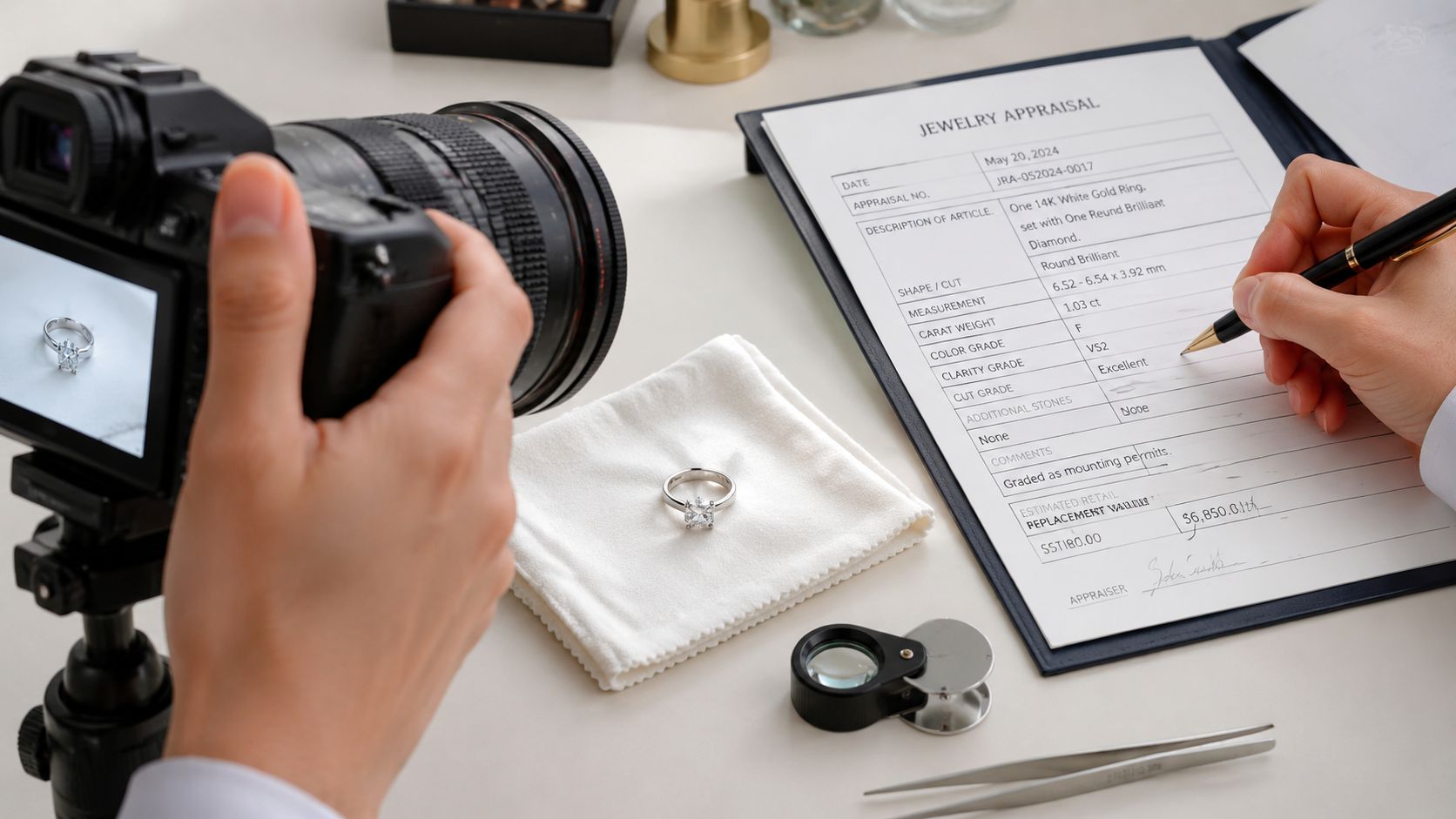
Start with what you already know. Fill in the parts of the jewelry appraisal template that don't require technical testing. Owner information, known purchase history, family provenance, previous repairs, and any original documents can all be assembled in advance.
What to gather before the photos
Put everything in one place before you open the camera app.
- Primary item such as the ring, necklace, watch, or loose stone
- Supporting papers including receipts, prior appraisals, service records, warranty cards, or lab reports
- Packaging and accessories if they exist
- A plain background such as white or light gray paper
- Soft light from a window or another diffused source
If the item is a watch that may later be sold online, examples of secondary-market presentation can be instructive. Looking at active listing photography in contexts such as used Rolex Submariner listings on eBay makes it clear that buyers and appraisers both need sharp, honest images of the exact item.
The shots an appraiser actually needs
Don't aim for dramatic photography. Aim for complete documentation.
Take these views:
- Front view showing the whole item straight on
- Side profile showing height, thickness, and setting depth
- Back view showing construction and closures
- Close-up of marks such as hallmarks, engravings, signatures, or serial numbers
- Condition details including scratches, dents, chipped stones, or worn prongs
A few practical habits make a big difference. Hold the phone steady. Tap to focus on the mark or stone, not the background. Take several versions of each shot because tiny inscriptions often require more than one attempt.
Common mistakes
Bad lighting is the biggest one. Direct overhead light creates glare and can hide wear.
The second is overediting. Don't use filters, portrait blur, or color enhancement. Those tools make jewelry look better, but they make records worse.
Use photos to document condition, not to flatter the piece.
The third is incomplete coverage. Owners often submit one attractive image and forget the clasp, the shank, the caseback, or the buckle. Those areas are where appraisers often find the details that confirm identity and condition.
The Watch Appraisal Supplement Fields for Luxury Timepieces
A standard jewelry appraisal template is a good base for a watch. It is not enough for a serious luxury watch appraisal.
That's because watches are not just adornment. They are mechanical objects, reference-specific products, and collector goods. Two watches that appear similar at arm's length can diverge sharply in value once you examine originality, service history, dial configuration, bracelet fit, or missing accessories.
The fields that belong in a watch supplement
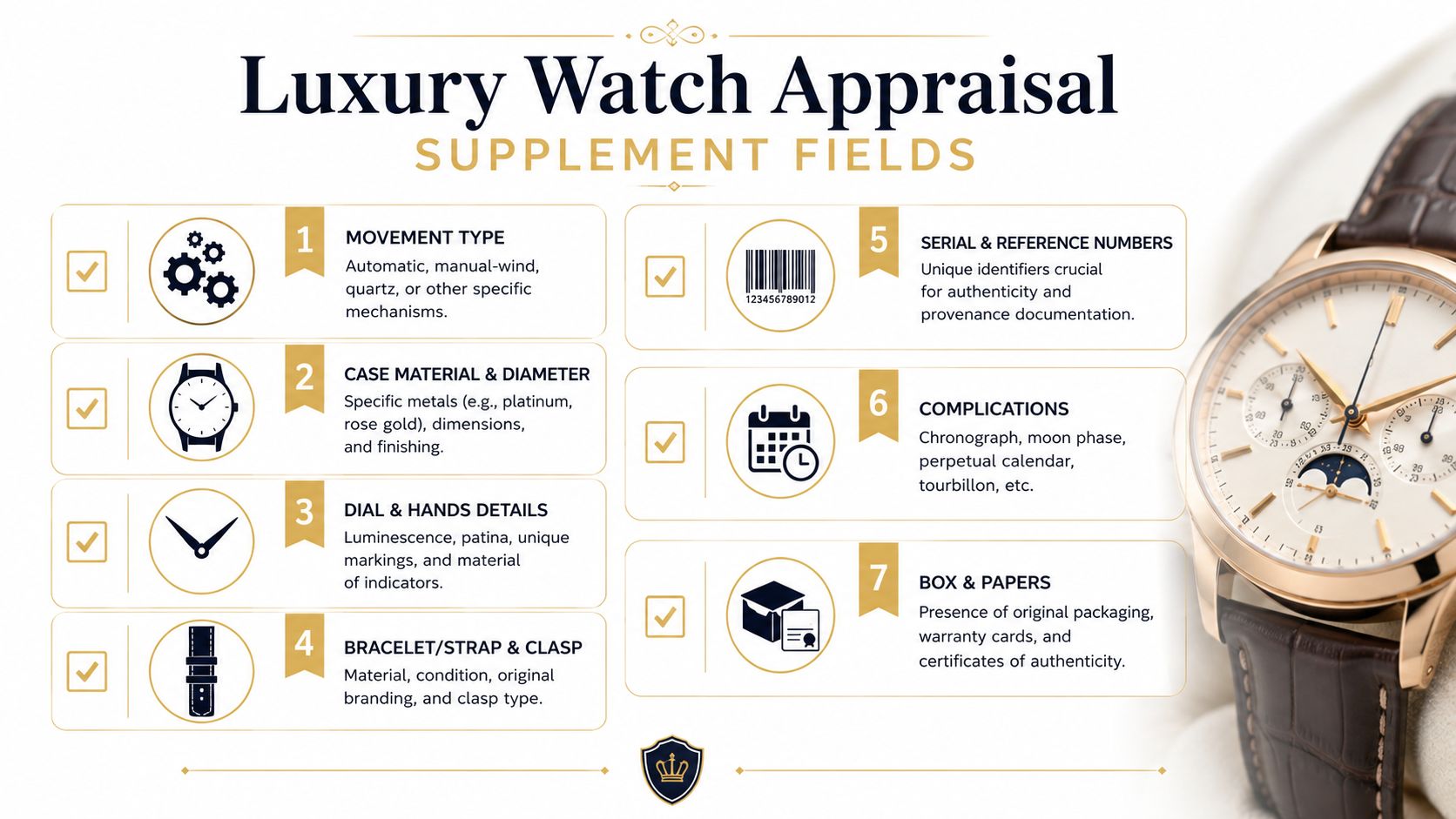
A proper luxury watch supplement should include:
- Reference number to identify the exact model family and configuration
- Serial number to document the individual watch
- Movement type and caliber because the internal specification matters
- Case material and case diameter because dimensions change wearability and market audience
- Dial and hand details including originality, finish, lume behavior, and any visible aging
- Bracelet or strap details including clasp style, stretch, wear, and whether it appears original to the watch
- Complications such as chronograph, moon phase, annual calendar, or dual time
- Box and papers when present
- Service history if known
- Polishing and case condition because refinishing changes both appearance and collector preference
Case size deserves special care because owners often estimate it incorrectly. A watch that wears small, broad, thick, or thin can be described more accurately once the dimensions are measured consistently, and that's why understanding watch case diameter is part of competent watch documentation.
What general jewelry forms tend to miss
Most generic forms leave no room for the details collectors care about most.
A ring appraisal usually doesn't need to note whether the dial appears refinished, whether the crown is signed and period-correct, or whether the bracelet has been replaced. A watch appraisal often does. In this category, originality and completeness aren't side notes. They are central facts.
A luxury watch can be authentic, attractive, and functioning, yet still be worth less than expected because a few key components are not original to the reference.
The role of accessories and presentation
Owners sometimes dismiss the outer package as optional. For luxury watches, that's often too simplistic.
Original warranty cards, booklets, hang tags, service papers, and presentation boxes help support provenance and market confidence. They don't replace the watch itself, and they don't cure condition problems, but they can change how comfortably a buyer or insurer understands the piece.
A dealer with direct possession of inventory can sometimes provide cleaner factual documentation than a marketplace listing. At Perpetual Time, the published process includes serial and reference verification, multi-point inspection of the movement, case, dial, and bracelet, plus high-resolution photos of the exact watch listed. That kind of recordkeeping is useful because it mirrors what a serious watch appraisal supplement should capture, even when the final valuation is performed for a different purpose.
What works in practice
For a luxury watch, the best intake sheet reads more like a technical checklist than a jewelry card.
Use a standard jewelry appraisal template for ownership, assignment, and broad description. Then attach a watch supplement that deals with the movement, reference, serial, dial, case, bracelet, accessories, and service record. That division keeps the file organized and avoids forcing a complex watch into a form built for earrings or pendants.
From Template to Trusted Valuation
A jewelry appraisal template is the starting point, not the finish line.
Its job is to make sure the facts are gathered correctly. The template creates order. It captures identity, records condition, preserves provenance, and anchors the assignment to a specific use. Once that framework is in place, the appraiser can do the work that no blank form can do alone, namely analyze quality, compare the market, and apply the correct definition of value.
That distinction matters most with significant pieces. Estate jewelry, signed designer work, larger gemstones, and luxury watches all carry layers of nuance that don't fit into shorthand descriptions. A complete form helps, but it can't substitute for trained inspection and market judgment.
If the item is meaningful or expensive, don't stop at filling out the template. Use it to prepare for a conversation with a qualified appraiser or specialist who can turn those details into a valuation that is credible, defensible, and useful for the purpose you have in mind.
If you need help documenting or evaluating a high-end watch, Perpetual Time offers direct, factual guidance on luxury timepieces, including model identification, condition review, and the details collectors and owners usually need to understand before a sale, trade, or appraisal.


